
You have no items in your shopping cart.
TeakHaus
TeakHaus Cutting Boards is proud to use renewable forestry in the production of their cutting boards. TeakHaus owns over 8,000 acres of forest in which to cultivate Teak trees. They are grown in a pristine environment without any fertilization or irrigation. When the trees are cultivated, they are then replaced, always reproducing new ones.
-

TeakHaus 20 x 15-inch Traditional Cutting Board
The TeakHaus Traditional Cutting Board in the 20 x 15-inch size is an everyday edge-grain board with two flat faces and no canal, so the whole surface is open for work on either side. It is large enough to break down a chicken or stage the ingredients for a full dinner and still leaves room on most counters.Teak’s natural oil helps the board resist moisture, and its medium hardness is kind to a knife edge. Grips cut into the ends help when it is time to carry the board to the sink. With two working faces, one side can be kept for produce and the other for raw proteins.A board this size is easier to live with when the counter and sink are measured first, since size is one reason a TeakHaus board is returned. TeakHaus boards also ask for regular oiling to stay in condition; the care schedule is in the details below.
Other Sizes and StylesThe 20 x 15-inch Traditional Carving Board with Juice Canal is this board with a canal on one face. For a deeper counter, the 24 x 18-inch Traditional Cutting Board adds working room. Learn More -

TeakHaus 24 x 18-inch Traditional Carving Board with Juice Canal
A holiday turkey, a standing rib roast or a packer brisket needs a board with room to rest the meat and a canal that holds what runs off it. The 24 x 18-inch TeakHaus Traditional Carving Board is the largest carving board in the line, with a canal on one face and a flat prep surface on the other.Carve on the canal side and the juices stay on the board for the gravy. Through the rest of the year, the flat side serves for batch prep and family-style platters. The board’s weight holds it steady while you carve, and grips cut into the ends make it possible to turn and carry.Before ordering, measure the counter and the sink. A board this size is too large for many sinks and needs a deep counter, and size is one of the reasons a TeakHaus board is returned. If space is limited, the 20 x 15-inch carving board handles most roasts.
Choosing a Carving BoardThe 20 x 15-inch Traditional Carving Board is easier to store and wash. The 24 x 18-inch Traditional Cutting Board is the same size with two flat faces. Learn More -
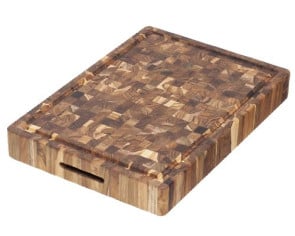
TeakHaus 20 x 14-inch Extra-Thick End Grain Butcher Block with Juice Canal
At 2.5 inches, this is the thickest board in the TeakHaus line, a true butcher block for cleaver work, barbecue and large roasts. The added depth keeps it solid under a heavy blade, and a deep juice canal on the carving face holds what runs from a brisket or a pork shoulder.The end-grain surface takes the impact of a cleaver splitting a chicken and closes up behind the cut. Turn the block over for a flat chopping face with no canal. Grips at each end give a secure hold when it has to move.It is a heavy board, best set in one spot near the stove or grill and left there. Measure the space before ordering, and plan to oil it often: end grain at this thickness takes a good deal of oil, and the care routine below matters more here than on a thin board.
Choosing a Butcher BlockFor a standard-thickness board without a canal, see the 20 x 15-inch End Grain Butcher Block. For more surface with a canal, see the 24 x 18-inch End Grain Butcher Block with Juice Canal. Learn More$180.00 -
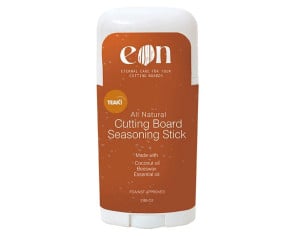
TeakHaus EON Cutting Board Seasoning Stick
Between full oilings, a wood board can look dry and dull after a few washes. The TeakHaus EON Seasoning Stick restores it in a minute: rub the solid stick across the clean, dry board and buff it in with a cloth. There is nothing to pour and nothing to drip.It works on teak and other hardwood boards, butcher blocks and wooden utensils, and it fits in a drawer.Use it in addition to regular oiling with TeakHaus EON Cutting Board Conditioning Oil, which reaches deeper into the wood. Learn More$18.25 -

TeakHaus 20 x 14-inch Marine Paddle Board
A paddle handle turns a cutting board into a serving board. The 20 x 14-inch Marine Paddle Board goes from the counter to the table in one motion, carrying a pizza, a carved steak or a full spread of cheese and charcuterie. Slim enough to hang on the wall between uses, it stores by the hole in its handle.As a prep board, it gives a broad, flat surface for everyday chopping, and the handle makes it easy to tip chopped vegetables into the pan.A board that goes to the table is judged by its looks as well as its surface. Teak’s color and grain vary, and the board you receive will have its own pattern, as the details below explain.
Choosing a Marine BoardFor a board with a juice canal, see the 18 x 14-inch Marine Cutting Board. For a narrower paddle for bread, see the 19 x 9-inch Canoe Paddle Board. Learn More$41.50 -
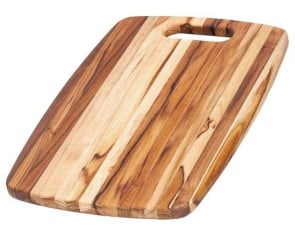
TeakHaus 18 x 12-inch Marine Chopping Board with Hole Handle
Grab it by the handle, chop, wash and hang it back on the hook: the 18 x 12-inch Marine Chopping Board is built for that routine. It is slim and light, with a hole handle cut into one end for carrying and hanging.The long, narrow shape fits a baguette, a row of vegetables or a side of salmon. TeakHaus notes that the board resists moisture and odors, which suits a board used for onions, garlic and fish. Both faces are flat, so there is no canal to work around.Because it is often hung on display, the board’s appearance matters. Teak’s color and grain vary from one board to the next, and the details below describe what to expect.
Choosing a Marine BoardFor a juice canal, see the 16 x 12-inch Marine Board or the 18 x 14-inch Marine Cutting Board. Learn More$40.00 -

TeakHaus 20 x 15-inch End Grain Butcher Block Cutting Board
For cooks who chop every day and want a surface that stands up to it, the 20 x 15-inch TeakHaus End Grain Butcher Block is a flat working block with no canal. Both faces are full cutting surfaces, so one can be kept for produce and the other for meat.The upright end-grain fibers part under the knife and close again, which keeps the surface smooth through heavy use and spares the edge. The board’s mass keeps it planted while you break down a chicken or chop a large batch of vegetables for stock. TeakHaus states that its end-grain teak resists moisture and bacteria. Grips at the ends make it manageable to turn and lift.Two things to know before buying: an end-grain board needs regular oiling, more than an edge-grain board, and it is heavy enough that it is best kept in one place. Measure the counter where it will sit.
With a Canal or LargerFor carving, the 20 x 14-inch Extra-Thick End Grain Butcher Block adds a deep canal. The 24 x 18-inch End Grain Butcher Block is the larger flat board. Learn More$138.00 -
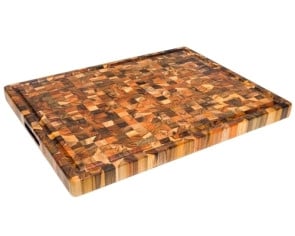
TeakHaus 24 x 18-inch End Grain Butcher Block with Juice Canal
Carving a packer brisket or a holiday turkey calls for a lot of surface and a canal deep enough to hold the juices. This 24 x 18-inch TeakHaus butcher block provides both on its carving face, with a flat end-grain surface on the reverse for prep.The upright end-grain fibers take repeated cuts without scoring deeply, which keeps the surface smooth and the knife sharper. Slots cut into the ends make a large, heavy board possible to lift and turn when it needs cleaning.Measure the counter before ordering. A board this size needs a deep counter and will not fit in most sinks, and size is a reason TeakHaus boards are returned. Plan on oiling it regularly as well; end grain at this size takes a good deal of oil.
Choosing a Butcher BlockThe 24 x 18-inch End Grain Butcher Block is the same size without a canal. The 20 x 14-inch Extra-Thick End Grain Butcher Block is shorter and much thicker. Learn More$168.00 -
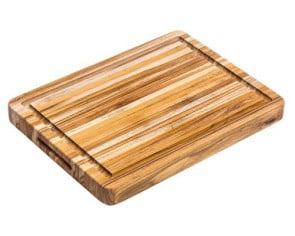
TeakHaus 16 x 12-inch Professional Carving Board with Juice Canal
For a home kitchen with an ordinary counter and a standard sink, the 16 x 12-inch Professional Carving Board is the TeakHaus Traditional board at its most practical size. It is large enough to carve a roast chicken or a pork loin and small enough to lift into the sink for washing.One face has a juice canal that keeps the drippings from a resting steak or a sliced tomato on the board. Turn it over and the other face is flat, a full surface for dicing onions and mincing herbs. Grips cut into the ends make a solid, 1.5-inch-thick board easier to pick up and turn.Before ordering any board, measure the counter where it will live and the sink where it will be washed. A board that crowds either one gets less use, and size is one of the reasons a TeakHaus board comes back to us.
Need More Room?The 20 x 15-inch Traditional Carving Board and the 24 x 18-inch Traditional Carving Board have the same canal on a larger face. The table below compares the full Traditional line. Learn More$72.00 -
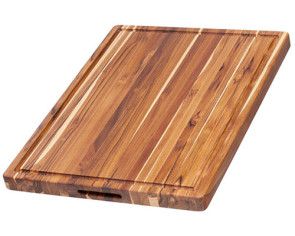
TeakHaus 20 x 15-inch Traditional Carving Board with Juice Canal
Slice a rested brisket or rib roast on a flat board and the juice runs onto the counter. This TeakHaus Traditional Carving Board has a canal around the edge of its carving face, so the juice stays on the board, where it can be spooned back over the meat or poured into the sauce. TeakHaus notes that Food & Wine included this board in a list of the seven best carving boards.On days with nothing to carve, turn it over. The reverse face is flat and gives a full prep surface for onions, herbs and bread. Grips cut into the ends make it easier to lift a heavy, wet board out of the sink.The 20 x 15-inch size handles a whole chicken, a pork shoulder or a small turkey and still fits a standard counter. If you are deciding between this and the 24 x 18-inch board, measure the counter and the sink first. One reason customers return a TeakHaus board is that it turned out larger than they expected.
Choosing a Carving BoardFor holiday turkeys and packer briskets, the 24 x 18-inch Traditional Carving Board adds room. If you will rarely carve, the 20 x 15-inch Traditional Cutting Board is the same size with two flat faces. Learn More$120.00

