
You have no items in your shopping cart.
Sharpening Steels
A sharpening steel, also called a honing rod, restores a straight, keen edge between full sharpenings. Knife Merchant stocks rods in steel, ceramic and diamond, in round, oval, square and flat profiles, from F. Dick, Victorinox, Idahone, Wüsthof and other makers. The material determines how much metal a rod removes; the cut and shape refine that choice.
Choose a material
Each material removes more metal than the one before it. Start with the gentlest rod that keeps your knives cutting cleanly.
Realigns the edgeRemoves the most metal
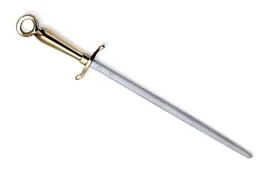
Steel
Metal removal: low
A steel rod realigns an edge that has rolled or bent in use. Regular and fine cuts also remove a small amount of metal; polish rods are smooth and only straighten and burnish the edge.
Best for: routine honing of Western kitchen knives
Shop steel rods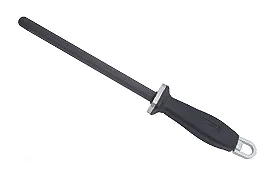
Ceramic
Metal removal: moderate
A ceramic rod abrades the edge rather than bending it back into line, removing a small amount of metal with each stroke. Ceramic is harder than knife steel, but brittle; it can break if dropped.
Best for: hard Japanese blades and fine edge refinement
Shop ceramic rods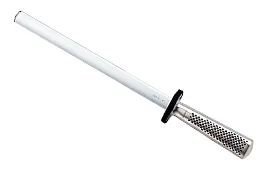
Diamond
Metal removal: high
A diamond rod carries a coating of diamond abrasive and removes metal faster than steel or ceramic. Light pressure and few strokes are enough; finish on a finer rod afterward.
Best for: bringing back an edge a standard steel no longer restores
Shop diamond rodsOur best sellers

Best seller overall
F. Dick EuroCut 12-inch Round Regular Cut SteelA round, regular cut steel hardened to 66 HRC, for routine honing of Western kitchen knives.
View this steel

Best seller among professionals
F. Dick Dickoron Micro 12-inch Oval Super Fine Cut SteelAn oval, super fine cut steel whose hard surface wears very slowly, sealed to meat industry hygiene standards.
View this steel
Narrow the selection
Jump straight to rods of a given shape, cut, length or brand.
Common questions
Our Honing Rod Guide covers technique in detail. For a recommendation suited to your knives, contact us.
How often should a knife be honed?
Hone before or after each use, or as soon as the knife begins to drag. A few light, alternating strokes are enough. When honing no longer restores the edge, the knife needs sharpening on a stone.
What angle should I hold the knife at?
Anywhere from 15 to 25 degrees works for most kitchen knives. Holding a consistent angle on every stroke matters more than the exact figure.
Can I use a steel on a Japanese knife?
Hard, thin Japanese blades can chip on a coarse, grooved steel. A ceramic rod or a fine or polish cut steel, used with light pressure, is the safer choice.
Which shape should I choose?
Round rods are the most common. Oval and flat rods present a wider surface to the edge, so they require fewer strokes and make a consistent angle easier to hold.
How long should the rod be?
Choose a rod at least as long as your longest blade, so each stroke covers the full length of the edge.

