Sharpening Steels

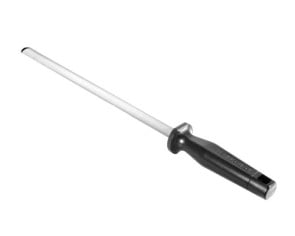
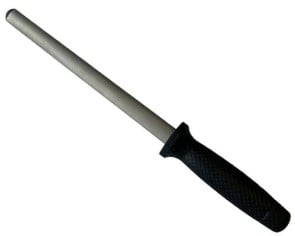
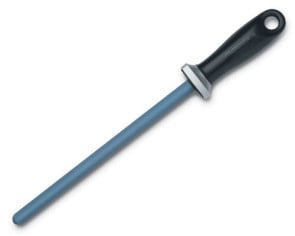
Sharpening Rods, also called Sharpening Steels and Honing Rods, are handheld tools used to hone or sharpen cutlery. They come in a variety of materials (mainly Steel, Ceramic and Diamond), a range of shapes (Round, Square, Oval and Flat), and varying degrees of courseness (smooth, polish, course, etc). We carry a very large selection of honing and sharpening steels and offer a breadth of information regarding the appropriate application of each tool. Please let us know if you need help selecting the proper honing steel for your cutlery or intended purpose; we are happy to offer our expertise.

Items 1 to 10 of 17 total

per page

Page:
  1. 1
  2. 2
  • Miyabi Black 10-inch Tungsten Honing Rod

    Edge Maintenance Matched to Miyabi Black Steel The Miyabi Black Tungsten Honing Rod is the maintenance tool for owners of Miyabi Black knives and other hard Japanese blades. Regular honing realigns the edge between sharpenings, which keeps a knife cutting cleanly and reduces how often it must go to the stones. Miyabi designed this rod specifically for the steel used throughout the Black series.
    Construction and Performance Tungsten rod. Tungsten is hard enough to work on high-hardness Japanese steels and keeps a consistent surface for honing over years of use. Light, efficient maintenance. A few strokes per side before or during prep restores the edge’s alignment without removing appreciable metal. Matched handle. The handle uses the same dyed maple burl, mosaic pin and D-shaped profile as the Miyabi Black knives, so the rod belongs with the set on the counter or the block. Protective bolster. A stainless steel bolster separates the hand from the rod during each stroke.
    Best Uses Routine honing of Miyabi Black knives Maintaining other hard Japanese kitchen knives Restoring a clean cut midway through a long prep session Pair it with any knife in the series, such as the Miyabi Black 8-inch Chef’s Knife. When honing no longer restores the edge, sharpen on whetstones. Learn More
  • Victorinox 12 in. Helical Cut Steel

    Victorinox 12 in. Helical Cut Steel is to be used for removing burrs and setting an edge. This is a coarse steel and is most often used on hunting knives, cleavers or in conjunction with a finer or ceramic rod. As an example, we use one as part of our knife sharpening process. On a damaged knife, we would grind the blade to remove chips, or reshape a broken tip. This rod will remove the heavy burr prior to next phase sharpening. It would not be used as part of normal edge maintenance where you would want a finer steel. Learn More
  • F. Dick Dark Nitro Sharpening Steel

    The F. Dick Dark Nitro is a new innovation in German manufacturing using new state of the art techniques to develop harder steel knives with tighter grain structures and higher HRC. In doing so Friedrich Dick needed to Develop steels that can straighten and align the edge on harder steeel knives. This unique Dark Nitro Steel has a special surface for very high abrasion and is therefore particularly suitable for hard knives. The oval shape of the blade provides large contact for the knife and therefore more effective sharpening results. The pear-shaped handle design sits comfortably and safely in the hand. This is truly a one of a kind German masterpiece brought to you by the company that has been pioneering honing steels since the early 1800's. 

    Learn More
  • F. Dick 8 in. Coarse Cut Sharpening Steel

    This smaller length sharpening steel is marketed by the manufacturer as a "household" steel. It is a hard chromed rod that works extremely well for renewing the edge on standard German and American steel blades. It is also used extensively by our poultry processors who use 5 and 6 inch boning knives. This is also a good choice for a hunter's field kit as they are small, lightweight and easier to pack than a standard 10 or 12 inch rod. Learn More
  • Zwilling 10 in. Oval Diamond Steel

    Oval steels make better contact with knife edges than round. This diamond rod is designed to cut a new edge on your knife, as opposed to simply honing. For most users, this is a much simpler and more cost effective way to sharpen a knife than using sharpening stones. Learn More
  • Victorinox 12 in. Oval Diamond Sharpening Steel

    The Victorinox/ Forschner 12 in. Oval Diamond Sharpening Steel is a 600 grit premium sharpening steel with a hollow rod that is coated with diamond for maximum sharpness. The oval shape of a sharpening steels allows you to get more contact with the steel and the blade's edge. The black nylon non-slip handle is comfortable to hold in either your left or right hand. Made in USA. Learn More
  • Victorinox 12 in. Round Solid Core Diamond Steel

    Victorinox 12 in. Round Solid Core Diamond Steel is a great way to sharpen your knives quickly on the go. At 600 grit, this is a fairly aggressive steel to be used for removing metal and establishing an edge on a dull knife. The Diamond particles are well-adhered to the solid stainless rod, making this a product that should last for many years. We suggest a fine ceramic rod as a secondary sharpening tool to smooth and refine an edge sharpened with Diamond steels. Learn More
  • Edgeware Oval Diamond Sharpening Steel

    This 10 inch oval diamond sharpening rod is approximately 600 grit with the flat of the rod perpendicular to the widest part of the hand guard for safety. This Diamond sharpening steel is intended for sharpening not honing, the rod is coated with diamond dust that is course and abrasive and with a couple of passes with the edge of your knife you can restore a blunted knife to a basic edge that has a little bite and is ideal for cutting through vegetables. To find the angle you should be passing your knife along steel at think generally that a Japanese knife will have a smaller angle around 12 to 15 degrees and a German forged knife usually will be at an angle of 18 to 20 degrees. A good trick to using this diamond rod would be to first examine your knives edge and look at how thin or wide the bevel you are working with is to determine the degree of angle you hold your knife relative to the steel, if it is a wide bevel then you can work at a smaller angle, if a thin bevel then hold your knife at a higher angle closer to 20 degrees. Personally I like to lay the blade face flat against the diamond rod and then lift the spine just slighlty so I can better see the bevel touching the steel. This is an oval shaped diamond rod, the flatter oval shaped rods are made that way so the user can better hit the correct angle. In general start with a couple of passes on either side of the blade 3 to 6 passes on both sides at first, then be sure to feel along the edge for a burr starting to develop and look closely at the edge for a bevel to develop. It is important with all sharpening that the user look and feel as the sharpen to know what stage of the process they are at so they don't over or under sharpen.  Learn More
  • Wusthof 10 in. Coarse Ceramic Sharpening Rod

    The WÜSTHOF 10" Ceramic Sharpening Rod J800 is best for dull to moderately sharp knives. The ceramic surface ensures exceptional sharpening of the blade: with just a few steps you can achieve the desired result. As this sharpener removes a tiny amount of metal from the knife, we recommend using a WÜSTHOF Honing Steel for daily or weekly edge maintenance. JIS800 (Japanese Industrial Standards) Grit 800 this Ceramic Sharpening Rod is intended to put a small bevel on either side of the kitchen knife. (NOT Honing) This rod will put a good ruff edge on your knife with just a few passes, an edge that is ideal for cutting through vegetable skin (tomato, bell pepper) and making thin more even slices. This ceramic rod works very well with Japanese knives that are hard with high rockwell hardness scores but also works very well on German knives that have lost their edge.    Learn More
  • Master Grade 11 in. White Ceramic Rod

    The Master Grade ST-3700 receives our top recommendation for a ceramic honing rod.

    Please note that a steel honing rod is used to straighten the edge of a knife that has "burred" or rolled over. Ceramic rods are used to remove metal and restore an edge. Knives with a Rockwell hardness of 61 or greater tend to not roll the edges, but will abrade and dull. Ceramic may be the best choice for these knives.

    Not all ceramics are equal: At 9 mohs of hardness, the Master Grade ST-3700 is significantly better than others. (Diamonds are 10 mohs). The vast majority of ceramic rods on the market are 8 mohs.

    Impact Resistant. Handle is square, so it is less likely to roll off the table. Rubber tip and metal core also help to make this rod more likely to survive a fall. The level of abrasiveness on a ceramic rod is anecdotal as they are textured ceramics that lack a grit that has been sieved to a particular grain size. These are roughly equivalent to a 2000 grit stone. Learn More

Items 1 to 10 of 17 total

per page

Page:
  1. 1
  2. 2