
You have no items in your shopping cart.
F Dick 1905 Knives
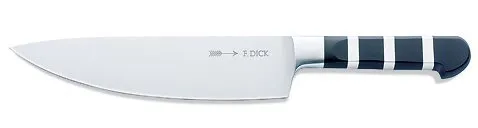
In 1905, a year of upheaval and technical progress, Friedrich Dick developed a series of knives which used aesthetic metal rings to secure the handle scales to the blade rather than the traditional 3 metal rivets used by all other German makers. This special design became the trademark of F. Dick knives as their blades could be identified easily when compared to any other maker. The symmetrical steel rings are inseparably connected to the handle using a proprietary technology that has never been replicated. Seamlessly polished and comfortable to hold, the 1905 series quickly became a favorite of German knife enthusiasts, so much so that these knives are still in production over 100 years later. Beautifully balanced 1905 Series blades are precisely ground from spine to heel and heel to tip resulting in a perfect taper that glides through food with ease. These knives are forged using a solid piece of X50CrMoV15 that holds an edge well, responds quickly to honing and can be sharpened with ease. A half bolster finger guard protects your fingers, but gives the user full access to the knife's edge in order to resharpen the cutting edge completely. Each knife in the 1905 series was thoughtfully designed and lovingly crafted to the exceptionally high standards associated with the name Friedrich Dick. The original marking of "F. Dick" is stamped by hand onto each blade as a quality mark. 1905 Series knives are Made in Taiwan using a process that combines traditional design and modern technology.
-
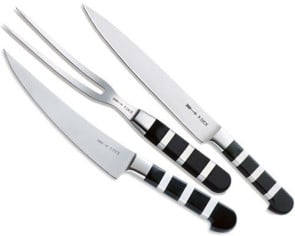
F. Dick 1905 Series 3-Piece Carving Set
Precision Meets Heritage: Master Your Presentation with the F. Dick 1905 Carving Set Elevate your kitchen skills with a set that bridges the gap between historical artistry and modern-day performance. The F. Dick 1905 3-Piece Carving Set is not merely a collection of tools; it is a tribute to the legendary design first introduced by Friedrich Dick at the turn of the 20th century. While most knives of that era utilized traditional rivets, the 1905 series revolutionized the handle with solid, symmetrical steel rings, a feature meticulously recreated in this modern set. Crafted for the chef who demands both aesthetic elegance and uncompromising utility, this set provides the ultimate solution for meat preparation and presentation. Whether you are breaking down a raw roast or performing the final carve on a holiday turkey at the table, these tools offer the balance and razor-sharp precision required for restaurant-quality results. The high-carbon X50CrMoV15 steel ensures a resilient edge that resists staining and wear, while the ergonomic POM handles provide a secure, comfortable grip for extended use. Every slice becomes a demonstration of skill when backed by over 240 years of F. Dick’s German cutlery expertise. This set includes: 8.5-inch Carving Knife 7-inch Curved Boning Knife 8- inch Curved Carving Fork Learn More -

F. Dick 1905 10-inch Round Regular Cut Steel
Matching the classic look of the 1905 knife series, this 10-inch round steel keeps those knives honed with a regular cut. It suits a home cook who wants the steel in the block to match the knives beside it.The regular cut realigns an edge that has rolled with use, so the knife keeps cutting cleanly and needs abrasive sharpening less frequently. Ten inches covers 1905 knives up to the 8-inch chef’s knife, with room for a full stroke. The handle and rod join without a gap, which keeps the steel easy to clean.Hang it by the stove, or keep it in the block beside the knives it serves.Pair it with the 1905 8-inch chef’s knife or the 1905 6-piece magnetic knife block set. For longer blades, a 12-inch rod such as the EuroCut 12-inch Round Regular Cut Steel adds reach, and a wood-handled steel is the F. Dick Honorary steel. Learn More$118.30 -

F. Dick 1905 4.5-inch Steak Knife, Plain Edge
A fine, plain edge slices a steak cleanly, without the tearing a serrated knife can cause, and this 4.5-inch 1905 steak knife keeps the texture and juices of the meat intact. It has the banded handle and substantial heft of the 1905 series.Plain-edged steak knives cut more like a kitchen knife, which suits diners who prefer a smooth slice. They can be honed and resharpened like any other knife, so with care they stay sharp for years. The weight in the hand also gives a sense of quality at the table.It also suits chops and roast chicken at the table.A matching set is the 1905 steak knife set. For serrated steak knives, see the Premier Plus 4.5-inch serrated steak knife and the Premier Plus 4-piece serrated steak knife set. Cut on wood or plastic boards and avoid scraping across porcelain plates, which dulls a plain edge. Learn More$53.95 -

F. Dick 1905 5-inch Serrated Utility Knife
Tomatoes, citrus, bagels and sandwiches all cut cleanly with a small serrated knife, and this 5-inch 1905 utility knife handles them without crushing soft flesh. The serrations bite through a waxy skin or a crust and then slide through what is underneath.Serrated edges are hard to resharpen when they finally dull, so the steel’s balance of corrosion resistance and edge retention matters here. Only the points of the serrations meet the board, which protects the rest of the edge and keeps the knife cutting for a long time. Each 1905 knife is checked for taper and balance at the factory.The 5-inch length suits a lunch prep station or a bar, where the knife handles lemons and limes all day.For plain-edged slicing of fruit and meat, the 1905 6-inch utility knife is the counterpart. A Premier Plus 5-inch tomato knife adds a forked tip for lifting slices, and the larger 1905 8.5-inch bread knife takes on loaves. Learn More$63.05 -

F. Dick 1905 6-inch Granton Edge Utility Knife
Prep cooks who cut potatoes, parsnips, beets and carrots know how starchy slices cling to a blade. This 6-inch 1905 utility knife has a granton edge, a row of hollow dimples that lets those slices fall away with each cut.Grinding the dimples is an extra step in manufacturing, and it pays off in speed on the board, since the cook does not have to stop to scrape food off the knife. The slim blade still makes delicate cuts and handles fruit and small cuts of meat like any utility knife.The 6-inch length suits cutting potatoes for a gratin or slicing carrots on the bias. A thin, even slice keeps those dishes cooking evenly.If sticking is not a concern, the plain-edged 1905 6-inch utility knife is simpler to sharpen. For larger volumes of vegetables, the 1905 7-inch granton edge santoku has the same hollows on a taller blade. The Premier Plus 6-inch granton utility knife is the modern-handle version. Learn More$104.65 -

F. Dick 1905 AJAX 9-inch Butcher’s Chef’s Knife
The AJAX combines some of the heft of a cleaver with the shape of a chef’s knife, and it is made for heavy meat portioning and high-volume prep. It has a broad blade and a wide, sweeping belly that rocks through a brisket or a stack of cabbage.Weight is what sets it apart from a standard 8-inch chef’s knife. The thick spine and tall blade carry the cut through dense food with less effort from the wrist, and the height gives generous knuckle clearance. It is at home on a butcher’s block breaking down subprimals and in a kitchen chopping large volumes of vegetables.The weight also helps when cutting through winter squash.The AJAX has its own fitted 1905 Ajax sheath for carrying it safely. For lighter everyday work, the 1905 8-inch chef’s knife is quicker in the hand. A different take on the same idea is the Red Spirit AJAX 8-inch chef’s knife. Learn More$127.40 -
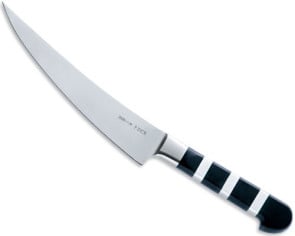
F. Dick 1905 7-inch Carving and Boning Knife
One of our team had never seen this shape in German steel before, counts this 7-inch 1905 knife among their own top picks, and calls it one of the best they have used for removing silver skin from tenderloins and veal legs. It trims fat from the back of ribs well and works as a boning knife for most jobs.The blade sits between a boning knife and a carving knife. It is long enough to follow a tenderloin in one pass and pointed enough to work around bones. The same member of staff finds the shape easier to resharpen than a typical boning knife, which matters on a knife used every day.The 7-inch length is also comfortable for trimming lamb racks and pork loins.For poultry joints and closer boning, the 1905 6-inch flexible boning knife bends further. Carving cooked meat suits the 1905 8-inch carving knife, and the 1905 7-inch fillet knife is shaped for fish. The comparison table below lists the 1905 slicing knives. Learn More$88.40 -

F. Dick 1905 8.5-inch Bread Knife
Everyday loaves, rolls and baguettes are the work for this 8.5-inch 1905 bread knife. It has a standard serration with sharp points and a wide bevel between them, a combination that keeps the serrations straight and cutting for a long time.Bread knife steel has to balance two needs. If it is too hard, the points can chip; if it is too soft, they bend and dull. This blade sits in the middle, which suits a knife that meets hard crusts every day. The forged construction gives it more weight than a stamped bread knife, so it saws with less pressure.It also slices tomatoes and soft fruit, and it levels small cakes. The 8.5-inch length fits a standard knife block.For wide country loaves, the 1905 10-inch bread knife has a curved edge and more reach, and the 12.5-inch bread knife handles the largest breads and sheet cakes. Our kitchen knife shapes guide covers bread knives. Learn More$89.05 -

F. Dick 1905 12.5-inch Bread Knife
This 12.5-inch 1905 bread knife is made for serious work where serrations are needed, such as slicing large loaves, splitting sheet cakes and leveling cake layers. Its long blade and wide serrations set it apart from ordinary bread knives.The extra length crosses a large boule or a full sheet of focaccia in one stroke, so slices come out even and the crumb is not torn. The blade has real heft, which lets the serrations work without much downward pressure. A slight curve and a reduced bolster make it comfortable to choke up on.Bakeries and caterers that cut sheet cakes and large loaves get even portions from the long, straight stroke. The length also splits a full cake layer without lifting the knife.For everyday breads, the 1905 10-inch bread knife is more manageable, and the 8.5-inch model fits a home block. Long slicing of roasts calls for a carving knife such as the 1905 8-inch carving knife. Learn More -

F. Dick 1905 7-inch Granton Edge Santoku
Santoku means “three virtues” in Japanese, for slicing, dicing and mincing, and this 1905 santoku covers that everyday work on meat and vegetables. Its granton edge, a row of hollow scallops along the blade, keeps slices of potato and cucumber from sticking.A santoku has a thin blade, a flatter edge than a chef’s knife and a rounded tip, so it works best with a straight push or a forward slice. The scallops put small pockets of air between the blade and wet or starchy food, which lets each slice fall away instead of riding up the knife. The thin profile also makes it capable of decorative cuts.Cooks who prefer a rocking cut should look at the 1905 8-inch chef’s knife. A smaller granton blade is the Premier Plus 5.5-inch granton edge santoku, and the 1778 santoku offers a much harder edge. See our knife shapes guide for santoku and chef’s knife profiles. Learn More$107.25

