
You have no items in your shopping cart.
Teak Cutting Boards
Renowned for its use in boat building and luxury furniture, Teak brings that same legendary durability into your kitchen. This tropical hardwood is naturally rich in silica and oils, which act as a powerful barrier against moisture, preventing warping, cracking, and staining. This unique composition makes Teak exceptionally resistant to deep knife scars while still being gentle enough to protect the fine edge of your blades. Its dense, beautiful grain ensures a stable and long-lasting cutting surface that only grows more beautiful with age.
-

TeakHaus 18 x 14-inch Scandi End Grain Cutting Board with Juice Canal
End-grain boards are usually thick and heavy. The Scandi End Grain board is built thinner, so a home cook gets an end-grain cutting surface in a board that washes and stores like an everyday one. The fibers stand upright, so the knife edge passes between them and the surface closes up behind each cut.One face has a juice canal for slicing a steak or a small roast; the other is flat for chopping or serving. Grips at each end make it easy to carry.End grain does need more oil than edge grain, and a thinner board dries out faster if it is neglected. The care schedule below is worth following closely; customers who return TeakHaus boards sometimes did not expect how much attention the wood needs.
Choosing a BoardThe 18 x 14-inch Scandi Edge Grain Board is the same size in edge grain. For a heavier end-grain block, see the 20 x 15-inch End Grain Butcher Block. Learn More -
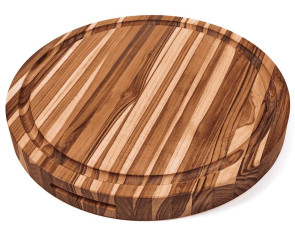
TeakHaus 18-inch Traditional Round Carving Board
A round board puts every slice within reach of everyone at the table. The 18-inch TeakHaus Traditional Round Carving Board is made for carving and serving in the same place, with a juice groove that keeps drippings off the tablecloth and a side handle for carrying a loaded board from the kitchen.It suits a roast chicken or tri-tip carved at the table, a pizza straight from the oven, or a full spread of cheese and charcuterie. In the kitchen, the 1.5-inch-thick board stays put for everyday chopping.Because it is often set out for guests, the board’s appearance matters, and teak varies. Each board has its own color and grain, as described in the details below.
Choosing a Round BoardFor a thicker end-grain round without a groove, see the TeakHaus 18-inch End Grain Butcher Block Round. The rectangular Traditional boards are compared below. Learn More$120.00 -

TeakHaus 18 x 14-inch Scandi Edge Grain Cutting Board with Juice Canal
The 18 x 14-inch Scandi board gives a full-size teak working surface in a board you can lift with one hand. It is thinner and lighter than the Traditional and Butcher Block boards, so it moves easily between the counter, the sink and the table, and it still has a juice canal for carving.Use the canal side for a roast chicken or a steak and the flat side for chopping or for carrying bread and cheese to the table. Grips cut into the ends make it easy to handle, and it stores on edge in a cabinet when counter space is short.For a cook who wants teak without a heavy board to wash, this is the size to start with. The lighter build does not change the care: it still needs hand washing and regular oiling, as set out below.
Edge or End Grain?The 18 x 14-inch Scandi End Grain Board is the same size in end grain. For a smaller board, see the 14 x 10-inch Scandi Edge Grain Board. Learn More$55.00 -
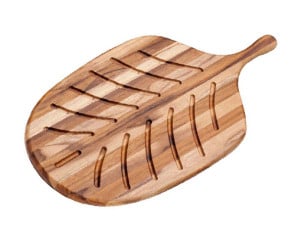
TeakHaus 19 x 9-inch Canoe Paddle Bread and Serving Board
A long, narrow paddle fits a baguette or a bâtard from end to end. The TeakHaus Canoe board is reversible: one face has canals that catch crumbs as you slice, and the other is flat for serving cheese, crostini or cured meats. The handle makes it easy to pass along the table.At half an inch thick, it is light to carry and stores on edge. The paddle shape also suits a row of bruschetta or sliders at a buffet.As a board meant for the table, it shows teak’s natural range of color and grain. Each board is different, as the details below describe.
Choosing a Bread BoardFor a rectangular bread board with crumb grooves, see the 16 x 11-inch Essential Bread Board. For a larger paddle, see the 20 x 14-inch Marine Paddle Board. Learn More$36.00 -
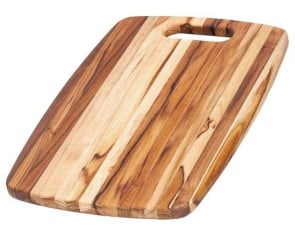
TeakHaus 18 x 12-inch Marine Chopping Board with Hole Handle
Grab it by the handle, chop, wash and hang it back on the hook: the 18 x 12-inch Marine Chopping Board is built for that routine. It is slim and light, with a hole handle cut into one end for carrying and hanging.The long, narrow shape fits a baguette, a row of vegetables or a side of salmon. TeakHaus notes that the board resists moisture and odors, which suits a board used for onions, garlic and fish. Both faces are flat, so there is no canal to work around.Because it is often hung on display, the board’s appearance matters. Teak’s color and grain vary from one board to the next, and the details below describe what to expect.
Choosing a Marine BoardFor a juice canal, see the 16 x 12-inch Marine Board or the 18 x 14-inch Marine Cutting Board. Learn More$40.00 -
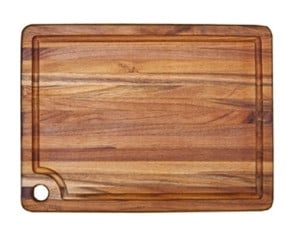
TeakHaus 18 x 14-inch Marine Edge Grain Cutting Board with Juice Canal
The 18 x 14-inch Marine board gives a full-size cutting surface at three-quarters of an inch thick, a board that is quick to wash and hangs out of the way when the work is done. A juice canal runs on one face and a corner hanging hole lets it dry on a hook.Use the canal side for slicing cooked meat or ripe fruit, and the smooth reverse for daily chopping or serving bread and cheese. As a second board, it keeps raw proteins away from produce.Thin boards still need care. Hand wash, dry it right away and oil it on the TeakHaus schedule; a thin board that is left wet or never oiled is more likely to warp or crack. The routine takes only a few minutes a month and is set out below.
Choosing a Marine BoardFor a smaller board, see the 16 x 12-inch Marine Board. The 20 x 14-inch Marine Paddle Board adds a handle for serving. Learn More -

TeakHaus 16 x 12-inch Marine Board with Juice Canal
Teak has long been used on boat decks because it stands up to water, and the TeakHaus Marine boards use it in thin, light boards for everyday cooking. The 16 x 12-inch board is the smallest in the collection, sized for daily vegetable prep and small carving jobs.A juice canal on one face catches the drippings from a steak or a few sausages, and the reverse is flat for chopping. A hole in one corner lets the board hang on a hook, where it dries in open air and stays off the counter.The Marine boards are three-quarters of an inch thick, much lighter than the Traditional boards. That makes them easy to wash and hang, though they do not have the mass that keeps a heavy board from moving during hard chopping; a damp towel underneath steadies it.
Choosing a Marine BoardThe 18 x 14-inch Marine Cutting Board is the larger version, the 18 x 12-inch Marine Chopping Board has a hole handle and no canal, and the 20 x 14-inch Marine Paddle Board carries to the table. Learn More$39.00 -

TeakHaus 16 x 12-inch Herringbone Cutting Board with Tablet Slot
Cooks who follow recipes on a tablet or phone know the problem: the screen lies flat on the counter, gets splashed, and is never where you can read it. This herringbone board has a slot cut into one face that holds the device upright at the back of the board, out of the mess and in view while you work.The other face has a juice canal for slicing a steak, a chicken breast or ripe fruit. The herringbone pattern of the teak strips gives the board a finished look, so it moves to the table for cheese or bread without seeming out of place. At 16 x 12 inches it fits a small counter and most sinks.A herringbone board shows off the variation in teak more than a plain board does. Each strip has its own tone, and the pattern is meant to display that contrast.
Larger Herringbone BoardsThe 18 x 14-inch Herringbone Board and the 24 x 18-inch Herringbone Board have juice canals but no tablet slot. Learn More$94.00 -

TeakHaus 16 x 12-inch End Grain Butcher Block with Juice Canal
End grain is usually sold in large, heavy blocks. The 16 x 12-inch TeakHaus butcher block brings it to a size that fits a small counter and a standard sink. The fibers stand upright, so a knife edge passes between them rather than slicing across them, and the surface shows cuts less than an edge-grain board does.One face has a juice canal for a steak or a chicken breast; the other is flat for mincing garlic, shallots and herbs. A grip cut into the end makes the dense board easier to lift.End grain asks more of its owner than edge grain. It draws in oil readily and needs regular, generous coats to keep from drying out. Customers who return a TeakHaus board sometimes did not expect that upkeep, so the full care routine is spelled out in the details below.
Larger End Grain BoardsThe 20 x 15-inch End Grain Butcher Block and the 24 x 18-inch End Grain Butcher Block with Juice Canal add surface. The full range is compared below. Learn More$82.00 -

TeakHaus 18-inch End Grain Butcher Block Round
Two inches thick and 18 inches across, the TeakHaus End Grain Butcher Block Round works as a heavy chopping block in the kitchen and a centerpiece on the table. It stays put under a cleaver, takes a pizza straight from the oven, and holds a full spread of cheese and charcuterie or a tray of sliced barbecue.The end-grain surface, with its fibers standing upright, closes up behind the knife, so the block keeps a smooth face through heavy use. The round shape lets guests reach it from every side.Two things are worth knowing in advance. End grain needs regular, generous oiling, and the block’s color and grain will be its own. A round block shows a great deal of grain pattern, and no two look alike.
Choosing a Round BoardFor a thinner edge-grain round with a juice groove and handle, see the TeakHaus 18-inch Traditional Round Carving Board. The rectangular butcher blocks are compared below. Learn More$170.00

