
You have no items in your shopping cart.
Minonokuni Knives
Authentic Japanese blades (hochoes) hand-forged using traditional Japanese methods of old-world craftsmanship; Minonokuni knives are part of a project designed to preserve and protect the master/apprentice relationship. Even as demand for Japanese knives has grown; the skilled masters are aging, and it has been difficult to keep apprentices. While the methods of construction mastered over the centuries have changed very little, the methods of bringing the pieces to market is dramatically different. Then Knife Merchant was asked to assist by bringing knives from various masters in different types of material to market, so that the craftsmen can concentrate on their work and keep the apprentice fully employed, without the burden of stopping production to make sales. Minonokuni is the name of a prefecture (state) that existed in the days of the Samurai. It encompassed a wide area including Seki-City and Sakai, which are the areas of Japan in which our craftsmen are making these blades. This is why we have chosen this as a brand name to represent these knives. You will find the quality to be far superior to comparable material types. When the knife maker has his name on the blade (instead of working for a company), there is greater pride and care taken in little details that make a great difference in final quality. Minonokuni knives are now available in a variety of grades to suit every need and price point.
-

Minonokuni Ume 165mm Deba
Minonokuni Ume 165mm Deba: The Authoritative Workhorse for Fish Butchery The quintessential tool for serious fish preparation, the Minonokuni Ume 165mm Deba is a classic workhouse. This hand-forged blade has the length and heft needed to process larger fish and the versatility to carefully dress smaller catches. The soul of a Deba lies in its dual nature: unyielding power and surgical finesse. This knife features a thick spine and a substantial weight that provide leverage to drive cleanly through tough fish heads, collars, and dense bones without hesitation. This raw power seamlessly transitions to a screamingly sharp, single-bevel edge. This traditional grind allows you to glide the blade flat against the fish's skeleton, separating pristine fillets with breathtaking precision and minimal waste. At 165mm (6.5"), this blade hits the "sweet spot" of professional performance. It provides the increased heft and longer cutting edge needed to confidently break down medium-to-large fish like cod, yellowtail, or salmon. Yet, it retains the balance and control required for all-around tasks, making it the one Deba that can truly do it all. It is the perfect upgrade for the dedicated home cook and an indispensable staple for the professional chef. Part of the "Ume" (梅) or "Plum Blossom" series, this knife represents resilience and refined strength. Where the plum blossom signals the promise of spring, this Deba signals the confident stride of a practitioner dedicated to mastering their craft. Learn More -

Minonokuni Take 135mm (5.3 in.) Ko-Deba
The Deba (fat knife) is primarily used for breaking down whole fish and poultry. This smaller knife commonly referred to as a Ko-Deba is a smaller more lightweight Deba, not so great for cleaving fish heads, use this Deba for filleting. The way the Deba tapers from a thick spine, near the handle, to a thin tip allows the user to often feel the tip of the knife touching the bones making tics at each bone as the knife glides through the fish. Learn More$180.00 -

Minonokuni Take 150mm (5.9 in.) Deba
The Deba (fat knife) is primarily used for breaking down whole fish and poultry. They are thick, heavy and very efficiently cleave fillets from the bone. The choice between 135mm and 150mm sizes really comes down to comfort in controlling the knife and size of fish to be cut. Learn about the Care and Maintenance of Carbon Steel Knives Learn More$190.00 -

Minonokuni Take 165mm Deba
The Také 165mm (6.5 inch) deba is especially well sized for processing fresh water fish and small to medium sized salt water species. It is also very well sized for processing poultry. Hand-forged Kasumi Shiro-ko White Paper #1 carbon steel takes an extremely fine edge that cleaves through flesh without tearing. Edge retention is moderately less than a blue steel, but considerably improved from yellow or SK5 steels, this blade is hard enough to hold a very fine edge, but less prone to chipping. Think of this as the goldilocks deba in terms of size and steel composition. Wash and dry immediately after use to prevent rust. Learn more about the Care and Maintenance of Carbon Steel Knives. Learn More$216.00 -

Minonokuni Take 180mm (7 in) Deba
Blade Width: 7 mm Blade Height: 55 mm Weight: 11.5 ounces Steel type: kasumi shiro-ko (white paper #2)(not stainless) The Deba (fat knife) is primarily used for breaking down whole fish and poultry. They are thick, heavy and very efficiently cleave fillets from the bone. The choice between 165 and 180mm sizes really comes down to comfort in controlling the knife and size of fish to be cut. Learn More$242.00 -

Minonokuni Take 150mm Left Handed Deba
For too long, the left-handed chef has been forced to adapt, to compromise, to work against the very design of their tools. The Minonokuni Take 150mm Left-Handed Deba is not an adaptation; it is a declaration. This is the definitive butchery knife, forged from the ground up to move with you, not against you. The Deba is the heavyweight champion of the Japanese kitchen, and its purpose is singular: the powerful, precise dismemberment of fish and poultry. The 150mm blade offers the perfect balance of compact agility and brutal efficiency, allowing you to navigate the delicate anatomy of a sea bream or quail with the same confidence you use to drive its thick, weighted spine through a sturdy fish collar. The heart of this knife is its Aogami #2 (Blue Paper Steel) core—a material chosen for its ferocious, long-lasting edge and its underlying toughness. This isn't just steel; it's the embodiment of resilience, capable of withstanding the demanding work of butchery while retaining the surgical sharpness needed to separate flesh from bone without tearing. The true left-handed, single-bevel grind is its defining feature, providing a level of control that feels like a revelation. The blade steers itself, tracing the bone structure naturally and intuitively, leaving behind pristine fillets. This Minonokuni Take Deba is more than a tool; it is the restoration of balance, an instrument of power finally placed correctly in your hand. Learn More$260.00 -

Minonokuni Take 195mm Deba
The Minonokuni Také 195mm Deba is hand-forged in Kasumi Shiro-Ko White Paper 2 Stainless Steel. This knife is thick and heavy, designed to cleanly cleave flesh from the bone of fish and poultry. This size is particularly well suited for saltwater fish and large freshwater fish. Learn about the Care and Maintenance of Carbon Steel Knives Learn More$265.00 -

Minonokuni Take 210mm Yanagiba
The Také 210 mm (8.25 in) Yanagi is handmade by master blacksmiths from Kasumi Shiro-Ko (White Paper) carbon steel. You can expect this knife to be ground extremely flat. While they are sharp out of the box, they tend to get better and better with use and subsequent sharpenings as you burnish and true the edge. The smaller 210mm Yanagi is ideal for a cramped or tight kitchen workspace or for cooks who prefer working with a smaller blade. This is the size that many home users are most comfortable using. Learn about the Care and Maintenance of Carbon Steel Knives Learn More$186.00 -

Minonokuni Take 210mm Left-Handed Yanagi
The Také 210 mm (8.3 in.) Left-Handed Yanagi slicer is beautiful, functional and extremely well-ground. Although it will be very sharp right out of the box, you can expect this knife to get better and better with use and subsequent sharpenings as you burnish and true the edge. This 210mm shorter Yanagi is suited for precise sashimi work that would be difficult with a longer Yanagi. One of the best cuts to perform with this knife is the difficult Usuzukuri slice common with fresh fish. The smaller Yanagi is better for this, as precision is key, the cuts should be so thin that the tip of the blade is visible through the fish as you slice.
Learn about the Care and Maintenance of Carbon Steel Knives. Learn More -
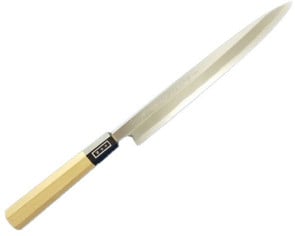
Minonokuni Take 240mm Yanagiba
This is the quintessential blade for the art of sashimi, a tool of perfect balance and uncompromising performance. The Minonokuni Take 240mm Yanagiba is the size trusted and revered by countless chefs, representing the ideal nexus of agile control and graceful reach. Its length is perfectly suited for slicing most fish fillets in a single, uninterrupted motion, the essential technique for creating the flawless, jewel-like surfaces that define world-class sushi and sashimi. There is no back-and-forth sawing; only one clean, fluid draw that preserves the delicate texture and locks in the pristine flavor of the fish. At the core of this exceptional knife is a blade forged from Shirogami #2 (White Paper Steel), a material celebrated in the culinary world for its ability to achieve a wickedly sharp edge and hold it through the rigors of a professional service. As a flagship of the premium "Take" (Bamboo) collection, this Yanagiba embodies a higher standard of craftsmanship and material excellence. For the serious home cook ready to elevate their craft or the professional chef seeking a reliable and masterfully balanced daily driver, the 240mm Yanagiba is the definitive choice—a true partner in the pursuit of culinary perfection. Learn More$200.00