
You have no items in your shopping cart.
Minonokuni Knives
Authentic Japanese blades (hochoes) hand-forged using traditional Japanese methods of old-world craftsmanship; Minonokuni knives are part of a project designed to preserve and protect the master/apprentice relationship. Even as demand for Japanese knives has grown; the skilled masters are aging, and it has been difficult to keep apprentices. While the methods of construction mastered over the centuries have changed very little, the methods of bringing the pieces to market is dramatically different. Then Knife Merchant was asked to assist by bringing knives from various masters in different types of material to market, so that the craftsmen can concentrate on their work and keep the apprentice fully employed, without the burden of stopping production to make sales. Minonokuni is the name of a prefecture (state) that existed in the days of the Samurai. It encompassed a wide area including Seki-City and Sakai, which are the areas of Japan in which our craftsmen are making these blades. This is why we have chosen this as a brand name to represent these knives. You will find the quality to be far superior to comparable material types. When the knife maker has his name on the blade (instead of working for a company), there is greater pride and care taken in little details that make a great difference in final quality. Minonokuni knives are now available in a variety of grades to suit every need and price point.
-

Minonokuni Take 9.4-inch (240mm) Left-Handed Yanagi
Made for left-handed chefs, this Take 240mm yanagi is ground with its bevel on the left face, so it slices sushi and sashimi as cleanly in the left hand as a standard yanagi does in the right. We keep it in stock.At 240mm, it is long enough for a saku of tuna or a full side of salmon to be cut in one stroke, which gives each slice a smooth surface. The knife is still short enough for an ordinary home board. For a cook who will slice in both a restaurant and a home kitchen, this length covers both.
SteelThe white steel in the Take line is good enough for professional use and less brittle than blue steel. That makes it a practical choice for a left-handed cook who is newer to single-bevel knives, where an awkward cut is more likely. The Matsu 240mm left-handed yanagiba is the blue steel option for experienced hands, and the Ume 240mm left-handed yanagi is the most forgiving.Other left-handed Take lengths are the 210mm and 270mm. See our kitchen knife shapes guide for an overview of slicers. Learn More$275.00 -
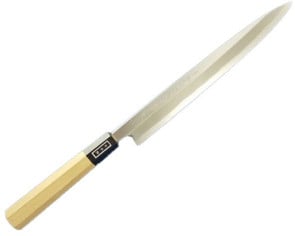
Minonokuni Take 9.4-inch (240mm) Yanagiba
For a cook who wants one yanagiba that can serve at home and in a professional kitchen, 240mm is the length to choose. It slices a full saku of tuna or a salmon fillet in a single pull, but it is not so long that it becomes awkward on an ordinary board.The Take line is the one we point a cook toward when in doubt. White steel takes an edge fine enough for sashimi and is less brittle than blue steel, so a slip of technique is less likely to cost a chip in the edge. It is the sweet spot between the Matsu 240mm yanagiba, for experienced hands, and the Ume 240mm yanagiba, for a first knife.
Using the LengthPlace the heel at the far edge of the fish and draw the blade toward you in one smooth motion, letting the tip finish the cut. The slice should come away with a bright, unbroken surface. If it needs a second stroke, the cut was too short or too slow.Other lengths are the 210mm and the 270mm. A left-handed cook should choose the Take 240mm left-handed yanagi. The knife shapes guide has more on Japanese slicers. Learn More$200.00 -

Minonokuni Take 8.3-inch (210mm) Left-Handed Yanagi
A left-handed sushi cook needs the bevel on the left side of the blade to slice cleanly, and this Take 210mm yanagi has it. Held in the left hand, the edge draws through the fish and steers the slice away from the block, the same way a right-handed yanagi works in the right hand.The 210mm length fits a home board and handles sashimi from salmon, tuna and yellowtail fillets. Expect a well-ground, flat blade that is sharp when it arrives. Like any single-bevel knife, it performs best once the cook has learned to maintain the edge on waterstones.
Choosing a Line for Left-Handed UseTake is the middle of our three standard lines, and we stock left-handed models in all three. Take’s white steel is less brittle than the blue steel Matsu 210mm left-handed yanagiba but holds an edge well enough for a professional kitchen. The Ume 210mm left-handed yanagi is the most forgiving and the easiest to learn to sharpen.For a longer stroke, see the Take 240mm left-handed yanagi. The right-handed version is the Take 210mm yanagiba. Our knife shapes guide explains the yanagi in detail. Learn More -

Minonokuni Take 8.3-inch (210mm) Yanagiba
A 210mm yanagiba is a comfortable length for slicing sashimi on a home cutting board, and the Take version gives a first-time sushi cook a knife that will grow with their skills. The blade is ground very flat, and the long, narrow edge cuts a block of fish in a single drawing stroke.Draw the knife toward you from the heel, keeping the pressure light. The single bevel and hollow back let each slice fall away cleanly instead of clinging to the blade. Short fillets of salmon or yellowtail are well within reach of this length.
Take or Matsu?The Take line uses white steel, which takes a very fine edge and comes back quickly on a waterstone. It is less brittle than the blue steel of the Matsu 210mm yanagiba, and so better suited to a cook who is still learning both the slicing stroke and how to sharpen a single bevel. It is good enough for professional use, which is why we call Take the sweet spot.Longer blocks of fish are easier with the Take 240mm yanagiba. Left-handed cooks should see the Take 210mm left-handed yanagi. The knife shapes guide covers the yanagiba. Learn More -

Minonokuni Take 7.7-inch (195mm) Deba
The 195mm is the largest deba in the Take line, built for large saltwater fish and big freshwater fish. Its mass is the point. A heavy blade drops through the head and collar of a large fish with little effort from the cook, and the long edge keeps the cut straight along a wide frame.That weight makes it slower on small fish, so it suits a cook who regularly handles large ones, such as a restaurant buying whole fish or an angler cleaning a large catch. For mixed work, the Take 180mm deba or Take 165mm deba is easier to manoeuvre.
Steel ChoiceWhite steel gives the Take line an edge that holds up in a professional kitchen while staying less brittle than blue steel. That combination is why we call Take the sweet spot of the Minonokuni range. A cook who wants the same size in the most forgiving steel can look at the Ume 195mm deba.Left-handed cooks will find the Take 180mm left-handed deba the largest left-handed option in the line. For more on choosing a deba, see the guide to knife shapes. Learn More$265.00 -

Minonokuni Take 5.9-inch (150mm) Left-Handed Deba
A deba ground for the left hand puts the bevel on the left face of the blade, so the edge follows the backbone when a left-handed cook fillets a fish. This Take 150mm deba is that mirror image, and we keep it in stock.The size suits trout, mackerel, small bream and similar fish, and it handles poultry jointing as well. Start at the head with the heavy heel, then work along the frame with the tip. A right-handed deba used in the left hand fights the cook on every pass and leaves meat on the bone, which is why the grind matters more on this knife than on a double-bevel blade.
Choosing TakeThe Take line is our recommendation for a cook who is new to single-bevel knives. Its white steel is ready for professional use, yet it is less brittle than blue steel and will tolerate the occasional misjudged cut while technique develops. A Ume 165mm left-handed deba is the more forgiving option for a cook who expects to spend time learning to sharpen.For larger fish, the Take 165mm left-handed deba and Take 180mm left-handed deba add length and weight. The right-handed version is the Take 150mm deba. The knife shapes guide has more on the deba. Learn More$260.00 -

Minonokuni Take 7.1-inch (180mm) Deba
When the fish on the board is a large salmon or a big snapper, the 180mm deba is the size to reach for. The extra length and weight let the heel drive through the head and collar in fewer strokes, and the longer edge follows a wide backbone in one pass.Being heavy, the knife does more of the work, and the cook should let it. Guide the blade along the bone instead of pushing it, and use the tip to separate the belly and ribs. A heavy deba still has a thin edge, so leave frozen fish and thick beef bones to other tools, and never twist the blade in a joint.
Why We Recommend TakeTake is the middle of the three standard lines. Its white steel holds an edge well enough for a working kitchen, and it is less brittle than blue steel, so it is the sensible choice for a cook who has not used many single-bevel knives. Cooks experienced with the grind may prefer the blue steel Matsu 180mm deba.The Take 165mm deba is more nimble, while the Take 195mm deba is the largest size. Left-handed cooks should see the Take 180mm left-handed deba. The knife shapes guide covers the deba in detail. Learn More$242.00 -

Minonokuni Take 6.5-inch (165mm) Deba
Between the small and large debas, the 165mm is the all-round size. It has enough weight to remove the head of a medium salmon or sea bass, yet it is easy enough to control on mackerel and trout. It is also a well-sized knife for breaking down whole chickens and for preparing poultry for yakitori.On poultry, the heel cuts through the joints and the thin wing tips, while the tip frees the oysters and the breast from the carcass. On fish, the single bevel keeps the edge flat to the frame for a clean three-piece fillet. Neither job calls for chopping through heavy bone, and the deba should not be used that way.
Matsu, Take or UmeAll three standard Minonokuni lines make a 165mm deba. Take, in white steel, is the sweet spot. It is adequate for professional use and less brittle than the blue steel Matsu 165mm deba. For a cook who wants the most forgiving knife to learn sharpening on, the Ume 165mm deba is the place to start.Left-handed cooks should choose the Take 165mm left-handed deba. The kitchen knife shapes guide covers how a deba differs from a boning knife. Learn More$216.00 -

Minonokuni Take 5.9-inch (150mm) Deba
A 150mm deba covers most fish a home cook will bring home whole, from trout and mackerel to a small snapper, and it is small enough for a standard home cutting board. The Take version is a sound first deba for a cook who wants to learn traditional fish butchery.The thick, heavy blade does the forceful work. Cut through the head and collar with the heel, then switch to the tip to follow the backbone and separate the fillets cleanly from the bone. The single bevel helps the edge ride flat along the frame, so less flesh is left behind.
A Steel That Tolerates LearningWe describe Take as the sweet spot of the Minonokuni range. Its white steel holds a fine edge well enough for professional kitchens, and it is less brittle than the blue steel used in the Matsu deba. That margin matters while a cook is learning how hard to lean on the heel.Other SizesSmaller fish are quicker work with the Take 135mm ko-deba. The Take 165mm deba adds weight for larger fish and for poultry. Left-handed cooks can order the Take 150mm left-handed deba, which we keep in stock. Read about the deba and its uses in our guide to kitchen knife shapes. Learn More$190.00 -

Minonokuni Take 5.3-inch (135mm) Ko-Deba
Ko-deba means small deba. At 135mm, this Take knife is built for fish that a full-size deba would overpower. Horse mackerel, sardines, smelt and small trout are its work. On fish this size, the work is mostly filleting rather than cleaving.The blade tapers from a thick spine near the handle to a fine tip. That taper lets the cook open a small fish along the belly, run the tip down each side of the backbone and lift the fillets with very little flesh left on the frame. It is a light knife, so we do not recommend it for splitting heads or cutting through heavy collars. For that work, use the Take 150mm deba or a larger size.
Why TakeTake sits in the middle of the three standard Minonokuni lines. Its white steel is adequate for professional use but less brittle than the blue steel of the Matsu line, which makes it a sound choice for a cook who is not yet an expert with single-bevel knives. The knife shapes guide shows how the deba compares with Western fillet knives.A cook who processes small fish for a restaurant, or an angler who cleans a cooler of panfish at home, will find the ko-deba quicker to handle than any larger size. Learn More$180.00