
You have no items in your shopping cart.
Santoku Knives
Translated to mean “three virtues”, Santoku knives are effective all-purpose tools that vary in shape from the western chef knife but serve the same purpose in terms of their utilitarian functionality. The “three virtues” to which the word Santoku refers align with the three tasks of slicing, dicing, and mincing. Their shape is unique to other knives in that Santokus resemble truncated chef knives with altered tips and minimal camber. Unlike the blades of German knives that sweep upwards to meet the tip, the spines of Santokus are rounded downwards to meet the knife edge. Please note that the lack of camber interferes with a traditional rocking motion so Santokus are more often use in a chopping manner.
-

Kyocera Innovation White 5.5-inch Ceramic Santoku, Blue Handle (TK-140 WH-BU)
Portioning a skinless salmon fillet or slicing tuna for a poke bowl calls for a blade that cuts in one smooth pass. A 5.5-inch ceramic santoku handles boneless fish well, and its blue handle matches the color many kitchens assign to seafood knives so it stays out of the vegetable work.The ceramic blade will not rust from brine or react with citrus marinades. Kyocera’s paper-cutting tests found its Innovation ceramic dulling half as fast as the brand’s earlier blades. The edge is hard and brittle, so pin bones, shells and frozen fish should go to a steel knife.Knife Merchant is an authorized Kyocera dealer, and shoppers want that confirmed before buying. That status keeps the knife under Kyocera’s limited warranty, which does not extend to unauthorized sellers.
Pairing a Blue SantokuFor smaller seafood jobs, the blue paring knife and utility knife complete the color group. For vegetables or raw meat, choose the black or red santoku. Learn More$75.00 -

Kyocera Innovation White 5.5-inch Ceramic Santoku, Black Handle (TK-140 WH-BK)
Push cutting is the santoku’s specialty. The flat edge meets the board along its length, so each stroke goes down and forward through an onion or a stack of zucchini rounds without rocking. At 5.5 inches, this Innovation White santoku is the compact version, sized for cutting boards and prep lists that do not call for a full chef’s knife.Kyocera lists slicing, dicing and mincing as its work on produce and boneless meat. The double-beveled ceramic edge cuts cleanly through produce and will not rust or react with acidic ingredients. Ceramic is brittle, though, so leave frozen food and bones to steel.How do you sharpen a ceramic santoku? Customers put that question to us, and the answer is diamond abrasive. The Kyocera Diamond Wheel Sharpener handles regular maintenance, and EVERSHARP, which Kyocera authorizes for service, grinds out chips and restores dull edges (details on Kyocera’s sharpening service page).
Santoku Sizes and ColorsFor a longer blade with a flat edge, see the Innovation White 6-inch Nakiri or the Innovation Black 6-inch Chef’s Santoku. This santoku also comes with a blue handle or a red handle, and the Innovation Black 5.5-inch Santoku has a black blade. Learn More$75.00 -

Kikuichi Warikomi Damascus Tsuchime Santoku
A fresh take on the WGAD series, now featuring a stunning Birch handle. The WDT series is a refined counterpart to the WG series, showcasing the same warm Birch handle paired with a meticulously crafted 17-layer hammered VG10 blade. This exceptional knife stands out both on the cutting board and in the knife block. With a weight comparable to many German knives, the WDT series is a favorite among those who appreciate the fusion of a Western-style handle with a precision Japanese blade. The VG10 edge is renowned for its fine grain structure and outstanding durability, while the hammered tsuchime finish enhances food release. Each knife is hand-engraved with the signature Kikuichi chrysanthemum logo. Learn More$309.95 -
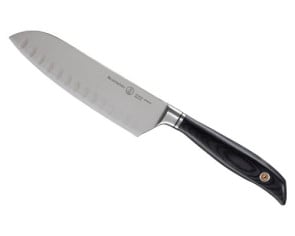
Messermeister Blacksmith 6.5 in Santoku
The Messermeister Blacksmith 6.5 Inch Kullens Santoku is a versatile Japanese chef's knife with a thin taper for maximum precision when slicing vegetables, fish and meat. The hollow oval shape of the kullens on either side of the blade reduce adhesion during the process of cutting and separating. The blade and handle are compatible in width and weight, resulting in a well-balanced knife. Learn More$189.95 -

Glestain K Series 160mm Santoku
The Glestain 160mm Santoku is dream to use. Food drops cleanly off the blade with each cut which improves the users technique and the cleanliness of your cutting surface. Learn More -

Kikuichi Molybdenum Santoku
The Kikuichi Moly Pro series is so named because it has a higher content of Molybdenum steel providing a razor sharp edge. This santoku is excellent for vegetable prep and for slicing meat that have already been removed from the bone.
Made in: Nara, Japan Learn More$189.95 -

Kikuichi GC Series Carbon Steel 7.1-inch (180mm) Santoku (SC18)
Kikuichi’s SC18 is the santoku of its GC Series carbon steel line, a 7.1-inch (180mm) blade with the flatter edge and rounded tip that suit push cuts and fine dicing. Kikuichi describes the series as sharp, light and tough, and shoppers find this knife by its model number.A santoku is a natural fit for cooks who chop straight down and forward without rocking the knife, and its broad blade scoops ingredients from the board. The carbon steel takes a keen edge and is easy to bring back on a whetstone. It will form a patina, and it needs wiping dry during prep, especially after cutting tomatoes or citrus. It makes a practical single knife for a home cook who mostly prepares vegetables.
Santoku or Gyuto?The 7.1-inch (180mm) Gyuto is the same length with a pointed tip and more curve for rocking cuts. For a longer all-purpose knife, see the 8.25-inch (210mm) Gyuto. Learn More$134.95 -

F. Dick Premier Plus 5.5 in. Granton Edge Santoku
This unique little Santoku by Friedrich Dick is an amazing addition to a home kitchen or chef's tool roll. This knife is small enough at 5.5 in. (140mm) to be a nimble utility knife but broad enough for a person with smaller hands to use this as an everyday vegetable knife. The Granton or Kullenschliff (in German) Edge is what really makes this knife special as many smaller blades don't have a hollow edge cut in. The Granton edge will help keep food like onion or tomato from clinging to the blade allowing for a quicker prepping experience. Made in Germany. Learn More$78.65 -

Global 7.1 in (180mm) HE Santoku
The Global G Series 7.1 in. (180mm) Santoku Knife is a versatile Japanese all-purpose knife designed for precision and control. Its compact size and balanced feel make it especially well-suited for detailed kitchen tasks such as mincing garlic and shallots, finely chopping herbs, and preparing vegetables with accuracy. The name Santoku translates to "three virtues," referring to the knife's ability to excel at slicing, dicing, and chopping. The broad blade provides ample knuckle clearance while helping transfer ingredients from cutting board to pan with ease. Crafted from Global's exclusive CROMOVA 18 stainless steel, this knife delivers exceptional sharpness, edge retention, and corrosion resistance, making it an indispensable tool for both home cooks and professional chefs. Learn More$149.95 -

Glestain 7.5 in. (190mm) Left Handed Santoku
The Glestain 7.5 in. (190mm) Left Hand Santoku is an excellent all purpose knife. The scalloped blade design of a santoku is particularly beneficial on a santoku that is normally used with more of a push cut than a rocking, slicing motiion. Learn More$170.00

