
You have no items in your shopping cart.
Oyster & Clam Knives
Used to open bivalve mollusks, oyster and clam knives are aesthetically similar despite their functional differences. Blunted on one side of the blade to allow comfortable maneuverability with fingertips, clam knives slide into the shell in a squeezing motion that lacerates the muscles that hold it closed. Clam knives come in two sizes, large and small and should be purchased in accordance with the size of clam upon which they will be used. If you are unsure of what clams you will be working with it is safer to select a larger clam knife. Oyster knives, which are used to manually pry open the shell of the creature, come in a variety of lengths and shapes each of which is unique to both the species of oyster on which it will be used and the handling style of the individual who will be using it. Wide-handled knives are ideal for use on beach oysters which require a firm grip and a blade that won’t break. Thinner handled oyster knives with pointed blade are intended for use on more delicate species, such as Kumumotos, as they are designed to prevent damage to the delicate shells that would crush if opened by a knife with a more substantial structure. If you are unsure of what oyster knife to select give us a call or send us an email and we will be more than happy to assist you.
-
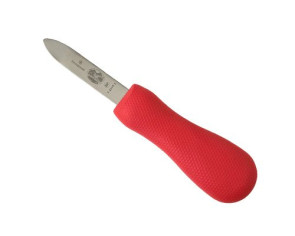
Victorinox 2.75-inch New Haven Curved Tip Oyster Knife
This 2.75-inch New Haven oyster knife is particularly useful for oysters whose top shell is smaller than the bottom at the hinge. Those can be difficult to pry at the hinge as you would other oysters.The curved tip lets you catch the lip of the top shell and lever against the bottom shell for an easy, clean opening. The short, sturdy blade keeps the leverage close to the hand.Set the oyster in a towel with the hinge toward you, hook the curved tip under the edge of the top shell and rotate the knife to lift it. Then run the blade along the inside of the top shell to cut the muscle.Rinse the knife in fresh water after use.For a straight pointed tip, see the Victorinox 2.75-inch Providence Style Oyster Knife. For larger oysters, the Victorinox 4-inch Galveston Oyster Knife. The table in the Details compares the shucking knives. Learn More$20.00 -
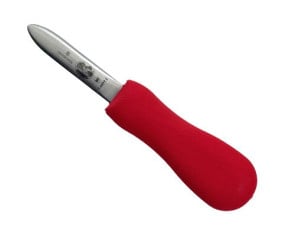
Victorinox 2.75-inch Providence Style Oyster Knife
Providence style oyster knives are short and strong, with a nice pointed tip. This 2.75-inch Victorinox knife is suitable for Northwest and Atlantic oysters, and it has a red SuperGrip handle designed for comfort and slip resistance.The short blade puts the hand close to the work, which gives leverage at the hinge and control as you twist the shell open. The point finds the hinge on small, tight oysters such as Kumamotos and Wellfleets.Work the tip into the hinge and twist rather than prying straight up. Once the shell pops, slide the blade along the inside of the top shell to cut the muscle, then under the oyster to free it.For a longer knife, see the Victorinox 3-inch Boston Style Oyster Knife. The Victorinox New Haven Curved Tip Oyster Knife handles oysters with a small top shell. The table in the Details compares all Victorinox shucking knives. Learn More$20.00 -

R. Murphy Duxbury 2.125-inch Oyster Knife, ECOgrip Handle
R. Murphy developed the Duxbury with the oystermen at Island Creek Oysters in Duxbury, Massachusetts. According to Edible Boston’s history of the company, the farm’s crew kept breaking the tips of their New Haven knives, so R. Murphy redesigned the blade with a stronger tip and named the result after the town.The blade is short, 2.125 inches, with a sharp, pointed tip that eases into the hinge with little force. A short blade keeps your hand close to the work and gives good control on small oysters and fast, repetitive shucking. The handle is R. Murphy’s ECOgrip, shaped to fit the hand and molded from recycled polypropylene in “Murphy Green,” so it can be cleaned and sanitized at a raw bar or on a farm.Customers ask us which knife suits which oyster. A pointed knife like this works well when the hinge is tight. If you prefer to lever the shell open with a curved tip, the New Haven shucker has a longer blade on the same handle material, and the Olympia shucker is ground for small, deep-cupped oysters. For a wood handle, compare the Wellfleet. Oyster knives are covered in our guide to knife shapes. Learn More$19.50 -
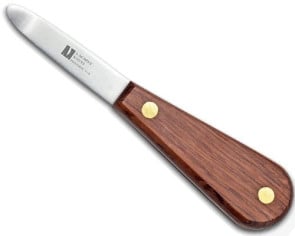
R. Murphy New Haven Elite 2.625-inch Oyster Knife, Rosewood Handle
R. Murphy’s New Haven Elite brings together the curved tip of the New Haven and the weighted, riveted rosewood handle of the Wellfleet. The 2.625-inch blade bends up slightly at the tip, and the hand-polished handle is shaped to fill the palm.A curved tip suits shuckers who open oysters at the hinge. Seat the tip, twist to pop the shell, then let the bend carry the blade along the top shell to release the adductor muscle. R. Murphy shapes the tip to ride slightly high inside the shell, which makes it easier to scrape the muscle free cleanly and leaves the meat intact.We hear from customers deciding between wood and plastic handles. A rosewood handle with brass rivets has more weight in the hand and a finished look, which makes the Elite a natural gift for someone who hosts oyster nights. For heavy commercial use with constant sanitizing, the ECOgrip New Haven shucker is the practical choice. The New Haven with a round wood handle is the lighter, classic version of this blade. If you prefer to open oysters with a pointed blade, the Wellfleet uses the same handle. Our overview of knife shapes includes oyster and clam knives. Learn More -
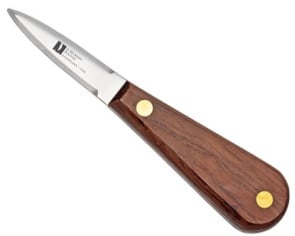
R. Murphy Wellfleet 2.625-inch Oyster Knife, Rosewood Handle
Named for the Cape Cod town known for its oysters, the R. Murphy Wellfleet is a pointed oyster knife with a weighted, hand-polished rosewood handle held with brass rivets. When The Wall Street Journal wrote about shucking in 2012, it called the Wellfleet “our favorite, for its pretty brass and rosewood grip and its steady heft in the hand.”The 2.625-inch blade comes to a tough point that slips into the hinge. R. Murphy designs it for small and medium oysters from any of the three American coasts. The contoured handle gives you something solid to push and twist against, and the extra weight helps steady the knife once the shell gives.Customers ask us whether to choose a pointed or a curved tip. A point like this one goes into a tight hinge easily. The upturned tip of the New Haven Elite rides along the top shell and keeps clear of the meat, and it shares this rosewood handle. The Damariscotta is a close sibling with the same blade. For a plastic handle that stands up to sanitizing, look at the Duxbury. Our kitchen knife shapes guide describes oyster knives alongside clam knives. Learn More$41.50 -
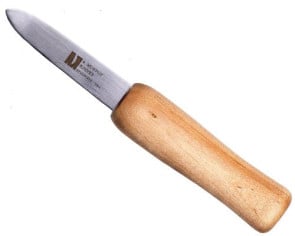
R. Murphy New Haven 2.625-inch Oyster Knife, Wood Handle
The R. Murphy New Haven oyster knife is the shucker America’s Test Kitchen named the winner of its oyster knife testing in 2012 and again in its current review, which found the New Haven design “dispatched oysters of all sizes easily.” Serious Eats also selected it as the Best Overall Oyster Knife. This version has a round wooden handle and a 2.625-inch blade.What sets a New Haven knife apart is the slight upward bend at the tip. You work the tip into the hinge and twist, and once the shell gives, the curve lets the blade ride along the underside of the top shell to cut the adductor muscle. The bend keeps the point lifted away from the oyster, which helps you open it without cutting into the meat. That makes it a forgiving knife to learn on, and it is just as much at home behind a raw bar.Wood or plastic is the handle question we hear. Wood has a warm grip and suits shucking at home or at a party. For a busy kitchen that sanitizes tools all day, the New Haven shucker with an ECOgrip handle has the same blade on recycled polypropylene. The New Haven Elite pairs this curved tip with a riveted rosewood handle. If you prefer a pointed blade, compare the Wellfleet, and see our guide to knife shapes for how oyster and clam knives differ. Learn More$18.00 -
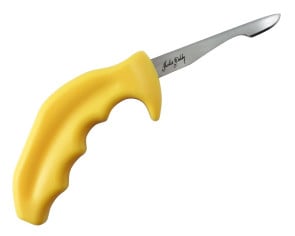
Swissmar Original Shucker Paddy Oyster Knife Yellow
This knife tip slides nicely into any oyster, and the unique handle allows you to pop the shell with a flick of the wrist. I usually am unhappy with the appearance of an oyster due to the top cut. So, I remove the lower abductor and flip the oyster over for better presentation. Not necessary with this shucker. No more cut knuckles and really fast. I know it looks strange, but I promise that you are going to love this oyster shucker. Learn More -
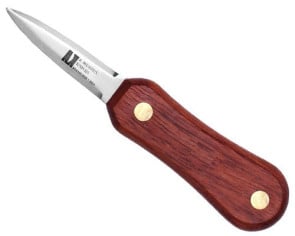
R. Murphy Damariscotta 2.625-inch Oyster Knife, Rosewood Handle
Damariscotta is an oyster town on the Maine coast, and R. Murphy’s knife of the same name is built in the traditional New England pattern, with a pointed 2.625-inch blade and a hand-polished rosewood handle fixed with brass rivets.Writer Rowan Jacobsen, author of The Oyster Guide, named the Damariscotta his favorite of the knives he tested in 2012. It is meant for small and medium oysters. The point finds the hinge, and a short twist pops the shell; the blade then slides under the top shell to cut the muscle.Next to the Wellfleet, the Damariscotta shares the blade length and the rosewood, but its handle is sleeker, a better fit for small to medium hands. Customers with larger hands, or who want more weight to push against, can compare the Wellfleet. For a curved tip on the same style of handle, see the New Haven Elite. If the knife will be sanitized every day in a commercial kitchen, the ECOgrip New Haven shucker is the more practical handle. For more about oyster knife shapes, read our kitchen knife shapes guide. Learn More$41.50 -

R. Murphy New Haven 2.625-inch Oyster Shucker, ECOgrip Handle
Raw bars, seafood counters and oyster farms need a shucker that can be scrubbed and sanitized all shift, and the R. Murphy New Haven oyster shucker is built for that work. It carries the classic New Haven blade, 2.625 inches long with an upturned tip, on an ECOgrip handle molded from recycled polypropylene in R. Murphy’s green.The curved tip is the reason the New Haven pattern has lasted. It catches the hinge, levers the shell open with a twist, and then follows the inside of the top shell to sever the muscle. Because the point bends up and away from the meat, beginners can learn the motion without gouging the oyster, and experienced shuckers can work quickly. The tip also curls away from the hand holding the oyster, which makes it a safer design for anyone concerned about poking a hand with the point.The plastic handle is the main difference from the wood-handled New Haven. It holds up to hot water and sanitizer, and a wet hand keeps its grip on it. Wood suits shucking at home; for a kitchen or a farm, we suggest this one. For small, deep-cupped oysters with tight hinges, the Olympia shucker has a blade ground for that job, and the Duxbury has a shorter, stronger tip. Our knife shapes guide covers oyster knives along with the rest of the kitchen. Learn More$19.50 -

F. Dick 2.25-inch Stainless Steel Oyster Shucker
A short, sturdy blade handles a wide range of oysters and clams, from robust to delicate, and this 2.25-inch F. Dick shucker is built for that everyday work. It is a compact tool for a raw bar or a home cook opening a dozen on the weekend.The short blade gives leverage at the hinge and keeps the tip from slipping deep into the shell. Stainless steel resists the corrosion that comes with saltwater and repeated washing. The compact size makes it easy to control while turning the shell in the other hand.It is a good first shucker for a home cook learning to open oysters.For small, wavy-shelled oysters and clams that need a cutting edge, the F. Dick 3-inch oyster knife is better suited. Hold the oyster in a folded towel or a cut-resistant glove, with the hinge facing you. Rinse the shucker in fresh water after each session. Learn More$46.15