
You have no items in your shopping cart.
Oyster & Clam Knives
Used to open bivalve mollusks, oyster and clam knives are aesthetically similar despite their functional differences. Blunted on one side of the blade to allow comfortable maneuverability with fingertips, clam knives slide into the shell in a squeezing motion that lacerates the muscles that hold it closed. Clam knives come in two sizes, large and small and should be purchased in accordance with the size of clam upon which they will be used. If you are unsure of what clams you will be working with it is safer to select a larger clam knife. Oyster knives, which are used to manually pry open the shell of the creature, come in a variety of lengths and shapes each of which is unique to both the species of oyster on which it will be used and the handling style of the individual who will be using it. Wide-handled knives are ideal for use on beach oysters which require a firm grip and a blade that won’t break. Thinner handled oyster knives with pointed blade are intended for use on more delicate species, such as Kumumotos, as they are designed to prevent damage to the delicate shells that would crush if opened by a knife with a more substantial structure. If you are unsure of what oyster knife to select give us a call or send us an email and we will be more than happy to assist you.
-
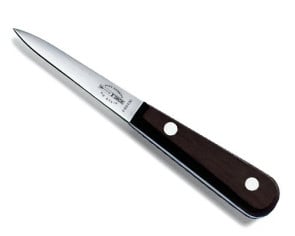
F. Dick 3-inch Oyster Knife
Small, delicate oysters with wavy shells, such as Kumamotos, Olympias and Belons, need a precise knife, and this 3-inch F. Dick oyster knife has a pointed tip and a sharpened edge to find the hinge and cut the adductor muscle cleanly.Most oyster knives have a blunt blade, which can crush a fragile shell. This one has an edge ground into it, so it also opens clams, which need to be cut rather than pried. The pointed tip slips into a tight hinge with little force, and the short blade gives control close to the hand.At a raw bar, a dedicated knife for small oysters also speeds up service. It keeps the presentation neat on the half shell.For larger, heavier oysters, the F. Dick 2.25-inch stainless steel oyster shucker is the counterpart. Protect the hand holding the shell with a folded towel or a cut-resistant glove. Our knife shapes guide covers oyster and clam knives. Learn More$28.60 -

Dexter-Russell Traditional 4-inch Boston Oyster Knife, Carbon Steel
The Dexter 4 in. Long Boston Oyster Knife is used on delicate shelled oysters grown in Japanese Lantern nets, like Kumamoto or Pacific/Kumamoto hybrids. The thin tip allows you to enter the oyster with a minimal amount of chipping and breakage. Learn More$15.60 -

Dexter-Russell Sani-Safe 3-inch Square Blade Clam Knife
The Dexter 3 in. Clam Knife knife is a necessity when shucking clams. Using the Clam knife allows you to open the clam shell, without damaging the clam. Learn More$16.99 -

Dexter-Russell Sani-Safe 4-inch Galveston Oyster Knife
The Dexter 4 in. Galveston Oyster Knife has a wide, strong blade with a large handle, making opening Gulf Oysters easy. Learn More$17.99 -

Dexter-Russell Sani-Safe 3-inch Boston Oyster Knife
A 3-inch Boston blade is long and narrow enough to slide in from the side of an oyster, and short enough for close control on small and medium shells. Dexter-Russell says this Sani-Safe S134 handles any size of oyster, and the narrow profile is less likely to crack thin, delicate shells than a wide blade. Shoppers also search for it as a short Boston or a Boston stabber.
Choosing a Boston KnifeThe Sani-Safe 4-inch Boston Oyster Knife adds reach for large oysters, and the New Haven S121 enters at the hinge instead. Learn More$17.99 -

Dexter-Russell Sani-Safe 2.75-inch Providence Oyster Knife
The Dexter 2 3/4 in. Providence Oyster Knife is great for prying open Gulf oyster shells. Made of high carbon steel, with a Grip-Tex polypropylene handle. Learn More$16.99 -

Dexter-Russell Sani-Safe 2.75-inch New Haven Oyster Knife
The New Haven pattern takes its name from the Connecticut oyster town, and this Sani-Safe S121 is the most visited oyster knife on our site. If you have worked in a fish market or a seafood restaurant, you have very likely used one, since it is the most common oyster shucker in commercial kitchens. Dexter-Russell gives it a short 2.75-inch blade with a curved tip that slips beneath the hinge, so a twist of the wrist pops the shell open.Once the hinge gives, the same curved tip runs along the top shell to cut the adductor muscle without tearing the meat. Dexter says the shape makes it easier to open oysters of any size, from small Wellfleets to large Blue Points. The white handle is long enough for a full grip and textured so it does not turn in a wet hand. For anyone unsure which pattern to choose, it is the knife to start with.
Which Oyster Knife Pattern?Shuckers who prefer to enter from the side of the shell often choose a Boston pattern such as the Sani-Safe 3-inch Boston Oyster Knife. For heavy Gulf oysters, the Sani-Safe 4-inch Galveston has more blade. The table below compares every Dexter oyster knife we carry. Learn More$16.99 -

Dexter-Russell Sani-Safe 4-inch Boston Oyster Knife
The Dexter Long Boston 4 in. Oyster Knife is used on delicate shelled oysters grown in Japanese Lantern nets, like Kumamoto or Pacific/Kumamoto hybrids. The thin tip allows you to enter the oyster with a minimal amount of chipping and breakage. Learn More$18.99