
You have no items in your shopping cart.
Oyster & Clam Knives
Used to open bivalve mollusks, oyster and clam knives are aesthetically similar despite their functional differences. Blunted on one side of the blade to allow comfortable maneuverability with fingertips, clam knives slide into the shell in a squeezing motion that lacerates the muscles that hold it closed. Clam knives come in two sizes, large and small and should be purchased in accordance with the size of clam upon which they will be used. If you are unsure of what clams you will be working with it is safer to select a larger clam knife. Oyster knives, which are used to manually pry open the shell of the creature, come in a variety of lengths and shapes each of which is unique to both the species of oyster on which it will be used and the handling style of the individual who will be using it. Wide-handled knives are ideal for use on beach oysters which require a firm grip and a blade that won’t break. Thinner handled oyster knives with pointed blade are intended for use on more delicate species, such as Kumumotos, as they are designed to prevent damage to the delicate shells that would crush if opened by a knife with a more substantial structure. If you are unsure of what oyster knife to select give us a call or send us an email and we will be more than happy to assist you.
-

Victorinox 3.25-inch Narrow Clam Knife
The Victorinox narrow clam knife works for all clams but is particularly useful for opening smaller sizes such as littlenecks and Manila clams. The blue handle lets you quickly tell the clam knife apart from your oyster knives.A clam knife has a sharpened edge that slips between the two shells instead of prying at the hinge. The narrow blade opens the clam cleanly without piercing the meat.Hold the clam in a towel with the hinge against your palm, set the edge in the seam opposite the hinge and squeeze the blade in with your fingers. Run the blade along the top shell to cut the muscles, then under the clam.Chill clams well before opening; cold clams relax and open more easily. Rinse the knife in fresh water after use and dry it.For large clams, see the Victorinox 3.5-inch Wide Clam Knife. The table in the Details compares the shucking knives, including the oyster knives. Learn More$13.00 -
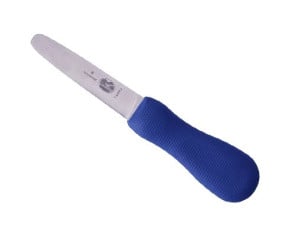
Victorinox 3.5-inch Wide Clam Knife
The Victorinox 3.5-inch wide clam knife has a broad blade for leverage and control, which makes quick work of large cherrystone and chowder clams. Its blue handle sets it apart from oyster knives at a glance.The sharpened edge slips into the seam between the shells, and the width of the blade gives a solid surface to push against as you work it in. It cuts the muscles cleanly so the clam comes free whole.Hold the clam in a towel with the hinge against your palm, set the edge in the seam and squeeze it in with your fingers rather than stabbing. Cut along the top shell, then under the clam.Chill the clams well before opening; cold clams relax and the seam is easier to find. Rinse the knife in fresh water after use and dry it before storing.For small clams, the Victorinox 3.25-inch Narrow Clam Knife fits a tighter seam. The table in the Details compares all Victorinox shucking knives. Learn More$15.00 -

Dexter-Russell Sani-Safe 3-inch Slim Clam Knife
Small clams close tightly, and a thick blade has trouble finding the seam. Dexter-Russell’s S127 has a slim 3-inch blade that slips into small shell openings, the knife Dexter recommends for littlenecks and tight hinges, and one it notes is popular with commercial processors. It has enough backbone to cut through the muscle and free the meat cleanly, and the textured handle stays secure through a long session at the raw bar.
Slim or Square Blade?For cherrystones and other large clams, the broader Sani-Safe S119 Square Blade Clam Knife gives more leverage. Learn More$12.99

