
You have no items in your shopping cart.
Kyocera Ceramic Knives
Ceramic knives offer practical advantages over steel, most notably their ability to hold a sharp edge for an extended period, their lightweight construction, and the fact that they are chemically inert, meaning they won't rust or alter the taste of food. As a Japanese company and a leader in advanced ceramics, Kyocera engineers its blades for precision and durability. Their product lines cater to different users: the Revolution series features the classic white ceramic blade, providing a dependable, all-purpose cutting tool perfect for everyday kitchen tasks. The Innovation series is designed for users seeking enhanced performance, utilizing a denser, black ceramic blade for even greater edge retention and often including a more ergonomic handle for added comfort and control. Whichever line you choose you can expect phenomenal performance for many years to come.
-

Kyocera Innovation White 5.5-inch Ceramic Santoku, Black Handle
Push cutting is the santoku’s specialty. The flat edge meets the board along its length, so each stroke goes down and forward through an onion or a stack of zucchini rounds without rocking. At 5.5 inches, this Innovation White santoku is the compact version, sized for cutting boards and prep lists that do not call for a full chef’s knife.Kyocera lists slicing, dicing and mincing as its work on produce and boneless meat. The double-beveled ceramic edge cuts cleanly through produce and will not rust or react with acidic ingredients. Ceramic is brittle, though, so leave frozen food and bones to steel.How do you sharpen a ceramic santoku? Customers put that question to us, and the answer is diamond abrasive. The Kyocera Diamond Wheel Sharpener handles regular maintenance, and EVERSHARP, which Kyocera authorizes for service, grinds out chips and restores dull edges (details on Kyocera’s sharpening service page).
Santoku Sizes and ColorsFor a longer blade with a flat edge, see the Innovation White 6-inch Nakiri or the Innovation Black 6-inch Chef’s Santoku. This santoku also comes with a blue handle or a red handle, and the Innovation Black 5.5-inch Santoku has a black blade. Learn More$75.00 -

Kyocera Innovation White 5-inch Ceramic Tomato Knife, Black Handle
A ripe tomato has a slick skin over soft flesh, and a plain edge tends to slide across the skin and press the tomato flat before it cuts. This 5-inch Innovation White tomato knife has a micro-serrated ceramic edge that catches the skin on the first stroke, so slices come away clean. Kyocera also recommends it for other tough-skinned fruits and vegetables and for bread, which makes it a natural choice for plums, peppers and dinner rolls.Ceramic does not react with the acid in tomatoes or citrus, so the cut surfaces keep their color and taste. The handle, designed by Yohei Kuwano, tapers toward the blade and is shaped to stay put in a wet hand.Before ordering, customers check that we are authorized to sell Kyocera. Knife Merchant is an authorized reseller, and Kyocera’s limited warranty excludes knives from unauthorized sellers.
Serrated or Plain Edge?For thin slices of cooked meat or fish, a plain edge such as the Innovation Black 5-inch Slicing Knife leaves a smoother face. For general prep, the Innovation White 4.5-inch Utility Knife is the plain-edge option in this line. Learn More$60.00 -

Kyocera Innovation White 4.5-inch Ceramic Utility Knife, Red Handle
Cubing chicken breast for skewers or trimming a pork tenderloin goes faster with a knife long enough to slice through in one stroke. A 4.5-inch ceramic blade fits those jobs, and the red handle follows the common kitchen convention of marking the knife used for raw meat.The ceramic blade slices boneless meat cleanly and cannot rust from the moisture of raw protein. Kyocera’s own figures show the Innovation ceramic holding its edge twice as long as earlier Kyocera blades. Bones and joints are another matter. Use a steel knife there, because ceramic chips if it strikes something hard.We hold authorized Kyocera dealer status, a point buyers raise with us before ordering ceramic. Kyocera’s limited warranty applies only to purchases from authorized resellers.
Red Handle Sizes and Other ColorsFor smaller trimming, the red-handled 3-inch Paring Knife is easier to steer. For slicing larger cuts thin, the red-handled 5.5-inch Santoku adds length. Other handle colors are black and blue. Learn More$50.00 -

Kyocera Innovation White 4.5-inch Ceramic Utility Knife, Blue Handle
Ceviche is a good test of a knife, because the fish is cut into small cubes and then soaked in lime juice. This blue-handled Innovation White utility knife has a 4.5-inch ceramic blade that slices raw fish cleanly and leaves no metallic taste in the cure.Blue handles conventionally mark the knives reserved for seafood in kitchens that color-code their tools, which makes this one easy to keep on task. Kyocera rates the zirconia and alumina blade at double the edge life of its older ceramic. Pin bones and frozen fillets are jobs for steel, since ceramic chips under that kind of stress.Sharpening is a question customers bring to us before they buy ceramic. The answer is diamond, either the Kyocera Diamond Wheel Sharpener at home or EVERSHARP, the shop Kyocera authorizes for repairs, for chips and heavy wear (Kyocera’s sharpening service page explains the process).
Building a Blue-Handled SetThe 3-inch Paring Knife and 5.5-inch Santoku share this handle color. Outside seafood work, the black-handled utility knife suits general prep, and the red-handled one is the raw meat choice. Learn More$50.00 -

Kyocera Innovation White 4.5-inch Ceramic Utility Knife, Black Handle
Kyocera recommends its 4.5-inch Innovation White utility knife for basic everyday cutting. It slices a sandwich, halves a lime and cuts an apple into wedges without the bulk of a larger knife.The straight blade is long enough to work on the board and short enough to handle in the air. Kyocera puts its weight at about half that of a comparable metal knife, and Yohei Kuwano’s handle tapers toward the blade with a rounded underside that holds steady in a wet hand. Citrus and tomatoes cannot discolor or corrode the ceramic.Is Knife Merchant an authorized Kyocera dealer? Customers ask, and the answer is yes, which keeps this knife eligible for Kyocera’s limited warranty, since Kyocera does not cover knives from unauthorized sellers.
Where the Utility Knife FitsThe Innovation White 3-inch Paring Knife is better for peeling, and the Innovation White 5.5-inch Santoku takes over for dicing vegetables. Shoppers who color-code can choose a blue or red handle, and the Innovation Black 4.5-inch Utility Knife pairs the length with a black blade. Learn More$50.00 -
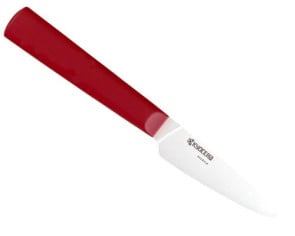
Kyocera Innovation White 3-inch Ceramic Paring Knife, Red Handle
A red handle is easy to spot in a crowded drawer, and in the color-coding scheme many kitchens follow it also marks the knife kept for raw meat. At 3 inches, this Innovation White paring knife suits the small trimming jobs in that category, such as cutting the tendon from a chicken tenderloin or scoring the fat cap on a pork chop.Ceramic gives a clean slice through boneless meat and fat. The blade will not rust, and Kyocera’s testing credits the Innovation ceramic with double the edge life of the brand’s earlier blades. It is still brittle. Keep the tip away from bones and cartilage, which call for a steel boning knife.Customers ask us how a ceramic paring knife gets resharpened. Diamond is the only abrasive that works. The RSD-01 sharpener handles home touch-ups. Kyocera’s authorized repair service, EVERSHARP, handles chipped tips and worn edges; Kyocera’s sharpening service page has the request form.
Matching Red-Handled KnivesThe 4.5-inch Utility Knife and 5.5-inch Santoku carry the same red handle for larger cuts. Prefer another color? The paring knife is also sold in black and blue. Learn More$40.00 -
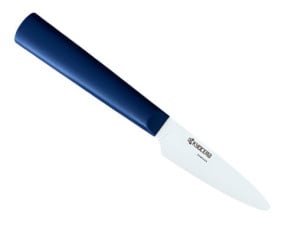
Kyocera Innovation White 3-inch Ceramic Paring Knife, Blue Handle
Deveining shrimp calls for a fine point that can follow the back of each shell without tearing the meat. With a 3-inch ceramic blade, this blue-handled paring knife is suited to that kind of small, exact cut, and it is just as useful for scoring scallops or trimming a citrus segment.In the color-coding many kitchens use to separate tasks, blue marks the knives kept for raw fish and seafood, so the handle can do double duty as a label. Kyocera says its zirconia and alumina blade outlasts the brand’s earlier ceramic knives by a factor of two. Lemon juice and brine have nothing to corrode.We sell Kyocera as an authorized dealer, something buyers check with us before ordering. Kyocera only honors its limited warranty on knives bought through authorized resellers.
Choosing a Paring Knife ColorFor general produce work, pick the black-handled version, or choose the red-handled one for raw meat. To color-code a second length, the Innovation White 4.5-inch Utility Knife, Blue Handle and the Innovation White 5.5-inch Santoku, Blue Handle match it. Learn More$40.00 -
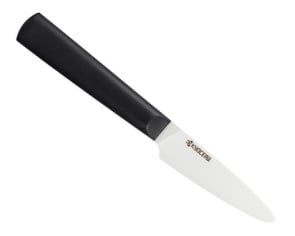
Kyocera Innovation White 3-inch Ceramic Paring Knife, Black Handle
Most paring work happens off the board, with the food in one hand and the knife in the other. This knife pairs a short, pointed 3-inch blade with a handle shaped for that kind of control, whether the job is peeling a kiwi, cutting the eyes out of a potato or trimming the stem from a strawberry.Kyocera worked with the Tokyo designer Yohei Kuwano on the handle. It narrows toward the blade so the fingers can choke up for fine cuts, and its rounded underside and thicker ends are shaped to keep a wet hand from slipping. Kyocera describes the blade material, a blend of zirconia and alumina, as the next step after its Innovation Black ceramic. Acidic fruit cannot corrode or stain it.Customers ask us how these knives are sharpened. A ceramic edge needs diamond. The Kyocera Diamond Wheel Sharpener keeps it in shape at home, and EVERSHARP, Kyocera’s authorized repair shop, restores dull or chipped blades (see Kyocera’s sharpening service page).
Other Handle Colors and SizesHandle colors include blue and red as well. For a black blade, see the Innovation Black 3-inch Paring Knife. When the job moves to the board, the Innovation White 4.5-inch Utility Knife gives more length. Learn More$40.00 -

Kyocera Universal Soft-Touch Round Knife Block, Black
Fixed-slot knife blocks dictate which knives fit where, and a santoku or nakiri can end up in a slot cut for a chef’s knife. Kyocera’s Universal Knife Block has a slotted top that accepts blades of different widths in any position, so a mixed set of ceramic and steel knives stands upright together. Kyocera rates it for six to eight knives.The round body takes little counter space, which suits a narrow strip of counter beside the stove. Its slots are gentle on edges, a real advantage for ceramic knives, which can chip if they knock against a hard surface. The black exterior has a soft-touch finish.Customers ask whether we are an authorized Kyocera dealer before buying. We are, and our blocks come through Kyocera’s authorized distribution.
Filling the BlockThe Kyocera Innovation Black 4-Piece Ceramic Knife Set fills half the capacity, leaving room for a paring knife such as the Innovation Black 3-inch Paring Knife and a few steel knives. For a stainless steel exterior, see the Kyocera Universal Stainless Steel Knife Block. Learn More -

Kyocera Innovation Black 4-Piece Ceramic Knife Set
This set builds a ceramic lineup for vegetable-heavy cooking, with a blade length for each stage of prep, from breaking down a head of cabbage on the board to cutting thin slices of cooked fish. A longer blade for chopping and a shorter one for slicing spare you from forcing one knife to do both.Kyocera spent more than 12 years developing this ceramic and says it keeps an edge twice as long as the ceramic it replaced. The knives cannot rust and leave no metallic taste on acidic food. Like all ceramic, they are brittle, so keep a steel knife in the kitchen for bones, frozen food and prying.Before buying a ceramic set, customers ask us how it will be sharpened. Plan on diamond. The RSD-01 Diamond Wheel Sharpener covers home maintenance for all four knives, and EVERSHARP, Kyocera’s authorized service provider, repairs chips and resharpens worn edges (Kyocera’s sharpening service page explains how to send knives in).
Storing a Four-Knife SetThe Kyocera Universal Knife Block has a slotted insert that takes ceramic blades of any shape, and holds up to eight knives, enough for this set and four more. For a smaller start, the Innovation Black 2-Piece Set pairs a 6-inch chef’s santoku with the utility knife. Learn More

