
You have no items in your shopping cart.
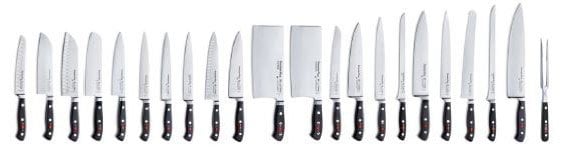
F Dick Premier Plus Knives

Thoughtfully designed, masterfully crafted and beutifully balanced; Friedrich Dick's Premier Plus knives are made to last for a lifetime of professional use. High-carbon Molybdenum Vanadium X50CrMoV15 blades have been hardened to 56° HRC. These fully forged knives are Made in Germany where master bladesmiths carefully hone each blade to create a beautifully polished cutting edge. Premier Plus knives are available in a wide array of shapes with comfortable, ergonomic handes that are easy to sanitize for optimal hygeine. This is a classic knife line that is offered at an excellent price point.
-

F. Dick Premier Plus 6-inch Granton Edge Utility Knife
Onion, tomato and potato slices stick to a flat blade, and the granton edge on this 6-inch Premier Plus utility knife lets them fall away. The hollows ground along the blade make repeated slicing faster on a busy board.A utility knife handles the cuts that are too large for a paring knife, such as a big grapefruit or a pork tenderloin. Using it for those jobs keeps the chef’s knife sharper for longer. The edge hones back easily and sharpens well on stones.The 6-inch length suits slicing potatoes for chips or gratins and cutting cucumbers into thin rounds. Uniform slices cook evenly and look neater on the plate. The narrow blade also trims meat cleanly.If sticking is not a concern, the plain-edged Premier Plus 6-inch utility knife is simpler to maintain. The Premier Plus 5.5-inch granton santoku has a taller blade for chopping, and the 1905 6-inch granton utility knife has the ringed handle. Learn More$94.25 -

F. Dick Premier Plus 6-inch Chef’s Knife
Cooks who value agility pick a 6-inch chef’s knife, and this Premier Plus model gives close control for mincing herbs, cutting julienne strips and dicing vegetables. The shorter blade is quick in the hand and easy to steer.It suits a small kitchen or a small board, and cooks with smaller hands find it more comfortable than an 8-inch blade. The tip sits closer to the hand, which helps with fine work such as removing seeds from peppers or scoring meat. The edge holds well and hones back quickly.A 6-inch blade also travels well in a knife roll and fits a small drawer. Cooks who prep in a tight space find it easier to move around a crowded counter. It is also a good first knife for a teenager learning to cook.For larger produce and longer cuts, the Premier Plus 8-inch chef’s knife is the all-round size. The Premier Plus 5.5-inch granton edge santoku is an alternative for push cuts, and the 6-inch utility knife is narrower at the same length. Learn More$82.55 -

F. Dick Premier Plus 5.5-inch Granton Edge Santoku
At 5.5 inches, this small santoku is nimble enough to serve as a utility knife and broad enough to be an everyday vegetable knife for a cook with smaller hands. It is a good addition to a home kitchen or a chef’s tool roll.Few blades this short have a granton edge. The hollows ground along the blade keep slices of onion, tomato and potato from clinging, so prep moves quickly. The flat edge and rounded tip suit push cuts and forward slicing rather than rocking.It also suits slicing mushrooms and soft cheese, where a thin, flat blade gives clean, even pieces. In a tool roll, it takes little more room than a utility knife.For more length, the 1905 7-inch granton edge santoku is the larger option. The Premier Plus 6-inch chef’s knife offers a curved edge for rocking, and the Premier Plus 6-inch granton utility knife is narrower. Our knife shapes guide explains the santoku shape. Learn More$78.65 -

F. Dick Premier Plus 6-inch Flexible Boning Knife
Deboning poultry, trimming silver skin and filleting delicate fish are the jobs for this 6-inch Premier Plus flexible boning knife. Its long, narrow blade moves around bones and through joints with control.Flex lets the edge bend against a bone and follow it closely, so more meat comes away and less is wasted. The sharp, pointed tip pierces and steers through tissue for precise cuts near the bone. It is a kitchen boning knife for chefs and home cooks who break down their own birds and roasts.The 6-inch length suits whole chickens and pork loins in a home kitchen, and it is easy to control for a cook new to boning. A knife roll keeps the flexible blade protected between uses.For joint work that needs more backbone, the Premier Plus 5-inch stiff boning knife is firmer. The 1905 6-inch flexible boning knife has a ringed handle, and the ErgoGrip 6-inch curved flexible boning knife is built for processing lines. Learn More$70.85 -

F. Dick Premier Plus 5-inch Stiff Boning Knife
A stiff blade makes clean, controlled cuts when breaking down meats, and this 5-inch Premier Plus boning knife goes through chicken joints and portions small cuts. It is even nimble enough to fillet fish.Stiffness lets the cook lever a joint apart without the blade bending, which suits poultry and work on frozen birds that are partly thawed. The short length keeps the tip close to the hand. The gap-free handle keeps it hygienic enough for commercial use.The 5-inch blade is also handy for trimming lamb chops and frenching a rack. A stiff tip makes it easy to scrape bones clean for presentation. The short length suits a home kitchen.For more flex around bones and under silver skin, the Premier Plus 6-inch flexible boning knife is the counterpart. Plants and butcher shops working long shifts may prefer the ErgoGrip 5-inch curved stiff boning knife. The table below lists the other Premier Plus slicing knives. Learn More$68.90 -

F. Dick Premier Plus 6-inch Utility Knife
Work that is too large for a paring knife, such as cutting a big grapefruit, trimming a cantaloupe or slicing pork and chicken, suits this 6-inch Premier Plus utility knife. Its narrow blade suits both produce and meat.Having a second knife for these jobs spreads the wear across blades, so a chef’s knife used for everything does not go dull as quickly. The steel hones back easily when the edge rolls to one side, and it sharpens well on stones when it needs more than honing.At 6 inches, it also slices sandwiches and cured meats neatly. The narrow blade turns easily inside a melon or a citrus fruit to free the flesh from the rind. That makes it a useful second knife beside a chef’s knife.A granton edge version keeps starchy vegetables from sticking. For a little more reach, the Premier Plus 7-inch utility knife handles melons and small fish, and the 6-inch chef’s knife has a taller blade for chopping. Learn More$65.65 -

F. Dick Premier Plus 5-inch Tomato Knife
A ripe tomato turns to mush under a dull or straight edge, and this 5-inch Premier Plus tomato knife pierces the skin and slides through the soft flesh without crushing it. The forked tip lifts and arranges each slice.The wave-cut serrations act like a fine saw, catching the waxy skin at once and keeping juices in the fruit. The same edge slices citrus, kiwi and soft cheese cleanly. With the forked tip, the cook can move slices of tomato or lemon onto a plate without a second tool.It also slices sausages and soft salami, and the fork lifts slices onto a platter without a second tool.For larger work on sandwiches and melons, the Premier Plus 5-inch serrated utility knife has a plain tip, and the 1905 5-inch serrated utility knife has the ringed 1905 handle. An offset option for tomatoes and bread is the ProDynamic 7-inch offset serrated knife. Learn More$58.50 -

F. Dick Premier Plus 5-inch Serrated Utility Knife
Slicing avocados and removing their pits, cutting a whole cantaloupe into cubes and slicing sandwiches are typical jobs for this 5-inch Premier Plus serrated utility knife. It sits between a paring knife and a chef’s knife for medium-sized foods.Serrations need sharpening less frequently than a plain edge, since only their points meet the cutting board and the rest of the edge stays sharp. When it finally needs attention, a slip file or a ceramic rod restores it. The forged blade carries the same steel and build as the larger Premier Plus knives.It also handles bagels and ripe stone fruit. The 5-inch length suits a bar or lunch station, where the knife cuts fruit and sandwiches through a shift.For tomatoes with a forked tip for serving, choose the Premier Plus 5-inch tomato knife. Plain-edged utility work suits the Premier Plus 6-inch utility knife. The comparison table lists all the Premier Plus small knives. Learn More$57.85 -

F. Dick Eurasia 4.5-inch Paring Knife
This 4.5-inch Eurasia paring knife takes on jobs a smaller parer is not suited for, such as cutting avocados, slicing grapefruit and navel oranges, and even cantaloupe. It also handles small fruit and vegetables off the board.What sets the Eurasia line apart is a partial bolster like a Japanese knife. It gives the cook more finger room for a better grip, and it makes the knife easier to pass on a honing rod or a stone, because nothing blocks the heel of the edge.The slightly longer blade reaches across a whole lemon or lime in one stroke, so slices come out even. It also trims chicken and slices small sausages on the board. For a cook who wants one small knife for both board and hand work, this length is a sensible middle ground.For in-hand peeling, the shorter Eurasia 3.5-inch paring knife is quicker. Larger produce suits the Eurasia 7-inch gyuto, and the comparison table below lists the full Eurasia range. Learn More$53.30 -

F. Dick Premier Plus 4.5-inch Paring Knife
An extra inch over the standard paring knife lets this 4.5-inch Premier Plus model do the same peeling and trimming jobs plus some utility work, such as mincing a shallot or cutting fully through a grapefruit.The longer blade reaches across a lemon or a small onion in one stroke, which a 3.5-inch knife cannot. It is still small enough to use in the hand. A full bolster gives the knife good balance, and the edge hones easily on an F. Dick steel and sharpens well on stones.It is also a comfortable size for cooks who find a standard paring knife too small for their hands. The longer handle-to-tip reach gives more leverage when cutting through a firm apple or quince.For close in-hand work, the Premier Plus 3.5-inch paring knife is quicker. Larger fruit and small cuts of meat suit the Premier Plus 6-inch utility knife, and tomatoes are easiest with the 5-inch tomato knife. Learn More$50.70

