
You have no items in your shopping cart.
Teak Cutting Boards
Renowned for its use in boat building and luxury furniture, Teak brings that same legendary durability into your kitchen. This tropical hardwood is naturally rich in silica and oils, which act as a powerful barrier against moisture, preventing warping, cracking, and staining. This unique composition makes Teak exceptionally resistant to deep knife scars while still being gentle enough to protect the fine edge of your blades. Its dense, beautiful grain ensures a stable and long-lasting cutting surface that only grows more beautiful with age.
-
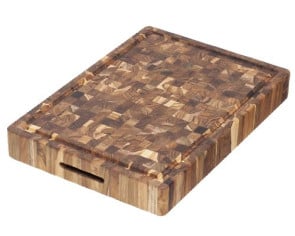
TeakHaus 20 x 14-inch Extra-Thick End Grain Butcher Block with Juice Canal
At 2.5 inches, this is the thickest board in the TeakHaus line, a true butcher block for cleaver work, barbecue and large roasts. The added depth keeps it solid under a heavy blade, and a deep juice canal on the carving face holds what runs from a brisket or a pork shoulder.The end-grain surface takes the impact of a cleaver splitting a chicken and closes up behind the cut. Turn the block over for a flat chopping face with no canal. Grips at each end give a secure hold when it has to move.It is a heavy board, best set in one spot near the stove or grill and left there. Measure the space before ordering, and plan to oil it often: end grain at this thickness takes a good deal of oil, and the care routine below matters more here than on a thin board.
Choosing a Butcher BlockFor a standard-thickness board without a canal, see the 20 x 15-inch End Grain Butcher Block. For more surface with a canal, see the 24 x 18-inch End Grain Butcher Block with Juice Canal. Learn More$180.00 -

TeakHaus 16 x 12-inch End Grain Butcher Block with Juice Canal
End grain is usually sold in large, heavy blocks. The 16 x 12-inch TeakHaus butcher block brings it to a size that fits a small counter and a standard sink. The fibers stand upright, so a knife edge passes between them rather than slicing across them, and the surface shows cuts less than an edge-grain board does.One face has a juice canal for a steak or a chicken breast; the other is flat for mincing garlic, shallots and herbs. A grip cut into the end makes the dense board easier to lift.End grain asks more of its owner than edge grain. It draws in oil readily and needs regular, generous coats to keep from drying out. Customers who return a TeakHaus board sometimes did not expect that upkeep, so the full care routine is spelled out in the details below.
Larger End Grain BoardsThe 20 x 15-inch End Grain Butcher Block and the 24 x 18-inch End Grain Butcher Block with Juice Canal add surface. The full range is compared below. Learn More -

TeakHaus 18-inch End Grain Butcher Block Round
Two inches thick and 18 inches across, the TeakHaus End Grain Butcher Block Round works as a heavy chopping block in the kitchen and a centerpiece on the table. It stays put under a cleaver, takes a pizza straight from the oven, and holds a full spread of cheese and charcuterie or a tray of sliced barbecue.The end-grain surface, with its fibers standing upright, closes up behind the knife, so the block keeps a smooth face through heavy use. The round shape lets guests reach it from every side.Two things are worth knowing in advance. End grain needs regular, generous oiling, and the block’s color and grain will be its own. A round block shows a great deal of grain pattern, and no two look alike.
Choosing a Round BoardFor a thinner edge-grain round with a juice groove and handle, see the TeakHaus 18-inch Traditional Round Carving Board. The rectangular butcher blocks are compared below. Learn More$170.00 -
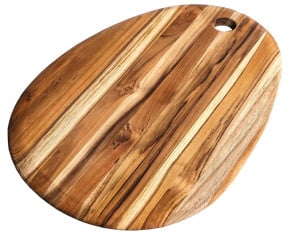
TeakHaus 18 x 12-inch Elegant Oval Board
The larger of the two TeakHaus Elegant Oval Boards holds a full cheese and charcuterie spread, a loaf of bread with its accompaniments, or a platter of appetizers for a party.It is slim and light for its size, easy to carry from the kitchen and to store in a cabinet. The edge-grain surface handles light cutting, so cheese can be sliced on the board where it is served.Teak’s color and grain vary from board to board, and a serving board puts that variation on display. The board you receive will not match the photograph exactly.
Choosing a SizeThe 16 x 11-inch Elegant Oval Board suits smaller gatherings and has a hanging hole. The 20 x 14-inch Marine Paddle Board adds a handle for carrying. Learn More$33.00 -
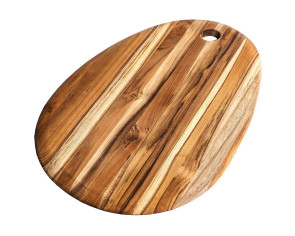
TeakHaus 16 x 11-inch Elegant Oval Board
An oval board sets a softer shape on the table than a rectangle. The 16 x 11-inch TeakHaus Elegant Oval Board suits a cheese board for a small gathering, bread service with butter or oil, or a round of light prep, and a hole at one end lets it hang on a hook between uses.The board is slim and easy to lift, carry and store. Its rounded edges feel comfortable in the hand and look finished on the table.Every teak board differs in color and grain, and that difference shows most on a board used for serving. If a matched look matters, the details below explain what to expect.
Choosing a SizeThe 18 x 12-inch Elegant Oval Board gives more room for a fuller spread. For a rectangular serving board, see the 16 x 11-inch Elegant Rounded Edge Board. Learn More$29.00 -

TeakHaus 16 x 11-inch Elegant Rounded Edge Serving Board
Softened corners and edges give the TeakHaus Elegant Rounded Edge board the finished look of a serving platter, while its edge-grain surface still handles light cutting. Slice a baguette on it, then carry it to the table with butter; set out cheese and crackers; cut fruit for a buffet.The board is thin and light, easy to carry and to store in a cabinet or on edge. Because it spends much of its time on the table, its appearance matters, and teak is a natural material. Color and grain vary from board to board, so the one you receive will be its own.
Choosing a Serving BoardFor an oval shape, see the 16 x 11-inch Elegant Oval Board or the 18 x 12-inch Elegant Oval Board. For slicing loaves, the 16 x 11-inch Essential Bread Board has crumb grooves. Learn More$31.00 -

TeakHaus 14 x 9.5-inch Edge Grain Cutting Board
The 14 x 9.5-inch TeakHaus board is sized for light prep for one or two: a shallot, a few cloves of garlic, an apple sliced for a snack. Thin and flat, it washes quickly in the sink and stores on edge in a cabinet.The edge-grain teak surface is gentle on a knife, and the board is light enough to serve on, so the same board can hold sliced fruit or cheese at the table. It also works as a second board alongside a larger one, keeping raw meat apart from produce.If this will be your main board, measure first and think about the work you do. A board that is too small is frustrating, and size is one of the reasons TeakHaus boards come back to us. Most full meals are easier on a larger board.
Other Thin BoardsFor something smaller, see the 12 x 8-inch Edge Grain Board. For a little more surface, see the 16 x 11-inch Elegant Rounded Edge Board. Learn More$26.50 -

TeakHaus 12 x 8-inch Edge Grain Cutting and Serving Board
A small board earns its place next to a large one. The 12 x 8-inch TeakHaus board is for slicing a lemon at the bar, cutting a few garnishes, or serving a wedge of cheese, and it keeps those small jobs off the main cutting board.It is a thin, flat edge-grain board with no canal, light enough to carry to the table with a snack on it and easy to wash and store on edge. Teak’s medium hardness is kind to a knife edge, so it suits a paring knife or a small utility knife.Thin boards are no exception to TeakHaus care. They need hand washing, prompt drying and regular oiling, and they show neglect sooner than a thick board.
Larger Thin BoardsThe 14 x 9.5-inch Edge Grain Board and the 16 x 11-inch Elegant Rounded Edge Board give more room for light prep and serving. Learn More -
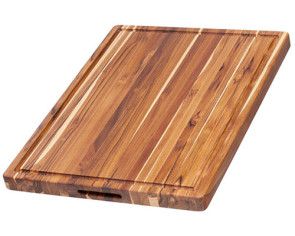
TeakHaus 20 x 15-inch Traditional Carving Board with Juice Canal
Slice a rested brisket or rib roast on a flat board and the juice runs onto the counter. This TeakHaus Traditional Carving Board has a canal around the edge of its carving face, so the juice stays on the board, where it can be spooned back over the meat or poured into the sauce. TeakHaus notes that Food & Wine included this board in a list of the seven best carving boards.On days with nothing to carve, turn it over. The reverse face is flat and gives a full prep surface for onions, herbs and bread. Grips cut into the ends make it easier to lift a heavy, wet board out of the sink.The 20 x 15-inch size handles a whole chicken, a pork shoulder or a small turkey and still fits a standard counter. If you are deciding between this and the 24 x 18-inch board, measure the counter and the sink first. One reason customers return a TeakHaus board is that it turned out larger than they expected.
Choosing a Carving BoardFor holiday turkeys and packer briskets, the 24 x 18-inch Traditional Carving Board adds room. If you will rarely carve, the 20 x 15-inch Traditional Cutting Board is the same size with two flat faces. Learn More$120.00 -

TeakHaus 24 x 18-inch Traditional Carving Board with Juice Canal
A holiday turkey, a standing rib roast or a packer brisket needs a board with room to rest the meat and a canal that holds what runs off it. The 24 x 18-inch TeakHaus Traditional Carving Board is the largest carving board in the line, with a canal on one face and a flat prep surface on the other.Carve on the canal side and the juices stay on the board for the gravy. Through the rest of the year, the flat side serves for batch prep and family-style platters. The board’s weight holds it steady while you carve, and grips cut into the ends make it possible to turn and carry.Before ordering, measure the counter and the sink. A board this size is too large for many sinks and needs a deep counter, and size is one of the reasons a TeakHaus board is returned. If space is limited, the 20 x 15-inch carving board handles most roasts.
Choosing a Carving BoardThe 20 x 15-inch Traditional Carving Board is easier to store and wash. The 24 x 18-inch Traditional Cutting Board is the same size with two flat faces. Learn More

