
You have no items in your shopping cart.
Victorinox Fibrox & Swiss Classic Knives
This collection features two distinct lines from Victorinox, each engineered for specific purposes. The Victorinox Fibrox Pro series is designed for professional use, featuring a patented, non-slip thermoplastic (TPE) handle for a secure, ergonomic grip. Its high-carbon stainless steel blades are durable, resilient, and can be easily maintained with any rod or sharpening system. The Fibrox Pro line is NSF certified for use in commercial operations of every size. The Victorinox Swiss Classic collection of paring knives are beloved by cooks, tradesmen, and first responders. They are agile, convenient and razor sharp. Swiss Classic Paring Knives are lightweight, versatile tools, that have a million and one uses in and out of the kitchen. Sharp enough for precise work, but tough enough to be relied upon in life and death situations, Swiss Classic paring knives are a trusted tool that no one should go without. Both the Fibrox Pro and Swiss Classic lines are crafted in Switzerland, offering exceptional durability and performance for culinary professionals and home cooks alike.
-
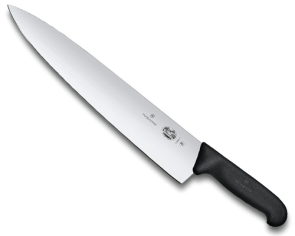
Victorinox Fibrox Pro 12-inch Chef’s Knife
Sized for commercial kitchens and serious cooks, the Victorinox Fibrox Pro 12-inch chef’s knife can do it all, cutting meat, vegetables and fruit in volume. The long blade covers more of the board with each stroke, which matters when the job is a case of onions or a crate of cabbage.The extra length gives long draw cuts through a boneless roast or a large melon, and the height of the blade keeps the knuckles clear when chopping. The stamped blade stays light for its size.A 12-inch knife needs a large, stable board. Use long, smooth strokes from heel to tip and keep the guiding hand well clear of the edge. On a small board, a 10-inch is easier to manage.For a shorter blade, see the Fibrox Pro 10-inch Chef’s Knife. The wood-handled version is the Hardwood 12-inch Chef’s Knife. Our Kitchen Knife Shapes guide compares chef’s knife lengths. Learn More$83.00 -

Victorinox Fibrox Pro 5-inch Serrated Mini Chef’s Knife
The Victorinox Fibrox Pro 5-inch serrated mini chef’s knife is narrow, similar to a utility knife, with an upward angle to the handle for better knuckle clearance. The blade is comparable to a salami knife.It is good for tomatoes and cheese, and for any time you want the long-lasting bite of a serrated edge. The serrations catch the skin of a tomato or the rind of a salami and saw through without crushing, and the angled handle keeps the fingers off the board.Draw the knife back and forth with light pressure and let the serrations do the work. Pressing down on soft food defeats the purpose of the teeth.For a straight edge in the same shape, see the Fibrox Pro 5-inch Mini Chef’s Knife. For more length, the Fibrox Pro 7.5-inch Serrated Chef’s Knife carries the same serrated edge. Our Kitchen Knife Shapes guide compares small knives. Learn More$40.00 -

Victorinox Fibrox Pro 7.5-inch Serrated Chef’s Knife
The Victorinox Fibrox Pro 7.5-inch serrated chef’s knife handles the jobs where a straight edge slips. It works as a deli or panini knife, cutting a pressed sandwich cleanly without crushing it, and its serrations cut through crusty breads and slice ripe tomatoes.It is also a good knife for meats, where the teeth grip a roast or a sausage and slice it evenly. The serrated edge keeps its bite for a long time, which makes it a low-maintenance knife for a busy line.Use a gentle sawing stroke and let the serrations do the work. On bread, start at the crust with the tip and draw the blade back and forth until it reaches the board.For a straight edge at this length, see the Fibrox Pro 7.5-inch Chef’s Knife. The Hardwood 7.5-inch Serrated Chef’s Knife is the wood-handled serrated version, and the 10-inch serrated has more reach. Our Kitchen Knife Shapes guide explains serrated shapes. Learn More$47.00 -
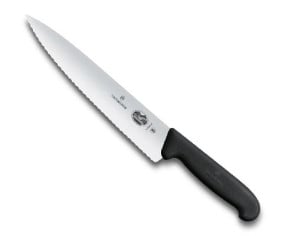
Victorinox Fibrox Pro 10-inch Serrated Chef’s Knife
The Victorinox Fibrox Pro 10-inch serrated chef’s knife is a multi-purpose knife that can be used as both a chef’s knife and a bread knife. Caterers and companies that process large volumes of fruit and melons use it for exactly that combination.The serrations cut through tough crusts and skins, and the 10-inch blade lets you cut large amounts of product at once. It delivers smooth, even cuts on roasts and other meats, and the wide blade sits steady on the board.For a melon, cut off both ends, stand the fruit on the board and follow the curve of the rind with long, sawing strokes. On bread, let the length of the blade do the work rather than pressing down.For the wood-handled version, see the Hardwood 10-inch Serrated Chef’s Knife. The 7.5-inch is the shorter serrated blade, and the Fibrox Pro 10-inch Chef’s Knife has a straight edge. Our Kitchen Knife Shapes guide explains serrated shapes. Learn More$75.00 -

Victorinox Fibrox Pro 8-inch Chef’s Knife, Blue Handle
This is the Victorinox Fibrox Pro 8-inch chef’s knife with a blue handle. The blue color lets a kitchen dedicate the knife to one food group under a HACCP color-coding plan, so it never crosses to another station.The knife uses Swiss martensitic steel known for its edge retention, toughness and ability to be resharpened. The best aspect of this knife is how well it responds to a honing or polishing steel. When the edge rolls over from continuous use, the burr can be easily aligned because the steel is slightly softer and tougher than other brands.The wide blade lifts and moves chopped food, and the 8-inch length cuts large amounts of product at a time. The handle’s contours fit the hand comfortably through a long prep shift.The same knife comes with a black or a green handle. Our Kitchen Knife Shapes guide compares the chef’s knife with other shapes. Learn More$62.00 -

Victorinox Fibrox Pro 8-inch Chef’s Knife
America’s Test Kitchen names the Victorinox Fibrox Pro 8-inch Chef’s Knife the winner of its chef’s knife review. It is a strong choice for cooks who want one dependable blade for nearly every job in the kitchen.The 8-inch blade curves gently toward the tip for a rocking motion through herbs and garlic, and the flatter heel chops onions and carrots cleanly. The blade is wide enough to give the knuckles clearance over the board and to scoop chopped food into a pan.Because the blade is stamped rather than forged, the knife is light and quick in the hand, with no bolster at the heel. The whole edge cuts and can be sharpened, and the steel comes back to a keen edge on a honing steel in a few strokes.For HACCP color coding, the same knife comes with a blue or a green handle. The wood-handled version is the Hardwood 8-inch Chef’s Knife. Our Kitchen Knife Shapes guide explains how the chef’s knife compares with a santoku. Learn More$62.00 -

Victorinox Fibrox Pro 8-inch Chef’s Knife, Green Handle
The green-handled Victorinox Fibrox Pro 8-inch chef’s knife suits kitchens that color-code their tools. A green handle can mark a knife for fruits and vegetables under a HACCP plan, keeping it away from raw meat and poultry.The knife uses Swiss martensitic steel known for its edge retention, toughness and ability to be resharpened. The best aspect of this knife is how well it responds to a honing or polishing steel. When the edge rolls over from continuous use, the burr can be easily aligned because the steel is slightly softer and tougher than other brands.Chop and slice fruits and vegetables with it. The wide blade lifts and moves chopped ingredients, and the 8-inch length handles large amounts of product at a time.The handle stands up to the hot washing and sanitizing a color-coded kitchen gives its tools between shifts.The same knife comes with a black or a blue handle. Our Kitchen Knife Shapes guide compares the chef’s knife with other shapes. Learn More$62.00 -

Victorinox Fibrox Pro 7-inch Granton Edge Santoku
A santoku has a flatter edge and a taller, blunter-tipped blade than a Western chef’s knife, which suits push cuts and straight up-and-down chopping. This 7-inch Victorinox santoku adds Granton hollows along both sides of the blade.The hollows reduce friction and help keep slices of potato, cucumber and other moist foods from sticking. The flat edge stays in contact with the board through each cut, so a stack of scallions or a row of carrot sticks separates completely.Slice with a forward push, or lift the blade and bring it straight down for each cut. The tall blade gives the knuckles clearance and scoops chopped food off the board.The 7-inch length suits small boards and smaller hands.For a wood handle, see the Hardwood 7-inch Granton Edge Santoku. If you rock through herbs, the Fibrox Pro 8-inch Chef’s Knife has more curve. Our Kitchen Knife Shapes guide compares the santoku with the chef’s knife. Learn More$62.00 -

Victorinox Fibrox Pro 8-inch Bread Knife
An 8-inch bread knife is the right size for sandwich loaves, baguettes and rolls on an everyday board. This Victorinox Fibrox Pro bread knife has pointed serrations that bite into a crust with very little downward pressure, so the loaf is cut rather than crushed.Start each slice at the far side of the crust with the tip, then saw back and forth with long, light strokes until the blade reaches the board. Let the teeth do the work; pressing down flattens a soft crumb.The same edge slices tomatoes and soft-skinned fruit cleanly, and it levels small cake layers and splits rolls for sandwiches. The textured handle stays secure when your hands are floured.For large rounds of sourdough, the Fibrox Pro 10.25-inch Bread Knife has more reach. The Fibrox Pro 7-inch Offset Bread Knife raises the handle for knuckle clearance, and the Hardwood 8-inch Bread Knife has a wood handle. The table in the Details compares all Victorinox bread knives. Learn More$47.00 -

Victorinox Fibrox Pro 6-inch Semi-Flexible Fillet Knife
This 6-inch Victorinox fillet knife has a semi-flexible blade that is a bit stronger than a fully flexible fillet knife. It is suitable for small to medium fresh and saltwater fish, such as trout, crappie, perch and small snapper, where a firm blade keeps the cut under control.The upswept tip mirrors the shape of a boning knife, which makes it just as useful for deboning poultry and frenching ribs. Run the tip along a rack of lamb to clean the bones, or use it to lift a chicken breast from the keel.To fillet, cut behind the gill plate down to the backbone, turn the blade toward the tail and let the slight flex ride over the rib bones. Finish by skinning from the tail end with the edge angled toward the skin.For a longer semi-flexible blade, see the Fibrox Pro 7-inch Semi-Flexible Fillet Knife. For more bend on thin fish, see the Fibrox Pro 7-inch Flexible Fillet Knife. The table in the Details compares the fillet knives. Learn More$32.00

