
You have no items in your shopping cart.
Best Sellers
-
Zwilling Four Star 8-inch Chef’s Knife
Four Star is the Zwilling line built around a molded, rivet-free handle. The polypropylene is molded to the tang with no rivets and no gaps, so there is nowhere for food or water to collect, and the pronounced bolster at the front of the handle guards the fingers. The 8-inch chef’s knife is the center of the series.Its curved edge rocks through herbs and garlic, the straighter heel chops onions and carrots, and the blade has enough height to keep the knuckles clear on the board. It is long enough for a whole cabbage and short enough for a shallot.Shoppers comparing Zwilling lines narrow it to Four Star or Pro. Four Star’s bolster gives a defined finger guard and its handle has no rivets; Pro’s curved bolster leaves the heel of the edge exposed for sharpening. The table in the Details compares the lines.For a shorter blade, see the Four Star 7-inch chef’s knife. Cooks who prefer flat push cuts can compare the Four Star 7-inch santoku. Our Kitchen Knife Shapes guide describes the chef’s knife and its alternatives. Learn MoreRegular Price: $149.95
Special Price $59.99
-

F. Dick 1905 AJAX 9-inch Butcher’s Chef’s Knife
The AJAX combines some of the heft of a cleaver with the shape of a chef’s knife, and it is made for heavy meat portioning and high-volume prep. It has a broad blade and a wide, sweeping belly that rocks through a brisket or a stack of cabbage.Weight is what sets it apart from a standard 8-inch chef’s knife. The thick spine and tall blade carry the cut through dense food with less effort from the wrist, and the height gives generous knuckle clearance. It is at home on a butcher’s block breaking down subprimals and in a kitchen chopping large volumes of vegetables.The weight also helps when cutting through winter squash.The AJAX has its own fitted 1905 Ajax sheath for carrying it safely. For lighter everyday work, the 1905 8-inch chef’s knife is quicker in the hand. A different take on the same idea is the Red Spirit AJAX 8-inch chef’s knife. Learn More$127.40 -

F. Dick Red Spirit Hektor 10-inch Granton Edge Scimitar
Named Hektor, this 10-inch Red Spirit scimitar trims fat and sinew, breaks down large cuts and portions steaks, and it slices roasts at the table as well. A granton edge along the blade keeps slices from clinging.Scimitars are a butcher’s tool, and many are made of soft steel that is quick to hone but dulls quickly. The Red Spirit steel should hold its edge longer between honings, which makes it a dependable blade for a long session at the board. The long, upswept curve rolls through a steak in one stroke and leaves a smooth cut face.At a cookout, it doubles as a slicer for tri-tip and smoked turkey breast.For plant and counter work, the ErgoGrip 10-inch scimitar is built around a butcher’s handle. The Hektor is also part of the Red Spirit Pit Master BBQ set, and the F. Dick Scimitar Knife Sheath protects the edge. Our knife shapes guide covers scimitars. Learn More$94.90 -

F. Dick Red Spirit AJAX 8-inch Chef’s Knife
F. Dick designed the AJAX shape to bridge the gap between a cleaver and a chef’s knife, and the Red Spirit AJAX brings that idea to barbecue pitmasters and butchers. Its curved belly and substantial weight carry it through smoked brisket, pork shoulder and heavy prep.A tall, weighty blade does more of the work than a standard chef’s knife, which helps with thick bark and connective tissue. The curve lets the cook rock through a stack of onions or herbs, and the height keeps the knuckles well above the board. Despite its size, the round Red Spirit handle keeps it easy to maneuver.Its height also gives the guiding hand a flat face to rest against when slicing through a thick flat of brisket.The AJAX has its own belt-carry cover, the F. Dick blade cover for the Red Spirit AJAX. A heavier forged version is the 1905 AJAX butcher’s chef’s knife, and the AJAX also comes in the Red Spirit Pit Master BBQ set. Learn More$87.75 -
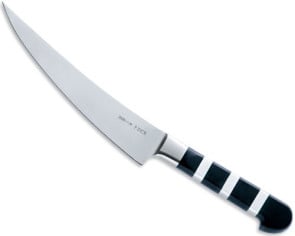
F. Dick 1905 7-inch Carving and Boning Knife
One of our team had never seen this shape in German steel before, counts this 7-inch 1905 knife among their own top picks, and calls it one of the best they have used for removing silver skin from tenderloins and veal legs. It trims fat from the back of ribs well and works as a boning knife for most jobs.The blade sits between a boning knife and a carving knife. It is long enough to follow a tenderloin in one pass and pointed enough to work around bones. The same member of staff finds the shape easier to resharpen than a typical boning knife, which matters on a knife used every day.The 7-inch length is also comfortable for trimming lamb racks and pork loins.For poultry joints and closer boning, the 1905 6-inch flexible boning knife bends further. Carving cooked meat suits the 1905 8-inch carving knife, and the 1905 7-inch fillet knife is shaped for fish. The comparison table below lists the 1905 slicing knives. Learn More$88.40 -

F. Dick 1905 7-inch Granton Edge Santoku
Santoku means “three virtues” in Japanese, for slicing, dicing and mincing, and this 1905 santoku covers that everyday work on meat and vegetables. Its granton edge, a row of hollow scallops along the blade, keeps slices of potato and cucumber from sticking.A santoku has a thin blade, a flatter edge than a chef’s knife and a rounded tip, so it works best with a straight push or a forward slice. The scallops put small pockets of air between the blade and wet or starchy food, which lets each slice fall away instead of riding up the knife. The thin profile also makes it capable of decorative cuts.Cooks who prefer a rocking cut should look at the 1905 8-inch chef’s knife. A smaller granton blade is the Premier Plus 5.5-inch granton edge santoku, and the 1778 santoku offers a much harder edge. See our knife shapes guide for santoku and chef’s knife profiles. Learn More$107.25 -

Mercer Renaissance 8-inch Chef’s Knife
The Renaissance 8-inch Chef’s Knife is Mercer’s forged knife with a traditional look: a triple-riveted Delrin handle and a full tang running through it. For a home cook who wants the build of a German forged knife without a premium-brand price, or a student assembling a first serious kit, it is a straightforward choice.Mercer shortens the bolster on the Renaissance line, so the edge runs to the heel and the whole blade can be sharpened. The 8-inch length dices onions, slices proteins and rocks through herbs, and it is the size most cutting boards and knife rolls are built around.
Renaissance or Genesis?Both lines are forged from the same high-carbon German steel at the same hardness. The difference is the handle. The Genesis 8-inch has a soft Santoprene grip that holds when wet; the Renaissance has a harder riveted handle with a classic shape. For more reach, see the Renaissance 9-inch and 10-inch Chef’s Knives. Learn More$71.20 -

Mercer Genesis 8-inch Short Bolster Chef’s Knife
The 8-inch Genesis chef’s knife is the forged Mercer knife for cooks who want the weight and balance of a German-style blade with a soft, non-slip handle. Mercer shortens the bolster on this model, so the edge runs all the way to the heel and the whole blade can be sharpened, a detail that matters after a few years of honing and sharpening.The Santoprene handle grips securely even when the hand is wet or greasy, which suits a busy professional station as well as a home kitchen. The blade has enough curve to rock through herbs and garlic and enough length to dice an onion or break down a chicken.
Choosing a Size and LineFor more reach, see the Genesis 9-inch and 10-inch Short Bolster Chef’s Knives. The Renaissance 8-inch Chef’s Knife is the forged alternative with a riveted handle, and the Millennia 8-inch Chef’s Knife is the lighter stamped option. Our kitchen knife shapes guide explains how chef’s knife lengths compare. Learn More$56.70 -

F. Dick Premier Plus 8-inch Chef’s Knife
Cooks reach for an 8-inch chef’s knife for almost every task in the kitchen, so comfort over long periods matters as much as the edge. The Premier Plus 8-inch is well balanced, and that balance is what you notice first when you use it for an hour of prep. In our view, no better chef’s knife is made in Germany than the Premier Plus.The bolster is smoothed where the thumb and forefinger rest, so a choke grip on the blade stays comfortable. The curved edge rocks through herbs and onions, and the tip handles finer work such as scoring and trimming. The steel gives a lasting edge and still hones back quickly on a steel.It is also the knife to choose first when building a kit.For cooks with smaller hands, the Premier Plus 6-inch chef’s knife is easier to control, and taller cooks may prefer the 9-inch or 10-inch versions. The 1905 8-inch chef’s knife has a classic ringed handle at the same length. Our knife shapes guide covers chef’s knives. Learn More$97.50 -
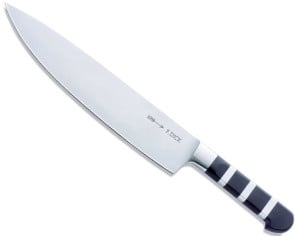
F. Dick 1905 10-inch Chef’s Knife
Professional cooks in high-volume kitchens buy this 10-inch 1905 chef’s knife to prep large amounts of vegetables without tiring their hand. The longer blade fits more food under it with each stroke and reaches across a whole cabbage or a large melon.A long, heavy blade can feel tip-heavy, and this one keeps good balance for its size, which makes it comfortable through a long prep list. The series responds well to regular honing, so a few strokes on a steel at the start of each shift keep the edge working.The long blade also slices roasts and large fish fillets neatly.If 10 inches feels like too much knife, the 1905 8-inch chef’s knife is the all-round size. For heavy portioning of meat, the 1905 AJAX butcher’s chef’s knife carries more weight. The Premier Plus 10-inch chef’s knife is the same length with a modern handle. Our kitchen knife shapes guide covers chef’s knife lengths. Learn More$128.05


