
You have no items in your shopping cart.
Deba
De(Fat) Ba(Knife)
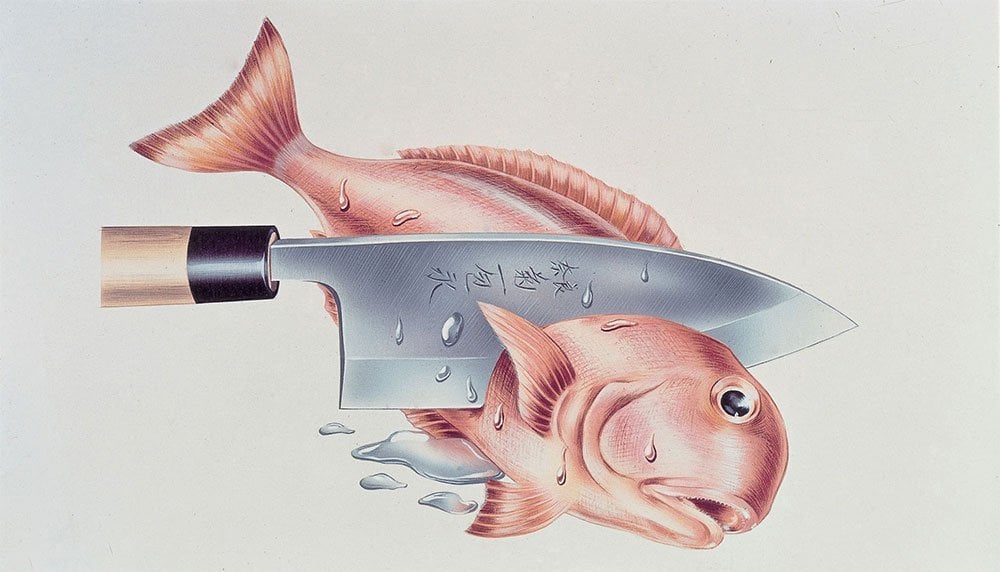
This traditional Japanese knife shape is ideal for butchering and filleting fish as its unique shape cuts cleanly and precisely preserving delicate flesh. Deba knives can also be used on poultry, vegetables, and meat although we do not recommend using it for breaking dense bones as the ultra-hard Japanese steel is subject to chipping and pitting. Keep in mind that Deba knives are typically single sided, but some more westernized debas are made with a double-bevel meaning that both sides are angled. Note that the term yo-deba may be used by certain makers to refer to a knife that is particularly thick, but this definition maintains no correlation to the standard deba characteristics.
-

Minonokuni Take 5.3-inch (135mm) Ko-Deba
Ko-deba means small deba. At 135mm, this Take knife is built for fish that a full-size deba would overpower. Horse mackerel, sardines, smelt and small trout are its work. On fish this size, the work is mostly filleting rather than cleaving.The blade tapers from a thick spine near the handle to a fine tip. That taper lets the cook open a small fish along the belly, run the tip down each side of the backbone and lift the fillets with very little flesh left on the frame. It is a light knife, so we do not recommend it for splitting heads or cutting through heavy collars. For that work, use the Take 150mm deba or a larger size.
Why TakeTake sits in the middle of the three standard Minonokuni lines. Its white steel is adequate for professional use but less brittle than the blue steel of the Matsu line, which makes it a sound choice for a cook who is not yet an expert with single-bevel knives. The knife shapes guide shows how the deba compares with Western fillet knives.A cook who processes small fish for a restaurant, or an angler who cleans a cooler of panfish at home, will find the ko-deba quicker to handle than any larger size. Learn More$180.00 -

Minonokuni Take 5.9-inch (150mm) Deba
A 150mm deba covers most fish a home cook will bring home whole, from trout and mackerel to a small snapper, and it is small enough for a standard home cutting board. The Take version is a sound first deba for a cook who wants to learn traditional fish butchery.The thick, heavy blade does the forceful work. Cut through the head and collar with the heel, then switch to the tip to follow the backbone and separate the fillets cleanly from the bone. The single bevel helps the edge ride flat along the frame, so less flesh is left behind.
A Steel That Tolerates LearningWe describe Take as the sweet spot of the Minonokuni range. Its white steel holds a fine edge well enough for professional kitchens, and it is less brittle than the blue steel used in the Matsu deba. That margin matters while a cook is learning how hard to lean on the heel.Other SizesSmaller fish are quicker work with the Take 135mm ko-deba. The Take 165mm deba adds weight for larger fish and for poultry. Left-handed cooks can order the Take 150mm left-handed deba, which we keep in stock. Read about the deba and its uses in our guide to kitchen knife shapes. Learn More$190.00 -

Minonokuni Sakura Damascus 5.9-inch (150mm) Deba
The Sakura Damascus deba is a hand-forged, water-quenched craftsman’s piece for breaking down whole fish and splitting lobster. At 150mm, it suits small and medium fish. Its rippled Damascus jacket makes it a knife people notice on the board.Use the heel for heads and lobster shells, and the forward edge to follow the backbone for clean fillets. The single bevel keeps the edge close to the bone. As with any deba, avoid twisting the blade in a joint or using it on frozen food.
A Specialty KnifeSakura is one of our specialty lines. It is technically more premium than our standard lines, but not necessarily right for every user. The blade is blue steel, which holds an edge a long time but is delicate, and its single-bevel edge is very thin by nature. A cook new to the deba will be better served by the Take 150mm deba or the Ume 150mm deba.Search results for “Sakura knives” also turn up an unrelated company. This knife is made by Minonokuni and sold by Knife Merchant. For more on the deba, see our guide to kitchen knife shapes. Learn More -

Minonokuni Take 5.9-inch (150mm) Left-Handed Deba
A deba ground for the left hand puts the bevel on the left face of the blade, so the edge follows the backbone when a left-handed cook fillets a fish. This Take 150mm deba is that mirror image, and we keep it in stock.The size suits trout, mackerel, small bream and similar fish, and it handles poultry jointing as well. Start at the head with the heavy heel, then work along the frame with the tip. A right-handed deba used in the left hand fights the cook on every pass and leaves meat on the bone, which is why the grind matters more on this knife than on a double-bevel blade.
Choosing TakeThe Take line is our recommendation for a cook who is new to single-bevel knives. Its white steel is ready for professional use, yet it is less brittle than blue steel and will tolerate the occasional misjudged cut while technique develops. A Ume 165mm left-handed deba is the more forgiving option for a cook who expects to spend time learning to sharpen.For larger fish, the Take 165mm left-handed deba and Take 180mm left-handed deba add length and weight. The right-handed version is the Take 150mm deba. The knife shapes guide has more on the deba. Learn More$260.00 -

Minonokuni Ume 5.9-inch (150mm) Deba
For a cook who has never owned a deba, the Ume 150mm is where we suggest starting. The size suits trout, mackerel and other fish that fit on a home cutting board, and the Ume line is the most forgiving of the three standard Minonokuni lines.The deba is a single-bevel knife with a thick, heavy spine. The heel cuts through heads and collars, and the thinner forward edge glides along the backbone to lift each fillet. Learning that motion takes a few fish, and a forgiving edge makes the learning easier.
Built for LearningUme uses a softer carbon steel than Take or Matsu. It is less likely to chip when a cut goes wrong, and it is the best of the three lines for learning to sharpen a single bevel. A Minonokuni 1000 grit waterstone is the stone to begin with. As skills grow, the Take 150mm deba in white steel is the natural next knife.For bigger fish and poultry, see the Ume 165mm deba. Our kitchen knife shapes guide shows how the deba is used alongside the yanagiba and usuba. Learn More -

Masahiro Traditional 5.3 in. (135mm) Deba
Master Precision Fish Processing with a Traditional Single-Bevel Edge The Masahiro Traditional 135mm Deba is a specialized instrument designed for the rigorous demands of fish and poultry butchery. Unlike Western fillet knives that rely on flexibility, the Deba utilizes a thick, heavy spine and a rigid profile to act as a precision cleaver. This weight is essential for processing through heads and small bones without damaging the edge, making it an indispensable tool for chefs working with whole proteins. At the heart of this knife is Yellow Paper Steel (Kigami), a high-carbon alloy prized for its purity and ease of maintenance. With a Rockwell Hardness of 60, it provides a stable, long-lasting edge that can be restored quickly on a whetstone—a critical factor in high-volume professional environments. The blade features a traditional Urasuki (concave) grind on the back side, which creates an air pocket during the cut to prevent the protein from sticking, ensuring clean, fluid separation. Built for durability and balance, the 135mm length offers superior maneuverability for small to medium-sized fish, such as sea bass or mackerel. The handle is crafted from untreated Japanese Magnolia (Ho) wood, offering a natural, slip-resistant grip that improves with use. The plastic ferrule ensures a tight, hygienic seal between the blade and the handle. Please note that as a carbon steel knife, this tool requires immediate drying after use to prevent oxidation and maintain its metallurgical integrity. Learn More$99.00

