
You have no items in your shopping cart.
Také Edition
Také (translated:bamboo, Pr: Tah-kay) series knives are made of Shirogami #2 white steel. Ferrules are buffalo horn with an oiled magnolia wood handle. A bit softer than aogami, many sushi chefs prefer this steel type as it is easier to sharpen and more affordable. Také knives are ideal for frequent home users and professionals shopping for value.
-

Minonokuni Take 7.1-inch (180mm) Left-Handed Usuba
Katsuramuki and fine julienne depend on the bevel being on the correct side of the blade. For a left-handed cook, this Take 180mm usuba puts it on the left face, so a daikon unrolls into an even sheet and each push cut falls straight.The usuba is a push-cutting knife. Its flat edge meets the board along the full length, so slices of cucumber or carrot separate completely without rocking. That flat profile also lets the cook cut vegetables into the very fine needle threads used for garnish.
A Practical First UsubaWe stock left-handed knives in all three standard lines. Take is the middle line, with white steel that is ready for professional work and less brittle than blue steel. It suits a left-handed cook who wants to learn the usuba without the more delicate edge of Matsu. The Ume 180mm left-handed usuba is the most forgiving and easiest to sharpen.The right-handed version is the Take 180mm usuba. For decorative work with a point, see the Take 180mm left-handed kama-usuba. The knife shapes guide describes the usuba. Learn More -

Minonokuni Take 8.3-inch (210mm) Usuba
The 210mm usuba is the size for steady vegetable prep. Its length takes a long daikon through katsuramuki without the sheet running off the blade, and its tall, flat face carries sliced vegetables neatly from the board to the pan.This is a Kanto-style usuba, square at the tip. Its single bevel and flat edge give the control needed for paper-thin sheets, delicate garnishes and precise cuts, and the blade passes through vegetables without cracking or bruising them. Keep the motion a straight push. A rocking cut wears the edge and leaves slices joined at the bottom.
Which Usuba to ChooseTake is the sweet spot of the three standard Minonokuni lines. Its white steel holds an edge well enough for professional use and is less brittle than blue steel, so it suits cooks who are confident with knives but newer to single-bevel blades. The Matsu 210mm usuba is the blue steel option, and the Ume 210mm usuba is the most forgiving.For a shorter knife, see the Take 180mm usuba. The Take 210mm kama-usuba is the pointed Kansai form. The knife shapes guide covers both shapes. Learn More$245.00 -
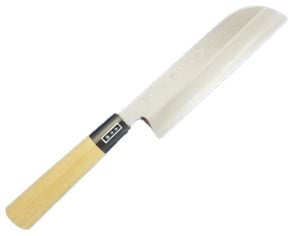
Minonokuni Take 7.1-inch (180mm) Kama-Usuba
With its sickle-shaped tip, the kama-usuba does what the square Kanto usuba cannot. The tip reaches into a vegetable for detailed carving and scoring, while the long, flat edge still handles push cuts and katsuramuki. This Kansai-style knife is sometimes called a kamagata usuba.At 180mm, it is easy to control on a home board and light enough for quick, repeated cuts without tiring the hand. Use the edge for slicing scallions, cucumbers and radishes, then turn to the tip to cut a crosshatch into a shiitake cap or shape a carrot into flowers for a garnish.
Take SteelWhite steel takes a very keen edge, and in the Take line it is good enough for professional use while staying less brittle than blue steel. The thin tip of a kama-usuba benefits from that extra tolerance. Experienced cooks can choose the Matsu 180mm kama-usuba, and beginners the Ume 180mm kama-usuba.The Take 210mm kama-usuba adds length. Left-handed cooks should see the Take 180mm left-handed kama-usuba. The kitchen knife shapes guide explains the usuba family. Learn More -

Minonokuni Take 7.1-inch (180mm) Left-Handed Kama-Usuba
Left-handed cooks who want a traditional Japanese vegetable knife with a point can choose this Take kama-usuba. The single bevel is on the left face, and the blade has the curved, pointed tip of the Kansai style, so the knife handles everyday slicing as well as fine detail work.At 180mm, the blade is easy to manoeuvre and small enough to tap-chop quickly without fatigue. The flat edge meets the board along its length for clean push cuts, and the tip can score and carve garnishes.
What to ExpectThe Take line uses white steel. It takes a very sharp edge, and it is less brittle than blue steel, which is why we recommend Take to cooks who are not yet experts in single-bevel knives. The Ume 180mm left-handed kama-usuba is a more forgiving introduction.For straight-edged vegetable work, see the Take 180mm left-handed usuba. The right-handed version is the Take 180mm kama-usuba. Read about the shape in our knife shapes guide. Learn More$265.00 -

Minonokuni Take 8.3-inch (210mm) Kama-Usuba
This 210mm kama-usuba gives a professional the length to work through large vegetables and the tip to finish them with detailed cuts. The Kansai, or Osaka, style blade curves down to a point, which makes it suited to decorative cutting as well as everyday slicing.Use the full length for push cuts on daikon and squash, and for katsuramuki on longer pieces. The tip handles scoring and carving. Because the blade is heavier than the 180mm, it moves through dense roots with less pressure from the cook.
Take Among the Three LinesWe call Take the sweet spot. Its white steel is good enough for professional use but less brittle than blue steel, which helps protect the thin tip from chipping during detail work. Cooks experienced with single-bevel knives can step up to the Matsu 210mm kama-usuba, and those learning to sharpen can start with the Ume 210mm kama-usuba.The Take 180mm kama-usuba is the lighter option, and the square-tipped Take 210mm usuba suits a cook who mostly cuts sheets and julienne. The knife shapes guide compares them. Learn More$245.00