You have no items in your shopping cart.
Minonokuni Knives
Authentic Japanese blades (hochoes) hand-forged using traditional Japanese methods of old-world craftsmanship; Minonokuni knives are part of a project designed to preserve and protect the master/apprentice relationship. Even as demand for Japanese knives has grown; the skilled masters are aging, and it has been difficult to keep apprentices. While the methods of construction mastered over the centuries have changed very little, the methods of bringing the pieces to market is dramatically different. Then Knife Merchant was asked to assist by bringing knives from various masters in different types of material to market, so that the craftsmen can concentrate on their work and keep the apprentice fully employed, without the burden of stopping production to make sales. Minonokuni is the name of a prefecture (state) that existed in the days of the Samurai. It encompassed a wide area including Seki-City and Sakai, which are the areas of Japan in which our craftsmen are making these blades. This is why we have chosen this as a brand name to represent these knives. You will find the quality to be far superior to comparable material types. When the knife maker has his name on the blade (instead of working for a company), there is greater pride and care taken in little details that make a great difference in final quality. Minonokuni knives are now available in a variety of grades to suit every need and price point.
-
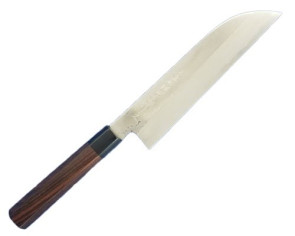
Minonokuni Sakura Damascus 8.3-inch (210mm) Kama-Usuba
The kama-usuba’s pointed, sickle-shaped tip sets it apart from the blunt-tipped Kanto usuba. This 210mm Sakura version gives the agility for decorative cuts (kazari-giri) and detailed vegetable work, along with the length for katsuramuki and long push cuts.The single-bevel edge allows very thin, clean slices that leave vegetables crisp rather than crushed. Use the flat section for sheets and julienne, and the tip for carving garnishes.
Who It SuitsSakura is a specialty line, technically more premium than Matsu, Take or Ume but not necessarily the right knife for every cook. Its blue steel core holds the edge a long time, and its thin tip is the most delicate part of the knife. It belongs with a cook experienced in single-bevel work. For a less brittle edge, compare the Take 210mm kama-usuba; for stainless, the Gin-San 210mm kama-usuba.The square-tipped Sakura Damascus 210mm usuba suits a cook who mostly cuts sheets and julienne. The knife shapes guide explains both forms. Learn More$660.00 -

Minonokuni Sakura Damascus 8.3-inch (210mm) Usuba
The Sakura Damascus usuba is a Kanto-style vegetable knife with a square tip and a long, flat edge. At 210mm, it handles long daikon for katsuramuki and whole heads of cabbage, and it slices vegetables into precise, even pieces with straight push cuts.The single bevel is what makes the paper-thin sheets of katsuramuki possible. Turn the peeled daikon against a still blade, keeping the edge parallel to the axis of the root, and a continuous sheet unrolls. Stack the sheets and push-cut them into fine threads for garnish.
Specialty LineSakura is technically more premium than our standard lines, but it is not necessarily the right usuba for every cook. Its blue steel core holds an edge for a long time, though the thin edge is delicate. Cooks newer to the usuba may prefer the Take 210mm usuba or the Ume 210mm usuba, and the plain blue steel option is the Matsu 210mm usuba.For a pointed tip, see the Sakura Damascus 210mm kama-usuba. The knife shapes guide compares the usuba with the nakiri. Learn More$660.00 -

Minonokuni Gin-San 8.3-inch (210mm) Kama-Usuba
For a professional who preps vegetables in quantity and wants a single-bevel knife that will not rust at a wet station, the 210mm Gin-San kama-usuba is the one to consider. The length handles long daikon and whole heads of cabbage, and the Kansai-style pointed tip handles detail work.Push straight down and forward for clean, separated slices, and use katsuramuki to turn daikon into long sheets for garnish. The tip carves vegetable flowers and scores the skin of eggplant. Because the blade is thin and hard, keep it away from frozen food and hard rinds.
Gin-san or Carbon?Gin-san is a specialty line. It sharpens with a feel close to carbon steel but resists rust, so it asks for far less upkeep. That makes it a practical choice for a busy kitchen, though not necessarily the right knife for every cook. In carbon steel, the Take 210mm kama-usuba is the sweet spot of our standard lines, and the Matsu 210mm kama-usuba suits experienced hands.The shorter Gin-San 180mm kama-usuba is easier on a home board. See the kitchen knife shapes guide for the usuba family. Learn More -
Minonokuni Gin-San 7.1-inch (180mm) Kama-Usuba
This Gin-San kamagata usuba is hand-forged to cut vegetables either in the hand or on the board. Its pronounced tip, which the square Kanto usuba lacks, gives precise control for decorative cuts, while the flat length of the edge handles push cuts and katsuramuki.At 180mm, the blade is long enough for nearly any fruit or vegetable without being heavy or cumbersome. Use the edge to slice daikon and cucumber into sheets or fine threads, and the tip to carve garnishes, score mushroom caps or trim a turned carrot.
A Stainless Single BevelGin-san is a stainless steel that can still be hammer-forged the traditional way. It asks far less care than a carbon knife, which makes it a good choice for a cook who prefers a low-maintenance blade. As a specialty line, it is technically more premium than our standard lines but not the right knife for every cook. A cook learning the shape may be better served by the Ume 180mm kama-usuba.For a longer blade, see the Gin-San 210mm kama-usuba. The knife shapes guide explains the square and pointed usuba. Learn MoreRegular Price: $330.00
Special Price $280.00
-
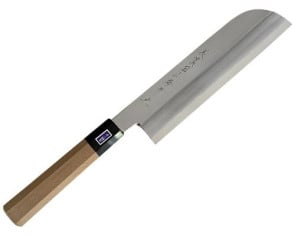
Minonokuni Matsu 8.3-inch (210mm) Kama-Usuba
In a professional kitchen, the 210mm kama-usuba can serve as the main vegetable knife. The length handles long daikon and large heads of cabbage, and the pointed tip handles the detail work that a square-tipped usuba cannot, from cutting decorative shapes to scoring the skin of eggplant.The weight is noticeably greater than the Matsu 180mm kama-usuba, which helps when pushing through dense roots such as burdock and kabocha. On softer produce, let the edge do the cutting and use only a light push.
Blue Steel, ConsideredThe Matsu line is forged in blue steel, so the edge stays keen through hours of prep. That hardness makes the edge more brittle, and the thin tip of a kama-usuba is the most exposed part of the blade. We recommend it for experienced cooks. The Take 210mm kama-usuba in white steel offers the same shape with an edge that tolerates more.Cooks who mostly cut sheets and julienne may prefer the square-tipped Matsu 210mm usuba. The knife shapes guide covers the usuba family.Because each Matsu knife is forged and finished by hand, small marks from the hammer and variations in the finish are expected and do not affect the edge. Learn More$400.00 -

Minonokuni Matsu 7.1-inch (180mm) Kama-Usuba
The kama-usuba is the Osaka, or Kansai, form of the usuba. It keeps the flat edge and single bevel for vegetable work, but the spine curves down to a pointed tip, which the square Kanto usuba lacks. That tip is what makes the knife useful for decorative cuts and fine garnish work.At 180mm, this Matsu is a manageable size on a home board. Use the length of the edge for push-cut slicing and katsuramuki, then switch to the tip to carve vegetable flowers, cut a pattern into shiitake caps, or trim a turned vegetable. Because the tip is thin and hard, keep it to vegetables and away from frozen food.
Selecting the LineThe blue steel in the Matsu line keeps a very fine edge the longest of the three standard Minonokuni lines. It is also the most delicate, so we suggest it for a cook who already works with single-bevel knives. The Take 180mm kama-usuba is less brittle and a better first knife, and the Ume 180mm kama-usuba is the most forgiving.For more length, see the Matsu 210mm kama-usuba. The square-tipped Matsu 180mm usuba suits cooks who do mostly sheets and julienne. The knife shapes guide explains both forms. Learn More$330.00 -

Minonokuni Matsu 8.3-inch (210mm) Usuba
For a cook who cuts vegetables all day, the 210mm usuba earns its place through length. A long daikon can be turned through katsuramuki without the sheet running off the end of the blade, and a full head of napa cabbage or a bunch of scallions can be cut in fewer strokes.The blade is square-tipped in the Kanto style, with a flat edge that meets the board along its whole length. Cutting is a straight push down and forward. Rocking the knife, as with a Western chef’s knife, wears the edge and makes uneven cuts.
Who the Matsu Usuba SuitsThe Matsu line is forged from blue steel. Its edge stays keen through long vegetable prep, but it is the most delicate steel in the range, and a careless twist or a stray bone will chip it. It belongs with a cook who already sharpens single-bevel knives. The Take 210mm usuba is the practical alternative for a cook still learning, with an edge that is less brittle.The Matsu 180mm usuba is shorter and lighter for home boards. For carved garnishes and work that needs a point, the Matsu 210mm kama-usuba is the Kansai-style alternative. The knife shapes guide has more on usuba and nakiri knives. Learn More$400.00 -

Minonokuni Matsu 7.1-inch (180mm) Usuba
The usuba is the Japanese vegetable knife, and the 180mm Matsu is the size for a home kitchen or a cook new to the shape. Its tall, flat blade meets the board along the full length of the edge, so a straight push cut separates each slice of cucumber or carrot completely.The single bevel gives the usuba its main job, katsuramuki. A peeled length of daikon is turned against the edge to unroll a continuous, paper-thin sheet, which is then cut into fine threads for garnish or rolled for decoration. The flat back keeps those sheets even in thickness.
Matsu, Take or Ume?All three lines make this shape in the same sizes. Matsu uses blue steel, which holds the finest edge longest and suits a cook already used to single-bevel knives. The Take 180mm usuba is less brittle, so it is a better choice for a cook learning the shape. The Ume 180mm usuba is the most forgiving and the easiest of the three to learn to sharpen.For long daikon and whole heads of cabbage, the Matsu 210mm usuba gives more length. A cook who wants a point for decorative cuts should look at the Matsu 180mm kama-usuba. The kitchen knife shapes guide compares the usuba with the nakiri, its double-bevel cousin. Learn More$330.00 -

Minonokuni Take 8.3-inch (210mm) Kama-Usuba
This 210mm kama-usuba gives a professional the length to work through large vegetables and the tip to finish them with detailed cuts. The Kansai, or Osaka, style blade curves down to a point, which makes it suited to decorative cutting as well as everyday slicing.Use the full length for push cuts on daikon and squash, and for katsuramuki on longer pieces. The tip handles scoring and carving. Because the blade is heavier than the 180mm, it moves through dense roots with less pressure from the cook.
Take Among the Three LinesWe call Take the sweet spot. Its white steel is good enough for professional use but less brittle than blue steel, which helps protect the thin tip from chipping during detail work. Cooks experienced with single-bevel knives can step up to the Matsu 210mm kama-usuba, and those learning to sharpen can start with the Ume 210mm kama-usuba.The Take 180mm kama-usuba is the lighter option, and the square-tipped Take 210mm usuba suits a cook who mostly cuts sheets and julienne. The knife shapes guide compares them. Learn More$245.00 -

Minonokuni Take 7.1-inch (180mm) Left-Handed Kama-Usuba
Left-handed cooks who want a traditional Japanese vegetable knife with a point can choose this Take kama-usuba. The single bevel is on the left face, and the blade has the curved, pointed tip of the Kansai style, so the knife handles everyday slicing as well as fine detail work.At 180mm, the blade is easy to manoeuvre and small enough to tap-chop quickly without fatigue. The flat edge meets the board along its length for clean push cuts, and the tip can score and carve garnishes.
What to ExpectThe Take line uses white steel. It takes a very sharp edge, and it is less brittle than blue steel, which is why we recommend Take to cooks who are not yet experts in single-bevel knives. The Ume 180mm left-handed kama-usuba is a more forgiving introduction.For straight-edged vegetable work, see the Take 180mm left-handed usuba. The right-handed version is the Take 180mm kama-usuba. Read about the shape in our knife shapes guide. Learn More$265.00