You have no items in your shopping cart.
Minonokuni Knives
Authentic Japanese blades (hochoes) hand-forged using traditional Japanese methods of old-world craftsmanship; Minonokuni knives are part of a project designed to preserve and protect the master/apprentice relationship. Even as demand for Japanese knives has grown; the skilled masters are aging, and it has been difficult to keep apprentices. While the methods of construction mastered over the centuries have changed very little, the methods of bringing the pieces to market is dramatically different. Then Knife Merchant was asked to assist by bringing knives from various masters in different types of material to market, so that the craftsmen can concentrate on their work and keep the apprentice fully employed, without the burden of stopping production to make sales. Minonokuni is the name of a prefecture (state) that existed in the days of the Samurai. It encompassed a wide area including Seki-City and Sakai, which are the areas of Japan in which our craftsmen are making these blades. This is why we have chosen this as a brand name to represent these knives. You will find the quality to be far superior to comparable material types. When the knife maker has his name on the blade (instead of working for a company), there is greater pride and care taken in little details that make a great difference in final quality. Minonokuni knives are now available in a variety of grades to suit every need and price point.
-
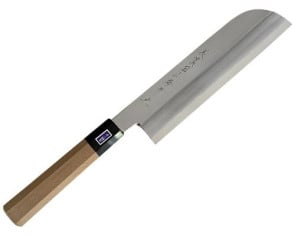
Minonokuni Matsu 8.3-inch (210mm) Kama-Usuba
In a professional kitchen, the 210mm kama-usuba can serve as the main vegetable knife. The length handles long daikon and large heads of cabbage, and the pointed tip handles the detail work that a square-tipped usuba cannot, from cutting decorative shapes to scoring the skin of eggplant.The weight is noticeably greater than the Matsu 180mm kama-usuba, which helps when pushing through dense roots such as burdock and kabocha. On softer produce, let the edge do the cutting and use only a light push.
Blue Steel, ConsideredThe Matsu line is forged in blue steel, so the edge stays keen through hours of prep. That hardness makes the edge more brittle, and the thin tip of a kama-usuba is the most exposed part of the blade. We recommend it for experienced cooks. The Take 210mm kama-usuba in white steel offers the same shape with an edge that tolerates more.Cooks who mostly cut sheets and julienne may prefer the square-tipped Matsu 210mm usuba. The knife shapes guide covers the usuba family.Because each Matsu knife is forged and finished by hand, small marks from the hammer and variations in the finish are expected and do not affect the edge. Learn More$400.00 -
Minonokuni Matsu 6.5-inch (165mm) Deba
A 165mm deba is sized for the whole fish a cook brings home from the market, such as sea bream, mackerel and small salmon. The Matsu version pairs that size with blue steel, so the edge stays keen through a full morning of breaking down fish before it needs the stone.
Work on the FrameThe heel and the thick spine take the heavy cuts through the head and collar. The forward third does the fine work, tracing the backbone for a clean three-piece fillet and lifting the belly away from the ribs. Kept to fish and poultry, the blade handles small bones well, but it is not a cleaver for frozen product or the heavy leg bones of beef.Blue steel is the hardest steel in the Minonokuni range and the most delicate, and a single-bevel edge is very thin by nature. Our advice is to choose Matsu after some experience with chisel-ground knives. A cook still learning that grind will be better served by the Take 165mm deba in white steel, which is less brittle, or the Ume 165mm deba, the most forgiving of the three.
165mm or 180mm?Choose this size for small and medium fish and for jointing chickens. For salmon and heavier heads, the Matsu 180mm deba carries more weight behind the heel. Our guide to kitchen knife shapes explains where the deba fits among the other Japanese knives. Learn MoreRegular Price: $330.00
Special Price $260.00