
You have no items in your shopping cart.
Knives
-

Kikuichi Carbon Elite 5.9 in. (150mm) Sakabone
The Kikuichi Elite Carbon 5.9 in. (150mm) Sakabone can be used to fillet fish, de-bone chickens or process meats. This shape, also called a Hankotsu, is particularly favored for processing pork. This knife is one sided, but becomes dull toward the heel of the blade, to make it easy and safe to break through bones. This is a fantastic and unique knife shape that performs beautifully for a very wide range of protien processing. If you're looking for a boning knife that will hold an edge for an extremely long time without becoming delicate this is a fantastic choice. The SK4 Carbon Steel blade takes an extremely polished edge that can be maintained easily with a honing rod and responds to stones very quickly. We highly recommend this knife to anyone who processes whole animals or frequently butchers game and livestock. Learn More$154.95 -

Kikuichi Carbon Elite 5.9 in. (150mm) Honesuki
Kikuichi Carbon Elite 5.9" (150mm) Honesuki: Nimble Control for Demanding Prep. Master detailed meat preparation with the Kikuichi Carbon Elite 5.9-inch (150mm) Honesuki. This agile knife, a compact version of the renowned Kikuichi Garasuki, is specifically designed for the precise task of de-boning poultry. Its sturdy yet maneuverable blade provides exceptional control, allowing you to expertly navigate joints and separate meat cleanly. Beyond poultry, its robust design makes it an invaluable tool for a variety of other intricate butcher duties, making challenging tasks feel effortless. Learn More$154.95 -

Minonokuni Homura 210mm Ao-Ko Wa-Gyuto
The Minonokuni Homura 210mm Gyuto is a beautiful, hand-crafted artisan knife. This knife has an Ao-Ko, Blue, Carbon steel core that has been sandwiched in Stainless Steel for rust resistance and ease of care. Hand-hammered and forged in the traditional sword-making methods this is a true craftsman work of art. Learn More$330.00 -

Minonokuni Homura 240mm Ao-Ko Wa-Gyuto
The Minonokuni Homura 240mm Ao-Ko Wa-Gyuto is a meticulously handcrafted Japanese chef’s knife built for exceptional sharpness, balance, and everyday reliability. At its core is Blue Steel (Ao-Ko), renowned for taking a razor edge and holding it through extensive prep work. To make maintenance easier, the blade is jacketed in stainless steel, reducing the risk of rust while still delivering the cutting performance of high-carbon steel. Its traditional wa-handle pairs warm Sandalwood with a dense, durable Blackwood ferrule, offering a comfortable, secure grip and a refined aesthetic. The 240mm profile provides excellent versatility—ideal for slicing, chopping, dicing, and precision cuts across proteins and vegetables. Combining artisanal forging with user-friendly design, the Homura Ao-Ko Wa-Gyuto is a standout tool for both professional chefs and serious home cooks seeking tradition, performance, and ease of care. Learn More -

Minonokuni Homura 170mm Ao-Ko Santoku
Minonokuni Homura 170mm Ao-Ko Santoku The Minonokuni Homura 170mm Santoku is an all-purpose Japanese knife for cooks who want the edge of blue carbon steel with less of its maintenance. A santoku, or “knife of three virtues,” handles slicing, dicing and mincing with equal ease, and its compact length suits smaller cutting boards and everyday preparation of vegetables, fish and boneless meat. Features Ao-ko carbon steel core: The cutting edge is Ao-ko (Blue Paper) carbon steel, valued for the fine edge it accepts and for its edge retention. Stainless steel cladding: A stainless jacket covers the faces of the blade, so only the exposed edge needs the attention a carbon knife requires. This construction greatly reduces the risk of rust compared with a blade made entirely of carbon steel. Double-bevel edge: The symmetrical edge cuts straight and suits right- and left-handed cooks alike. Japanese wa-handle: The light, oval red sandalwood handle places the balance toward the blade and gives a secure grip in either hand. Choosing Within the Homura Line Cooks who prepare mostly vegetables may prefer the flat edge of the Minonokuni Homura 170mm Ao-Ko Nakiri. For longer slicing strokes and larger cuts of meat, the Homura 210mm Ao-Ko Wa-Gyuto offers more length. The Homura 150mm Petty covers detail work and trimming. Learn More$230.00 -

Minonokuni Homura 170mm Ao-Ko Nakiri
The Minonokuni Homura 170 mm (6.9 inch) nakiri construction consists of a matte stainless steel jacket welded to a core of Blue 2 carbon steel. This leaves only the exposed edge requiring the special care needed for carbon steel and creates a beautiful two-tone design as the exposed carbon steel develops a patina. Should the stainless steel become scratched or marred over time, it is easily restored using fine 0000 steel wool or synthetic pad. The blade is sharpened 50/50 and the oval sandalwood handle and blackwood ferrule are suitable for either left or right handed users. Primarily used as an all-purpose vegetable knife, the nakiri is a more durable version of an usuba due to the double grind. Learn More -

Minonokuni Homura Blue/Stainless 150mm Petty
Minonokuni Homura Blue/Stainless 150mm Petty Learn More -

Made In 2-Piece Japanese Damascus Steel Knife Set
The Made In 2-Piece Japanese Damascus Steel Knife Set pairs the two blades that cover most of a home cook’s prep: the gyuto for meat, fish, and general cutting, and the nakiri for vegetables. Both are forged in Seki, Japan, with VG-10 cores inside 66 layers of Damascus steel, so they share the same sharp 15-degree edge, balance, and hand-finished handles.
What Each Knife Does8-inch gyuto: The all-purpose blade for slicing proteins, dicing onions, and mincing herbs.6.6-inch nakiri: A tall, flat-edged vegetable knife that makes clean straight-down cuts through onions, carrots, and cabbage.
Why It PerformsMatched steel and edges: Both knives share the same VG-10 core and 15-degree edge, so they cut and sharpen the same way.Two complementary shapes: The gyuto handles slicing and rocking cuts; the nakiri handles push cuts and chopping.Full tang, polymer handles: Balanced knives with handles that resist slipping and staining.
Choosing the Right Made In SetFor a third, more compact all-purpose blade, the Made In 3-Piece Japanese Damascus Steel Knife Set adds the santoku. Each knife is also sold on its own: the Made In 8-inch Japanese Damascus Steel Gyuto and the Made In 6.6-inch Japanese Damascus Steel Nakiri. Learn More -
Made In 3-Piece Japanese Damascus Steel Knife Set
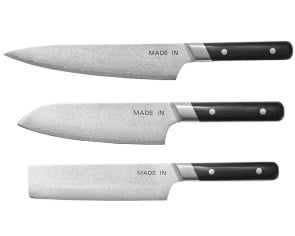
The Made In 3-Piece Japanese Damascus Steel Knife Set gives you the three classic Japanese kitchen shapes in one matched set. The gyuto handles slicing and general prep, the santoku is a nimble everyday blade, and the nakiri is built for vegetables. All three are forged in Seki, Japan, with VG-10 cores inside 66 layers of Damascus steel and 15-degree edges.
What Each Knife Does8-inch gyuto: The longest blade, for slicing meat and fish and for larger prep jobs.6.6-inch santoku: A compact all-purpose knife with a flat edge and rounded tip for push cuts.6.6-inch nakiri: A tall, flat vegetable knife for clean straight-down chopping.
Why It PerformsOne steel, one edge: All three share the VG-10 core and 15-degree edge, so they cut and sharpen alike.Three shapes, three cutting styles: Rocking, push cutting, and straight chopping are each covered by the shape best suited to them.Full tang, polymer handles: Balanced knives with handles that resist slipping and staining.
Choosing the Right Made In SetIf you want only a chef’s knife and a vegetable knife, the Made In 2-Piece Japanese Damascus Steel Knife Set includes the gyuto and nakiri. Each knife is also sold individually: the Made In 8-inch Japanese Damascus Steel Gyuto, the Made In 6.6-inch Japanese Damascus Steel Santoku, and the Made In 6.6-inch Japanese Damascus Steel Nakiri. Learn More -

Made In 6.6-inch Japanese Damascus Steel Nakiri
The Made In Japanese Damascus Steel Nakiri is built for vegetables. Its tall, rectangular blade and perfectly flat edge meet the cutting board along their full length, so each straight downward cut goes cleanly through an onion, a carrot, or a stack of greens without leaving connected pieces. Made In has it forged in Seki, Japan, with a VG-10 core inside 66 layers of Damascus steel.
Why It PerformsFully flat edge: Made for push cuts and straight chopping. Every cut reaches the board, so slices separate cleanly.Tall blade: The 1 7/8-inch height gives your knuckles clearance and doubles as a scoop for moving chopped vegetables to the pan.Double bevel at 15 degrees: Sharpened on both sides, so it cuts straight for both right- and left-handed cooks.VG-10 core and Damascus cladding: A hard stainless core for a long-lasting edge, protected by layered steel.Full tang, polymer handle: Balanced, with a hand-finished handle that resists slipping and staining.
What It Does BestDicing onions, carrots, and celeryShredding cabbage and slicing leafy greensThin slices of potatoes and root vegetablesFine brunoise and julienne cuts
Choosing the Right Made In KnifeThe nakiri is not designed for meat, bones, or a rocking cut. Pair it with the Made In 8-inch Japanese Damascus Steel Gyuto for proteins, or buy both in the Made In 2-Piece Japanese Damascus Steel Knife Set. For a single all-purpose blade of the same length, see the Made In 6.6-inch Japanese Damascus Steel Santoku. Learn More$199.00

