
You have no items in your shopping cart.
Ceramic Sharpening Rods
Keep your kitchen knives razor sharp with our selection of ceramic sharpening rods. Ceramic rods offer fine abrasive surfaces that gently realign and refine blade edges, making them ideal for routine maintenance and touch‑ups between full sharpenings. Durable, corrosion‑resistant, and easy to use, these rods help you achieve smooth, precise cuts and extend the life of your cutlery. Whether you’re caring for chef’s knives, paring blades, or specialty knives, find the right ceramic honing tool to keep your blades performing their best.
-
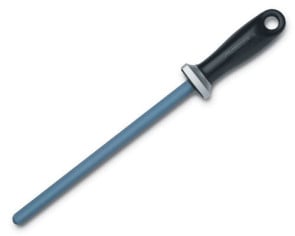
Wüsthof 10-inch Ceramic Sharpening Rod J800
When a honing steel no longer brings a knife back, the edge needs a little steel removed, and the Wüsthof 10-inch ceramic sharpening rod does that without a whetstone or an electric sharpener. Wüsthof recommends it for dull to moderately sharp knives; the ceramic surface removes a tiny amount of metal with each stroke and leaves a fresh edge.Use it the way you use a steel, drawing each side of the blade down the rod with light, even pressure. Ceramic is harder than knife steel, so a few passes per side are enough. It works well on hard Japanese knives with high Rockwell ratings and on German knives that have lost their edge. Between sharpenings, Wüsthof suggests a regular honing steel for daily or weekly maintenance.Customers ask us whether they need both. A ceramic rod sharpens; a steel maintains. Together they keep a knife sharp for years without sending it out. Pair this rod with the Wüsthof 10-inch honing steel. For a fixed-angle option, see the two-stage hand-held sharpener. The difference between honing and sharpening is set out in our guide to honing steels. Learn More$64.95 -
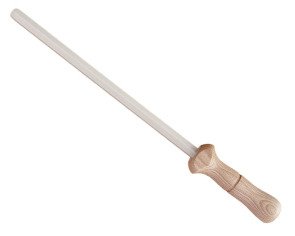
Glestain 10.8-inch (275mm) Hexagonal Ceramic Honing Rod
The Glestain ceramic honing rod is made to maintain Glestain knives between sharpenings, and it suits other Japanese and Western plain-edged knives as well. Its 10.8-inch (275mm) rod gives enough length to hone blades from a petty knife to a 270mm gyuto or sujihiki in full strokes.A round rod touches the edge at a single narrow line. This rod is hexagonal, so each stroke runs along a flat face, giving a larger contact area and steadier control of the angle. Ceramic is harder than steel, so it realigns the edge and refines it slightly, removing far less metal than a stone. The handle is weighted for balance, so the tip of the rod does not feel heavy during rapid vertical honing.Our article on sharpening Glestain and Masahiro knives explains when honing helps and when it is time to go back to the stone. Learn More$36.00 -

MAC Black Ceramic 10.5-inch Honing Rod
A ceramic sharpening rod differs from a steel honing rod in that it is intended to remove a bit of metal. A steel honing rod is intended to straighten the edge of a softer (German or American) steel knife that has rolled with use. A ceramic rod will remove the burr from an edge and may be used in conjunction with a fine steel honing rod. As a rule of thumb, we use ceramic on steels greater than 60 Rockwell hardness.The SRB-104 is the 10.5-inch version of MAC’s black ceramic rod, long enough for 10-inch chef’s knives and slicers such as the BK-100 and the MSL-105. For knives up to 8 inches, the 8.5-inch SRB-84 is easier to handle.Compare all our ceramic sharpening rods. Learn More$59.95 -
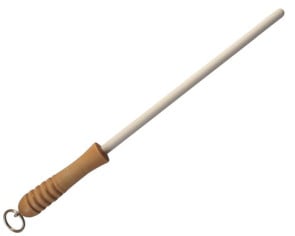
Idahone 10-inch Fine Ceramic Sharpening Rod, Hard Rock Maple Handle
The Idahone 10-inch Fine Ceramic Sharpening Rod is for home cooks who want a simple, daily way to keep their knives sharp. A honing steel only pushes a rolled edge back into line. This high-alumina ceramic rod removes a small amount of steel, so it sharpens and polishes the edge at the same time. Its finish is comparable to a fine Japanese whetstone, which makes it a maintenance tool between full sharpenings rather than a substitute for them.
What It Does for Your Knives Fine ceramic abrasive: Refreshes a working edge in a few light strokes and leaves a smooth, polished finish. Suited to Japanese and Western knives: Because the rod abrades the edge rather than bending it, it maintains softer German steels and the harder steels of many Japanese knives, which tend to wear or chip rather than roll. Compact length: Handles paring knives, utility knives and shorter chef’s knives, and fits a kitchen drawer. Natural maple handle with hanging ring: Provides a secure grip for steady strokes and keeps the rod within reach near the cutting board.
Other Sizes and Grits For longer blades, the Idahone 12-inch Fine Ceramic Sharpening Rod, Hard Rock Maple Handle allows a full stroke from heel to tip. The same 10-inch rod is also available as the Idahone 10-inch Fine Ceramic Sharpening Rod, Black Wood Handle. When a knife no longer responds to the fine rod, the Idahone 10-inch Coarse Ceramic Sharpening Rod removes steel faster to restore the edge, and the fine rod then refines it. Learn More$36.45 -
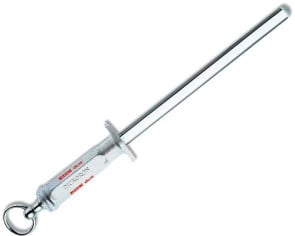
F. Dick Dickoron Duo 10-inch Diamond and Ceramic Steel
When a knife needs more attention than routine honing, the Dickoron Duo can cut a fresh edge and refine it on one rod. F. Dick makes it for sharpening and honing hard grades of steel.Two sides are diamond rods carrying millions of diamond grains, which remove metal and sharpen. The other two sides are ceramic, which smooths and straightens the edge after the diamond. A knife that has lost its edge through heavy use can get a new bevel on the diamond side and a smoother finish on the ceramic, which can save a trip to the stones.It is a good tool for a knife roll.For routine honing of hard knives, the Dickoron Titan 12-inch oval steel is the everyday rod. A diamond-only rod with a non-slip handle is the F. Dick 10-inch oval diamond sharpening steel. Our honing steel guide explains when to sharpen and when to hone. Learn More$133.25 -

Idahone 10-inch Fine Ceramic Sharpening Rod, Black Wood Handle
The Idahone 10-inch Fine Ceramic Sharpening Rod is for cooks who want to keep a sharp knife sharp with a few strokes before each use. A honing steel only pushes a rolled edge back into line. This high-alumina ceramic rod removes a small amount of steel, so it sharpens and polishes the edge at the same time. Its finish is comparable to a fine Japanese whetstone, which makes it a maintenance tool between full sharpenings rather than a substitute for them.
What It Does for Your Knives Fine ceramic abrasive: Refreshes a working edge in a few light strokes and leaves a smooth, polished finish. Suited to harder steels: Because the rod abrades the edge rather than bending it, it suits the harder steels of many Japanese knives, which tend to wear or chip rather than roll. Fewer whetstone sessions: Regular use keeps an edge in service longer, so full sharpenings are needed less often. Compact length: Handles paring knives, utility knives and shorter chef’s knives. For longer blades, the Idahone 12-inch Fine Ceramic Sharpening Rod, Black Wood Handle allows a full stroke from heel to tip.
Choosing a Fine or Coarse Rod The fine rod is the right tool for routine maintenance of a knife that is still sharp. When a knife no longer responds to it, the Idahone 10-inch Coarse Ceramic Sharpening Rod removes steel faster to restore the edge, and the fine rod then refines it. The same fine rod is also available with a natural maple handle as the Idahone 10-inch Fine Ceramic Sharpening Rod, Hard Rock Maple Handle. Learn More$36.45 -

Kikuichi 10.6-inch (270mm) Ceramic Honing Rod, Cherry Handle
Hard Japanese knives can chip on a grooved steel, and Kikuichi’s ceramic honing rod is the fine-grit alternative for them. At roughly 8000 grit equivalent, it removes a very small amount of metal, so a few light strokes realign the edge and refine it at the same time.Because so little metal comes off, the rod is suited to frequent, even daily, use between whetstone sessions, and regular honing extends the time before a knife needs full sharpening. It is not a substitute for a whetstone when an edge is truly dull. The 270mm rod handles gyutos and sujihikis in full strokes, and the cherry handle has a stainless hanging ring. Kikuichi suggests hanging it from a butcher’s belt or keeping it in the dedicated slot of the Kikuichi knife block.
Using the RodHold the blade at a consistent angle with light pressure and alternate sides for a few strokes. Wipe the rod clean afterward. Learn More$99.95 -

Idahone 10-inch Coarse Ceramic Sharpening Rod, Hard Rock Maple Handle
The Idahone 10-inch Coarse Ceramic Sharpening Rod is for cooks who want to bring a dull knife back without setting up a whetstone. Its coarse high-alumina ceramic removes steel faster than Idahone’s fine rods and restores a working edge in a few strokes. The compact length is easy to handle and fits a drawer or a smaller kitchen.
What It Does for Your Knives Coarse ceramic abrasive: Restores sharpness to knives dulled by regular use. A honing steel only realigns the edge. Measured metal removal: The grit is somewhat finer than the coarse rods in Idahone’s V-type sharpeners, so the rod corrects an edge while removing less steel than a sharpening system’s first stage. Compact length: Suits paring knives, utility knives and shorter chef’s knives, and stores easily. For longer blades, the Idahone 12-inch Coarse Ceramic Sharpening Rod allows a full stroke from heel to tip. Wood handle with hanging ring: Provides a secure grip and convenient storage near the cutting board.
Using the Coarse and Fine Rods Together The coarse rod restores the edge, and a fine rod refines it. Use the coarse rod when a knife no longer responds to honing, then finish on the Idahone 10-inch Fine Ceramic Sharpening Rod. For routine maintenance of a knife that is still sharp, the fine rod alone removes less steel and is the better choice. Learn More$36.45

