
You have no items in your shopping cart.
Cutting Boards
The surface beneath a knife has a direct effect on how long its edge lasts. Glass, stone, and ceramic dull a blade quickly; wood absorbs the impact of each cut and helps a fine edge stay sharp. This collection focuses on two woods chosen for their compatibility with quality cutlery: teak and hinoki.
Teak is a dense tropical hardwood with a high natural oil content, which gives it strong resistance to moisture. Our TeakHaus boards are available in edge-grain and end-grain construction, from compact serving boards to full butcher blocks. Hinoki, a Japanese cypress, is a softer wood that gives slightly under the blade, which makes it a preferred surface for thin, hard Japanese knives. Both woods benefit from regular oiling, and board oil is available in this collection.
-

TeakHaus 24 x 18-inch Traditional Carving Board with Juice Canal
The TeakHaus Traditional Carving Board with Juice Canal in its largest size is for cooks who host holidays and cook big: whole turkeys, prime rib, packer briskets. It carves on one side and preps on the other, so one board covers both jobs. According to TeakHaus, America’s Test Kitchen has named the Traditional board its winning wood cutting board since 2013.
Features Edge-grain teak: Teak’s high natural oil content acts as a moisture barrier, and its medium hardness gives a cutting surface that is easy on knife edges. Juice canal: A channel on the carving side holds the juices from a large roast, so they stay on the board for serving or for the gravy. Smooth reverse side: The other face has no canal, which leaves the full surface free for chopping and prep. Hand grips: Grips cut into the ends make a large, heavy board easier to lift, turn, and bring to the table. Stable mass: The board’s weight holds it in place while you carve.
How to Use It Carve a whole turkey, ham, or prime rib and serve from the board. Slice a full packer brisket or several racks of ribs. Use the smooth side for large prep jobs and batch cooking. Lay out a family-style platter of carved meat and sides.
Choosing a Size For everyday roasts, the TeakHaus 20 x 15-inch Traditional Carving Board with Juice Canal is easier to store. If you want the same size with no canal, see the TeakHaus 24 x 18-inch Traditional Cutting Board. Learn More$138.00 -
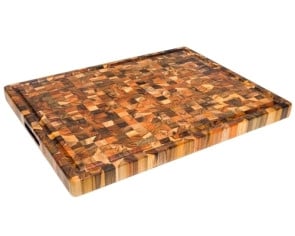
TeakHaus 24 x 18-inch End Grain Butcher Block with Juice Canal
The TeakHaus End Grain Butcher Block with Juice Canal is for cooks who want a large end-grain surface for both carving and prep. It has room for a whole turkey or brisket on one side and a flat chopping surface on the other.
Features End-grain teak: The wood fibers stand upright, so the knife edge passes between them rather than across them. Teak’s high natural oil content acts as a moisture barrier. Deep juice canal: A deep channel around the carving face holds the juices from large roasts. Flat reverse side: The other face gives a full, uninterrupted area for prep work. Hand slots: Slots cut into the ends make a large, heavy board easier to lift and turn.
How to Use It Carve holiday turkeys, hams, and prime rib. Slice a full brisket or several racks of ribs. Set up a full mise en place on the flat side. Serve a large spread for a crowd.
Choosing a Size The TeakHaus 24 x 18-inch End Grain Cutting Board is the same size without a canal. For a more compact board, see the TeakHaus 20 x 14-inch Extra-Thick End Grain Butcher Block with Juice Canal. Learn More$168.00 -

TeakHaus 24 x 18-inch End Grain Butcher Block Cutting Board
The TeakHaus End Grain Butcher Block Cutting Board in its largest size is for cooks who want a permanent end-grain work surface with room for everything. With no canal, every inch of the board is usable for chopping, portioning, and staging ingredients.
Features End-grain teak: The wood fibers stand upright, so the knife edge passes between them rather than across them. Teak’s high natural oil content acts as a moisture barrier. Uninterrupted surface: With no canal, the whole face is open for work. Large footprint: Room to stage a full mise en place or break down large cuts. Hand grip: A cut-in grip makes a heavy block easier to lift and move for cleaning.
How to Use It Set it up as a fixed prep station on the counter or an island. Break down whole chickens, pork shoulders, and primal cuts. Chop large batches of vegetables for stocks and sauces. Knead and portion bread or pasta dough.
Choosing a Board For the same size with a juice canal, see the TeakHaus 24 x 18-inch End Grain Butcher Block with Juice Canal. For a smaller board without a canal, see the TeakHaus 20 x 15-inch End Grain Butcher Block Cutting Board. Learn More$168.00 -
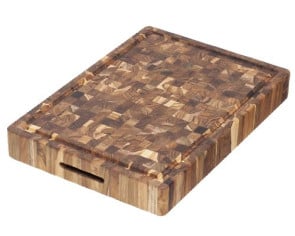
TeakHaus 20 x 14-inch Extra-Thick End Grain Butcher Block with Juice Canal
The TeakHaus Extra-Thick End Grain Butcher Block is for cooks who want the most substantial board in the TeakHaus line: a true butcher block for cleaver work, large roasts, and heavy daily use. The extra thickness sets it apart from the standard butcher block boards, and a deep juice canal handles the carving side.
Features Extra-thick end-grain teak: The fibers stand upright, so the knife edge passes between them, and the added depth keeps the block solid under a cleaver. Teak’s high natural oil content acts as a moisture barrier. Deep juice canal: A deep channel holds the juices from roasts, brisket, and ribs. Flat reverse side: Turn it over for chopping on a full, uninterrupted surface. Hand grips: Grips cut into the ends give you a secure hold on a heavy block.
How to Use It Split poultry and chop through small bones with a cleaver. Carve brisket, pork shoulder, and roasts on the canal side. Use it as a permanent prep station beside the stove. Slice and serve barbecue at the table.
Choosing a Size For a standard-thickness board without a canal, see the TeakHaus 20 x 15-inch End Grain Butcher Block Cutting Board. For a larger surface with a canal, see the TeakHaus 24 x 18-inch End Grain Butcher Block with Juice Canal. Learn More$180.00

