
You have no items in your shopping cart.
Best Sellers
-

F. Dick ErgoGrip 10-inch Scimitar
Butchers in grocery meat departments and beef processors portion steaks with a scimitar, and this 10-inch ErgoGrip model is sized for that counter work. It trims the fat cap and tail, removes silver skin and scrap, and then cuts even steaks.The long, upswept curve lets the edge roll through a steak in one motion, so the cut face stays smooth. A polished blade sheds residue, and the ErgoGrip handle has an extra-wide thumb rest and a pronounced guard for a secure grip on long strokes.The 10-inch length is easier to steer than the 12-inch model when trimming a strip or tenderloin, and it still finishes most steaks in one stroke.The 12-inch ErgoGrip scimitar handles whole primals and wider steaks. For a rounded tip, see the 10-inch bull nose butcher knife. Both scimitars fit the F. Dick Scimitar Knife Sheath, and we are glad to test the sheath on another knife for fit if you call. Our guide to kitchen knife shapes covers scimitars. Learn More$39.65 -

F. Dick ErgoGrip 12-inch Scimitar
Cutting steaks from whole primal cuts is the job of a 12-inch scimitar, and this ErgoGrip version is used at grocery butcher counters, in slaughterhouses and on beef processing floors. It also trims fat and silver skin before portioning.Twelve inches of curved edge crosses a whole ribeye or strip loin and finishes a steak in one stroke, which keeps the cut surface smooth and the thickness even. The rounded spine and the ErgoGrip guard and thumb rest make the long blade safer to handle, and the polished surface is easy to clean.The long blade also trims the fat cap from a whole rib before portioning, so the cutter can move from trimming to steaks without changing knives. That speeds up a busy counter.The 10-inch ErgoGrip scimitar is easier to control on smaller cuts. For a rounded nose at the same length, the 12-inch bull nose butcher knife is the alternative. Protect the edge with the F. Dick Scimitar Knife Sheath. Learn More$45.50 -

F. Dick ErgoGrip 6-inch Skinning Knife, Red Handle
The red handle on this 6-inch skinning knife makes it easy to pick out on a kill floor or at camp, where knives get set down on a hide or in grass. The blade is F. Dick’s ErgoGrip skinner, shaped to take the hide off without cutting into the meat.Its wide blade sweeps upward and finishes in a broad, rounded tip. Difficult cuts around legs and the neck can be made precisely, and the rounded point lets the edge work close under the hide without piercing it. Hunters carry the shorter skinner for exactly this kind of control.The broad, curved belly makes long strokes along the flanks, and the rounded point handles the tight areas around the legs and head.The standard ErgoGrip 6-inch skinning knife has the same blade. To open the abdominal wall, add the special gutting knife, and for field dressing in high-visibility orange see the Master Grip 3 Piece Field Dressing Kit. Learn More$24.05 -

F. Dick ErgoGrip 7-inch Semi-Flexible Fillet Knife
Anglers and fish processors use a fillet knife to take the fillets off the frame with little waste, and this 7-inch ErgoGrip model also loosens skin and pin bones. In meat processing, it removes tendons and skin before portioning.The long, slender blade curves upward slightly and widens toward the front, which adds surface for a long, pulling cut. Semi-flex lets the edge ride over the rib bones and stay close. The blade moves in a slight wave as it cuts, which helps it follow the contour of the fish.The 7-inch length suits fish such as trout, walleye and salmon fillets. It is long enough to take the fillet in a few strokes and short enough to control near the head. It also skins the fillet afterward by running the blade flat along the skin.For longer boning cuts on meat, the ErgoGrip 7-inch semi-flexible boning knife is the closer match. Small fish and gill work suit the 4-inch small fillet knife. Our knife shapes guide compares fillet and boning profiles. Learn More$24.05 -

F. Dick ErgoGrip 7-inch Semi-Flexible Boning Knife
The longest boning blade in this ErgoGrip group, the 7-inch semi-flexible knife handles longer cuts along the bone and doubles as a fillet knife for fish. For a butcher who works through meat, poultry and fish in the same day, one blade that moves between them saves a knife change.The extra length lets the edge follow a full rib or the length of a loin in one pull, and the semi-flex blade gives enough to stay against the bone. It still has the spine to cut a joint on a turkey or take a leg off a lamb.Seven inches also gives a longer stroke when skinning a fish fillet or removing the silver skin from a whole tenderloin.If the main job is fish, the 7-inch ErgoGrip semi-flexible fillet knife has a profile built for lifting fillets. For poultry work, the shorter 6-inch semi-flexible boning knife is quicker in the joints. Our guide to kitchen knife shapes compares boning and fillet profiles. Learn More$22.10 -
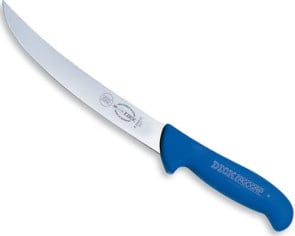
F. Dick ErgoGrip 8.25-inch Breaking Knife
Breaking primal cuts into subprimals on hogs, lamb and deer calls for a blade long enough for a flowing pull and short enough to steer, and this 8.25-inch ErgoGrip breaking knife sits in that range. Hunters use the same length for dressing out deer and elk.A breaking knife is narrow and curves upward to a point. That shape lets the edge glide through meat in long strokes while the hand stays in a comfortable position, which spares the wrist over a shift. It also cleans up tendons and fatty tissue so the cut is ready for portioning.The 8.25-inch blade gives the cutter close control at the tip when separating a ham or shoulder into its muscles, while still reaching through the piece in one stroke.For beef sides and larger primals, the 10-inch ErgoGrip breaking knife adds reach. The 8.25-inch granton edge version has hollows along the blade that reduce sticking, and the ExpertGrip 2K 8.25-inch breaking knife puts this blade on a soft-shell handle. Learn More$27.95 -
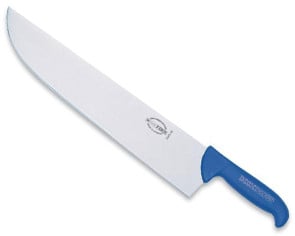
F. Dick ErgoGrip 14-inch Butcher Knife
The longest butcher knife in the ErgoGrip range, this 14-inch ErgoGrip butcher knife is for trimming fat and breaking down whole primal cuts where reach matters more than nimbleness.Fourteen inches of edge crosses the full width of a beef side or a whole brisket, so the cutter can separate it without restarting the stroke. The wide blade adds stiffness and a broad face for moving large pieces. The ErgoGrip handle has a pronounced guard and a wide thumb rest for a secure hold on a long knife.The long edge also turns large roasts and briskets into even slices without sawing.For most counter work, the 12-inch ErgoGrip large butcher knife or 12-inch butcher knife is easier to manage. Large seafood such as tuna can also be broken down with the 12-inch bull nose butcher knife. A knife this long belongs in a F. Dick Knife Scabbard with Belt when not in use. Learn More$60.45 -

F. Dick ErgoGrip 5-inch Curved Flexible Boning Knife
This curved, flexible 5-inch blade handles the varied work of breaking down a whole bird or a pork shoulder. It removes skin, cuts through joints and traces along rib and thigh bones without much force.The upswept curve gives a longer edge than a straight blade of the same length, so each draw cuts more. Flex lets that edge bend around rounded bones and stay in contact, which leaves less meat behind. On fish, the same combination lifts a fillet from the frame in a single motion.For poultry, the 5-inch length keeps the tip close to the hand during the many short cuts around the hip and shoulder joints.The curved flexible blade also comes in a 6-inch length for larger birds and pork loins. Cutters who want more backbone for joints choose the 5-inch curved stiff boning knife, and those who want something between the two pick the 5-inch semi-flexible boning knife. More on boning blade shapes is in our guide to kitchen knife shapes. Learn More$16.90 -
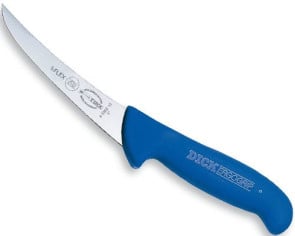
F. Dick ErgoGrip 5-inch Semi-Flexible Boning Knife
Semi-flexible blades sit between the stiff and flexible ErgoGrip boning knives. At 5 inches, this one has the length and give that poultry work calls for, and it separates wings and legs and then fillets the breast meat from the keel bone.A semi-flex blade bends enough to follow the curve of a carcass but keeps enough spine to push through a joint. That balance makes it a sensible first boning knife for a processor or a home butcher who handles chicken, duck and rabbit and does not want to switch knives between tasks.Its 5-inch length keeps the tip within easy reach of the fingers, which helps when cutting the small joints of a wing or a rabbit leg.For whole turkeys or larger cuts, the 6-inch semi-flexible boning knife adds an inch of reach. If the work leans toward joints and cartilage, a stiff blade such as the 5-inch curved stiff boning knife is the better tool, and for skinning and silver skin the 5-inch curved flexible boning knife bends further. Learn More$16.90 -
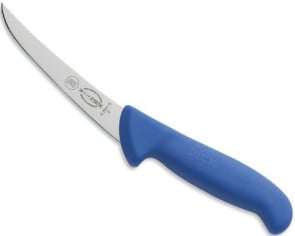
F. Dick ErgoGrip 5-inch Curved Stiff Boning Knife, Blue Handle
Separating wings and legs on chicken and other poultry is the job this 5-inch curved stiff blade was shaped for. Its upswept tip slips into the joint, and its rigid spine lets the cutter lever the joint apart without the blade bending.The thumb rest on the ErgoGrip handle gives the cutter a place to press when the knife is held like a dagger, which is how professional meat cutters hold a boning knife for most of a shift. The curve adds edge length for drawing cuts along the thigh and keel, so the knife works quickly on a poultry line.Five inches is short enough to turn inside a chicken carcass and long enough to free the thigh in a single pull.The same blade is sold with a black handle and a red handle for plants that assign handle colors to stations or to raw and cooked product. For larger birds and pork, the 6-inch curved stiff boning knife gives more reach. Learn More$16.90

