
You have no items in your shopping cart.
Best Sellers
-

F. Dick ErgoGrip 8.25-inch Sticking Knife
Known to hunters and hog farmers as a pig sticker, this double-edged ErgoGrip dagger is made for bleeding an animal after it has been stunned. A complete bleed gives whiter meat and less gamey flavor, which matters most on wild boar, deer and elk.The blade narrows to a pronounced point and has a diamond-shaped cross-section with an edge on both sides. That shape delivers the precise, quick vein incision that sticking calls for. The straight, symmetrical handle has a prominent finger guard, and its textured surface stays secure when it is wet and greasy.The 8.25-inch blade gives the reach needed on large hogs and wild boar.Butchers pair a sticking knife with a skinning knife and a gut and tripe knife as the basic slaughter kit. For smaller animals, the single-edged 6-inch and 7-inch ErgoGrip sticking knives are shorter. Store it in a Single Knife Scabbard or the F. Dick Knife Scabbard with Belt. Learn More$53.95 -
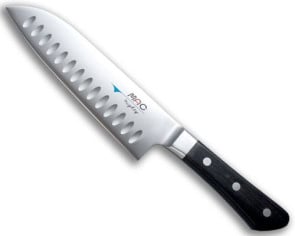
MAC Professional 6.5-inch Santoku with Dimples
The MSK-65 is the santoku of the MAC Professional Series, with a bolster for balance and a row of dimples along the blade. It is one of the two Professional knives MAC makes in its sub-zero tempered Superior steel, alongside the MTH-80 chef’s knife.The flat edge suits push cuts and chopping, and the dimples help release sticky food such as sliced potatoes, cucumbers and apples. The bolster gives a secure pinch grip. It is a good choice for a cook who wants a compact main knife with a little more weight than a plain santoku.For a lighter santoku without a bolster, see the Superior SK-65. The MSK-65 is also part of the MAC 2-piece santoku set. Our Kitchen Knife Shapes guide compares the santoku with the chef’s knife. Learn More$139.95 -
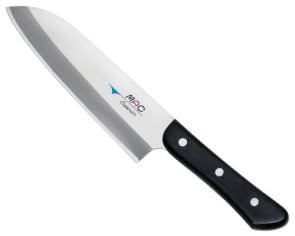
MAC Superior 6.5-inch Santoku
The santoku is the Japanese all-purpose knife: a flat edge for push cuts and chopping, a rounded nose, and a tall blade that keeps the knuckles off the board. The MAC SK-65 is a 6.5-inch santoku in the Superior Series, for cooks who prefer a shorter blade.The MAC Superior Santoku has a thick spine that tapers to a very thin edge, which glides through food with ease. Its large, ergonomically shaped handle feels extremely comfortable in the hand, and a sand-blasted strip runs along the edge of the blade to reduce surface tension and prevent sticking. This knife is a fantastic addition to any collection, and was voted “Favorite Knife” by Food & Wine.It suits cooks who chop more than they rock. Onions, cabbage, carrots and boneless chicken fall to straight down-and-forward cuts, and the height lets you scoop the prep off the board. At 6.5 inches it is shorter than an 8-inch chef’s knife and easier to control on a small board.The Professional MSK-65 adds a bolster and dimples. The SK-65 is paired with a small santoku in the Superior santoku set. Browse the Superior Series, or see our guide to kitchen knife shapes. Learn More$84.95 -

F. Dick 1905 7-inch Granton Edge Santoku
Santoku means “three virtues” in Japanese, for slicing, dicing and mincing, and this 1905 santoku covers that everyday work on meat and vegetables. Its granton edge, a row of hollow scallops along the blade, keeps slices of potato and cucumber from sticking.A santoku has a thin blade, a flatter edge than a chef’s knife and a rounded tip, so it works best with a straight push or a forward slice. The scallops put small pockets of air between the blade and wet or starchy food, which lets each slice fall away instead of riding up the knife. The thin profile also makes it capable of decorative cuts.Cooks who prefer a rocking cut should look at the 1905 8-inch chef’s knife. A smaller granton blade is the Premier Plus 5.5-inch granton edge santoku, and the 1778 santoku offers a much harder edge. See our knife shapes guide for santoku and chef’s knife profiles. Learn More$107.25 -

Masahiro Virgin Carbon 8.25 in. (210mm) Gyuto
The Masahiro Virgin Carbon 210mm Gyuto is one of chef David's favorite knives. A reliable workhorse with scalpel like precision. The asymetrical shape of this knife drops through food with remarkable ease, pushing each slice cleanly from the blade. This blade size is an excellent choice for line cooks who don't have the space to accomodate a larger knife. This knife takes a beautiful edge that can be maintained between sharpenings with a quality honing steel. We highly recommend this knife, it is one of our most popular models (with good reason)! Learn More$106.00 -

Masahiro MV 8.25-inch (210mm) Gyuto
A Professional Workhorse That Values Performance Over Flash In a market often saturated with flashy Damascus patterns and fragile edges, the Masahiro MV 210mm (8.25 in.) Gyuto stands as a testament to practical Japanese engineering. This isn't a knife for the display case; it is a precision tool built for the heavy-duty demands of a professional kitchen. The core of this knife is the proprietary MBS-26 high-carbon stainless steel. Masahiro developed this alloy specifically to achieve a perfect balance: it is tough enough to resist chipping during high-speed vegetable prep, yet high enough in carbon (0.9%) to maintain a razor-sharp edge through cases of mirepoix. What truly sets the MV series apart is the 80/20 asymmetrical edge. While many knives use a 50/50 symmetrical grind, Masahiro uses a single-sided approach where the face side carries the primary taper. This allows the blade to glide through dense root vegetables with significantly less resistance, while the minimal bevel on the backside makes the edge incredibly easy to realign on a whetstone. Every knife is hand-sharpened by master blacksmiths in Seki City and verified using the Gifu Prefectural Research Institute's Honda-Type Paper Cutting Test—ensuring out-of-the-box sharpness that most manufacturers simply can't match. For the chef who needs a knife that is easy to maintain, resistant to rust, and comfortable for all-day use, the Masahiro MV is the industry's best-kept secret. Learn More$119.25 -

MAC Professional 8-inch Chef’s Knife with Dimples
The MTH-80 is the knife MAC itself describes as its most popular for everyday use. It is an 8-inch gyuto with a flat stretch of edge near the heel, so the blade stays in contact with the board for push cuts and fine dicing, and a tip fine enough for shallots and garlic.What the Dimples and Bolster DoA row of dimples above the edge breaks the seal that forms between a flat blade and wet or starchy food, so slices of potato, apple and summer squash fall away instead of riding up the knife. The bolster adds a little weight at the handle and gives the thumb and forefinger a firm place to pinch. Tempered using a special sub-zero treatment, this knife is both harder and tougher than others with the same steel composition. This knife has a traditional gyuto profile, unlike the other Mighty MACs in the Professional line, which have a French or Western profile.RecognitionThis knife has been named the Best Chef’s Knife Overall by Bon Appétit. It has also been named the Best Overall Chef’s Knife by Food & Wine and the Best Chef’s Knife for Most Cooks by Wirecutter.For a lighter knife with the same dimpled blade and no bolster, see the Chef Series TH-80. For a longer Professional knife with a French profile, compare the 9.5-inch MBK-95. Our guide to kitchen knife shapes explains how a gyuto differs from a Western chef’s knife. Learn More$159.95 -
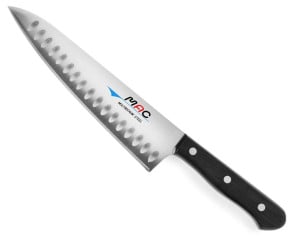
MAC Chef Series 8-inch Chef’s Knife with Dimples
The TH-80 is the Chef Series counterpart to the Professional MTH-80. Both are 8-inch knives with dimples. The TH-80 has no bolster, so it is the lighter of the two and the blade runs straight back into the handle, which suits cooks who choke up on the blade or work long prep lists.Where It Fits in a Day of PrepThe thin Chef Series blade passes through onions and carrots with little wedging, and the dimples help release sliced potatoes, cucumbers and soft cheese. The profile has enough curve to rock through herbs. It is light enough to use for hours, though the absence of a bolster means less weight to drive the edge through dense squash.The same blade comes in a 10-inch length for larger volumes of prep, and the BK-80 is the undimpled version. Our kitchen knife shapes guide compares chef’s knife shapes and sizes. Learn More$109.95 -
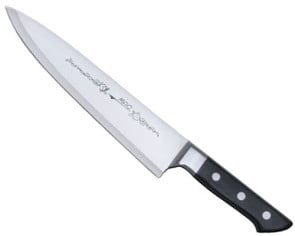
MAC Ultimate 9-inch Chef’s Knife
Cooks who like the weight of a German forged knife but want a thinner Japanese edge are the audience MAC designed the Ultimate Series for. The SBK-95 has the look and feel of a forged German chef’s knife, with a thinner blade.The larger bolster puts more weight behind the edge, which helps when chopping winter squash, breaking down a chicken at the joints or pushing through a pile of root vegetables. The blade is still stamped and thin enough to slice tomatoes cleanly, so the weight serves control rather than brute force. The trade-off is a knife that is heavier in the hand over a long prep list than the Chef or Professional models.The 10.25-inch SBK-105 is the longer Ultimate chef’s knife. For a lighter bolstered knife, compare the Professional MBK-85 and MBK-95. Our kitchen knife shapes guide explains the French chef’s knife shape both lines follow. Learn More$319.95 -

MAC Chef Series 8.5-inch Chef’s Knife
The HB-85 is the entry point to MAC chef’s knives: a narrow, light 8.5-inch blade in the Chef Series, stamped and bolsterless. It suits a cook buying a first Japanese knife and a professional who wants a spare knife for the line.The narrow blade gives a little more length than the 8-inch models for slicing proteins and long vegetables, and its low height makes it quick through onions and peppers. With less steel behind the edge, it is lighter than the BK-80 and less suited to dense squash or chopping through hard rinds.Choosing Between the Chef Series KnivesFor a taller blade and more knuckle clearance, see the BK-80. For a shorter knife from the same family, the 7.25-inch HB-70 is a compact gyuto for small boards. Our guide to kitchen knife shapes explains how blade height and profile change the way a knife cuts. Learn More$79.95

