You have no items in your shopping cart.
Best Sellers
-
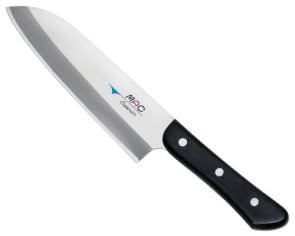
MAC Superior 6.5-inch Santoku
The santoku is the Japanese all-purpose knife: a flat edge for push cuts and chopping, a rounded nose, and a tall blade that keeps the knuckles off the board. The MAC SK-65 is a 6.5-inch santoku in the Superior Series, for cooks who prefer a shorter blade.The MAC Superior Santoku has a thick spine that tapers to a very thin edge, which glides through food with ease. Its large, ergonomically shaped handle feels extremely comfortable in the hand, and a sand-blasted strip runs along the edge of the blade to reduce surface tension and prevent sticking. This knife is a fantastic addition to any collection, and was voted “Favorite Knife” by Food & Wine.It suits cooks who chop more than they rock. Onions, cabbage, carrots and boneless chicken fall to straight down-and-forward cuts, and the height lets you scoop the prep off the board. At 6.5 inches it is shorter than an 8-inch chef’s knife and easier to control on a small board.The Professional MSK-65 adds a bolster and dimples. The SK-65 is paired with a small santoku in the Superior santoku set. Browse the Superior Series, or see our guide to kitchen knife shapes. Learn More$84.95 -

MAC Professional 8-inch Chef’s Knife with Dimples
The MTH-80 is the knife MAC itself describes as its most popular for everyday use. It is an 8-inch gyuto with a flat stretch of edge near the heel, so the blade stays in contact with the board for push cuts and fine dicing, and a tip fine enough for shallots and garlic.What the Dimples and Bolster DoA row of dimples above the edge breaks the seal that forms between a flat blade and wet or starchy food, so slices of potato, apple and summer squash fall away instead of riding up the knife. The bolster adds a little weight at the handle and gives the thumb and forefinger a firm place to pinch. Tempered using a special sub-zero treatment, this knife is both harder and tougher than others with the same steel composition. This knife has a traditional gyuto profile, unlike the other Mighty MACs in the Professional line, which have a French or Western profile.RecognitionThis knife has been named the Best Chef’s Knife Overall by Bon Appétit. It has also been named the Best Overall Chef’s Knife by Food & Wine and the Best Chef’s Knife for Most Cooks by Wirecutter.For a lighter knife with the same dimpled blade and no bolster, see the Chef Series TH-80. For a longer Professional knife with a French profile, compare the 9.5-inch MBK-95. Our guide to kitchen knife shapes explains how a gyuto differs from a Western chef’s knife. Learn More$159.95 -
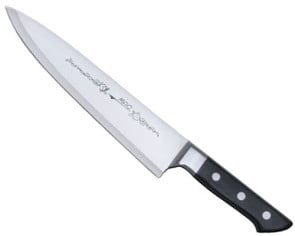
MAC Ultimate 9-inch Chef’s Knife
Cooks who like the weight of a German forged knife but want a thinner Japanese edge are the audience MAC designed the Ultimate Series for. The SBK-95 has the look and feel of a forged German chef’s knife, with a thinner blade.The larger bolster puts more weight behind the edge, which helps when chopping winter squash, breaking down a chicken at the joints or pushing through a pile of root vegetables. The blade is still stamped and thin enough to slice tomatoes cleanly, so the weight serves control rather than brute force. The trade-off is a knife that is heavier in the hand over a long prep list than the Chef or Professional models.The 10.25-inch SBK-105 is the longer Ultimate chef’s knife. For a lighter bolstered knife, compare the Professional MBK-85 and MBK-95. Our kitchen knife shapes guide explains the French chef’s knife shape both lines follow. Learn More$319.95 -

MAC Chef Series 8.5-inch Chef’s Knife
The HB-85 is the entry point to MAC chef’s knives: a narrow, light 8.5-inch blade in the Chef Series, stamped and bolsterless. It suits a cook buying a first Japanese knife and a professional who wants a spare knife for the line.The narrow blade gives a little more length than the 8-inch models for slicing proteins and long vegetables, and its low height makes it quick through onions and peppers. With less steel behind the edge, it is lighter than the BK-80 and less suited to dense squash or chopping through hard rinds.Choosing Between the Chef Series KnivesFor a taller blade and more knuckle clearance, see the BK-80. For a shorter knife from the same family, the 7.25-inch HB-70 is a compact gyuto for small boards. Our guide to kitchen knife shapes explains how blade height and profile change the way a knife cuts. Learn More$79.95 -

Dexter-Russell Traditional 8-inch Flexible Fillet Knife, Beech Handle
Before plastic handles came to the fish house, a fillet knife had a wood handle and brass rivets, and Dexter-Russell still makes this one that way. The Traditional 8-inch fillet knife has a flexible blade with just enough give, in Dexter’s words, to glide under skin, and Dexter designs it for commercial and charter boat fishermen who skin and fillet larger fish.It is the most visited Dexter fillet knife page on our site, and Traditional knives like it are especially popular with our customers in the Northeast. Stiff enough to follow the backbone without deflecting and flexible enough to skin a fillet flat on the board, it handles bluefish, sea bass and striped bass equally well. The wood handle feels warm in a cold hand and gives a secure, familiar grip.
Wood Handle or Sani-Safe?The Sani-Safe 8-inch Narrow Flexible Fillet Knife has a comparable blade with a textured plastic handle that can be sanitized. Dexter’s leather sheath for 8- and 9-inch fillet knives suits this knife for carrying. Learn More -
Miyabi Kaizen 8-inch Chef’s Knife
Kaizen looks the part, with a flower Damascus blade and a black Micarta handle, and it costs considerably less than Miyabi’s powdered steel lines. The 8-inch Kaizen chef’s knife has a VG10 core at 60 HRC that holds its edge very well.This is the flagship knife of the Kaizen line. What sets it apart is its smooth spine and bolster, which do not dig into your hand, and the balance between the blade and the handle, which makes it feel like an extension of your hand.The blade is thin and the edge is delicate. Kaizen knives do not need to be honed, but they must be used with greater care to prevent chipping. Cut straight down or draw the blade rather than twisting it, and keep it off bones and frozen food.For a sturdier workhorse that responds well to honing, compare the Miyabi Koh 8-inch. For more length, see the Kaizen 9.5-inch; our guide to kitchen knife shapes explains the gyutoh. Learn MoreRegular Price: $179.95
Special Price $169.99
-
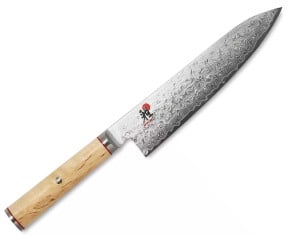
Miyabi Birchwood SG2 8-inch Chef’s Knife
The Birchwood 8-inch chef’s knife is the Miyabi knife our customers search for most, and with reason: an SG2 powder steel core takes an extremely refined edge and holds it for a long time without regular honing, and the Karelian birch handle makes each knife look a little different from the next. Birchwood and Black are Miyabi’s two most premium lines, for cooks who want top performance and the looks to match.Miyabi calls this shape a gyutoh. It is lighter and thinner behind the edge than a German chef’s knife, with a flatter belly for push cuts through onions and peppers and a fine tip for shallots and herbs. The D-shaped handle settles the blade into a pinch grip.Birchwood or Black?In our own head-to-head testing in working kitchens, the Birchwood steel stayed sharp longer than Miyabi Black through heavy vegetable prep, particularly citrus, onions and tomatoes. Black held its edge longer only when used mainly on proteins and low-acid foods. Compare the Miyabi Black 8-inch, or step up to the Birchwood 9.5-inch for more length. Our guide to kitchen knife shapes explains the gyutoh. Learn MoreRegular Price: $364.95
Special Price $299.99
-

Mercer Renaissance 8-inch Chef’s Knife
The Renaissance 8-inch Chef’s Knife is Mercer’s forged knife with a traditional look: a triple-riveted Delrin handle and a full tang running through it. For a home cook who wants the build of a German forged knife without a premium-brand price, or a student assembling a first serious kit, it is a straightforward choice.Mercer shortens the bolster on the Renaissance line, so the edge runs to the heel and the whole blade can be sharpened. The 8-inch length dices onions, slices proteins and rocks through herbs, and it is the size most cutting boards and knife rolls are built around.
Renaissance or Genesis?Both lines are forged from the same high-carbon German steel at the same hardness. The difference is the handle. The Genesis 8-inch has a soft Santoprene grip that holds when wet; the Renaissance has a harder riveted handle with a classic shape. For more reach, see the Renaissance 9-inch and 10-inch Chef’s Knives. Learn More$71.20 -

Mercer Genesis 8-inch Short Bolster Chef’s Knife
The 8-inch Genesis chef’s knife is the forged Mercer knife for cooks who want the weight and balance of a German-style blade with a soft, non-slip handle. Mercer shortens the bolster on this model, so the edge runs all the way to the heel and the whole blade can be sharpened, a detail that matters after a few years of honing and sharpening.The Santoprene handle grips securely even when the hand is wet or greasy, which suits a busy professional station as well as a home kitchen. The blade has enough curve to rock through herbs and garlic and enough length to dice an onion or break down a chicken.
Choosing a Size and LineFor more reach, see the Genesis 9-inch and 10-inch Short Bolster Chef’s Knives. The Renaissance 8-inch Chef’s Knife is the forged alternative with a riveted handle, and the Millennia 8-inch Chef’s Knife is the lighter stamped option. Our kitchen knife shapes guide explains how chef’s knife lengths compare. Learn More$56.70 -

F. Dick Premier Plus 8-inch Chef’s Knife
Cooks reach for an 8-inch chef’s knife for almost every task in the kitchen, so comfort over long periods matters as much as the edge. The Premier Plus 8-inch is well balanced, and that balance is what you notice first when you use it for an hour of prep. In our view, no better chef’s knife is made in Germany than the Premier Plus.The bolster is smoothed where the thumb and forefinger rest, so a choke grip on the blade stays comfortable. The curved edge rocks through herbs and onions, and the tip handles finer work such as scoring and trimming. The steel gives a lasting edge and still hones back quickly on a steel.It is also the knife to choose first when building a kit.For cooks with smaller hands, the Premier Plus 6-inch chef’s knife is easier to control, and taller cooks may prefer the 9-inch or 10-inch versions. The 1905 8-inch chef’s knife has a classic ringed handle at the same length. Our knife shapes guide covers chef’s knives. Learn More$97.50