
You have no items in your shopping cart.
Best Sellers
-
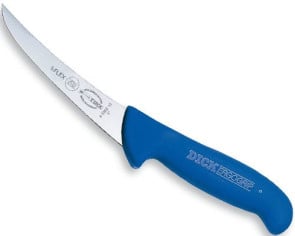
F. Dick ErgoGrip 5-inch Semi-Flexible Boning Knife
Semi-flexible blades sit between the stiff and flexible ErgoGrip boning knives. At 5 inches, this one has the length and give that poultry work calls for, and it separates wings and legs and then fillets the breast meat from the keel bone.A semi-flex blade bends enough to follow the curve of a carcass but keeps enough spine to push through a joint. That balance makes it a sensible first boning knife for a processor or a home butcher who handles chicken, duck and rabbit and does not want to switch knives between tasks.Its 5-inch length keeps the tip within easy reach of the fingers, which helps when cutting the small joints of a wing or a rabbit leg.For whole turkeys or larger cuts, the 6-inch semi-flexible boning knife adds an inch of reach. If the work leans toward joints and cartilage, a stiff blade such as the 5-inch curved stiff boning knife is the better tool, and for skinning and silver skin the 5-inch curved flexible boning knife bends further. Learn More$16.90 -

F. Dick ErgoGrip 5-inch Curved Flexible Boning Knife
This curved, flexible 5-inch blade handles the varied work of breaking down a whole bird or a pork shoulder. It removes skin, cuts through joints and traces along rib and thigh bones without much force.The upswept curve gives a longer edge than a straight blade of the same length, so each draw cuts more. Flex lets that edge bend around rounded bones and stay in contact, which leaves less meat behind. On fish, the same combination lifts a fillet from the frame in a single motion.For poultry, the 5-inch length keeps the tip close to the hand during the many short cuts around the hip and shoulder joints.The curved flexible blade also comes in a 6-inch length for larger birds and pork loins. Cutters who want more backbone for joints choose the 5-inch curved stiff boning knife, and those who want something between the two pick the 5-inch semi-flexible boning knife. More on boning blade shapes is in our guide to kitchen knife shapes. Learn More$16.90 -

F. Dick ErgoGrip 6-inch Skinning Knife, Red Handle
The red handle on this 6-inch skinning knife makes it easy to pick out on a kill floor or at camp, where knives get set down on a hide or in grass. The blade is F. Dick’s ErgoGrip skinner, shaped to take the hide off without cutting into the meat.Its wide blade sweeps upward and finishes in a broad, rounded tip. Difficult cuts around legs and the neck can be made precisely, and the rounded point lets the edge work close under the hide without piercing it. Hunters carry the shorter skinner for exactly this kind of control.The broad, curved belly makes long strokes along the flanks, and the rounded point handles the tight areas around the legs and head.The standard ErgoGrip 6-inch skinning knife has the same blade. To open the abdominal wall, add the special gutting knife, and for field dressing in high-visibility orange see the Master Grip 3 Piece Field Dressing Kit. Learn More$24.05 -

F. Dick ExpertGrip 2K 6-inch Curved Semi-Flexible Boning Knife
For cutters who debone all day, a 6-inch semi-flexible blade covers the widest range of cuts, and this ExpertGrip 2K model puts that blade on F. Dick’s cushioned two-part handle. It handles poultry, pork loins and lamb legs with the same knife.The curved, semi-flexible blade bends enough to ride a bone and stays stiff enough to part a joint. Six inches gives one-pass cuts along a loin. F. Dick’s molding process joins the soft shell and hard core to the blade without gaps, which keeps the handle sanitary and comfortable through long shifts. This is what we call a “double pour” handle.The curve puts more edge into each pull, so drawing around a thigh bone or along the length of a loin takes fewer strokes. The soft shell also cushions the palm in a dagger grip.For smaller birds, the 5-inch ExpertGrip 2K semi-flexible boning knife is quicker in the joints. More flex comes with the 6-inch curved flexible model, and the MasterGrip 6-inch curved semi-flexible boning knife offers an open-ended handle in high-visibility orange. Learn More$17.55 -
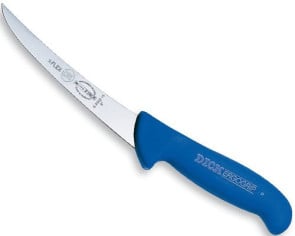
F. Dick ErgoGrip 6-inch Semi-Flexible Boning Knife
Duck, chicken and turkey all break down well with a 6-inch semi-flexible blade, and this ErgoGrip knife handles all three. The extra inch over the 5-inch model helps on a turkey breast and on the longer bones of a leg.Semi-flex means the blade gives a little when it meets a bone and then springs back. The cutter can follow a curve without the knife wandering, and there is still enough stiffness to cut through a joint. The curved edge is easier to slide along a bone than a straight one and offers more cutting length for each pull.On a turkey, the longer blade follows the breastbone from end to end and frees each half of the breast in a single pass.For smaller birds and tight joints, the 5-inch semi-flexible boning knife is quicker. When the work calls for a blade that bends further, such as removing silver skin, choose the 6-inch curved flexible boning knife. The 7-inch semi-flexible boning knife adds length for larger cuts and filleting. Learn More$18.20 -

MAC Professional 5-inch Utility Knife
The Mac Professional 5-inch Utility Knife is made for cutting or slicing medium-sized foods. When a paring knife is just too short and a chef’s knife seems too long, this utility knife will be just right. The narrow blade can even be used for small boning tasks.In practice that means slicing a sandwich, halving limes for service, trimming chicken thighs and cutting cheese for a board. The bolster gives the same grip and balance as the larger Professional knives, so it feels familiar beside a MTH-80.For a little more reach, the PKF-60 is the 6-inch model. For a smaller blade, the PKF-30. Our guide to kitchen knife shapes explains where utility knives fit. Learn More$69.95 -

MAC Chef Series 5.5-inch Utility Knife
The Mac Chef Series 5.5-inch Utility Knife is an all-purpose knife, and is commonly used when a paring knife is just too small and a chef’s knife is too large. The thin, light blade makes quick work of slicing tomatoes, cutting a sandwich or trimming chicken.It is the plain-steel version of the non-stick BF-HB-55, and either one works as a small second knife for a cook who does most of the work with a chef’s knife. The pointed tip and narrow blade are useful for jobs such as cutting around the pit of an avocado or peeling ginger.For a bolstered utility knife, see the Professional PKF-50. Our guide to knife shapes compares utility knives with parers and petty knives. Learn More$49.95 -

F. Dick 1905 Steak Knife Set
Steak night and backyard barbecues are what this 1905 steak knife set is for. The knives share the banded handle design of the 1905 series and are forged for a solid, balanced feel at the table.A good steak knife makes a clean slice that keeps the meat’s juices in, and a forged knife with real weight does that with little effort. These knives are made for years of use, and with hand washing and occasional honing they will outlast disposable sets.For a restaurant or a home that entertains, a forged steak knife also feels more substantial in the hand than a stamped one. The weight helps the blade do the cutting with little pressure, which keeps each slice clean and the plate unscratched.Single knives are available as the 1905 4.5-inch plain-edge steak knife. For a serrated set in a more modern style, see the Premier Plus 4-piece serrated steak knife set. Hand wash the knives and dry them before putting them away. Learn More$191.10 -

Glestain K Series 6.7-inch (170mm) Santoku
A santoku is used mostly with a straight push cut, with the blade driven down and forward through the food, and that motion is where Glestain’s dimples help most. Each slice of potato, cucumber or onion drops off the face instead of riding up it, so the next cut starts on a clear blade.The 170mm blade is compact and tall, with a flatter edge than a gyuto. It suits dicing vegetables, mincing herbs and slicing boneless meat and fish, and it fits easily on a small cutting board. The asymmetrical grind pushes each slice away from the knife, which keeps a rhythm of fast, even cuts.The K Series has a bolster and no end cap. Glestain is bought by home cooks and professionals alike, and this santoku suits a home cook who wants one compact knife as well as a professional who keeps a santoku for vegetable work.
Choosing a SantokuFor a smaller blade, see the K Series 160mm Santoku; for an all-stainless handle, the Ice Handle 170mm Santoku. Left-handed cooks can choose the 170mm Left-Handed Santoku. If you prefer a rocking cut, a 210mm gyuto has more curve. Our guide to kitchen knife shapes compares the santoku and the gyuto. Learn More -
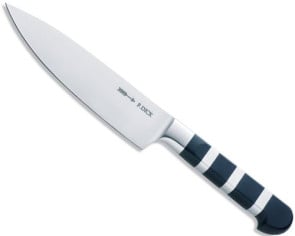
F. Dick 1905 6-inch Chef’s Knife
A 6-inch chef’s knife suits cooks with smaller hands, small cutting boards and quick jobs such as slicing a shallot or a few cloves of garlic. This 1905 version stays sharp and has a comfortable handle that does not cramp the hand through long use.The shorter blade gives more control near the tip, which helps with fine dicing and with work close to the hand. It still has enough height for chopping herbs and enough length to slice a chicken breast. The 1905 knives are easy to hone and resharpen, so the edge is simple to keep in shape at home.It also fits easily in a knife roll or a small drawer, which makes it a good travel knife for a vacation rental kitchen.For bigger produce and longer slicing, the 1905 8-inch chef’s knife is the standard size. A 1905 6-inch utility knife is narrower at the same length, and the 1905 herb knife is built for mincing. Learn More$92.95

