
You have no items in your shopping cart.
Yanagi / Sujihiki
One of the traditional Japanese shapes, Yanagi knives are similar to carvers in appearance but can be distinguished by their long thick spines, prominent shinogi lines, and concave back sides. The westernized version of this form is known as Sujihiki. Flat ground and never more than 3mm in width, Sujihiki knives have long, thin, pointed blades that are very comparable to carving knives in both appearance and application.
Sujihikis (also known as Sujibikis) are commonly made in both carbon and stainless steels. Yanagis (also known as Yanagibas) are more commonly made in Carbon Steel. We do have a selection of Stainless Steel Yanagis as well. You can browse our selection of Stainless Steel Yanagis here.
-

Minonokuni Sakura Damascus 10.6-inch (270mm) Yanagi
The 270mm Sakura yanagi gives a long, even stroke for slicing sashimi from broad blocks of fish, and its Damascus jacket makes it as much a statement as a tool. The length completes each slice in one pass, which preserves texture and presentation.A long yanagi rewards a relaxed grip and an unhurried draw. Let the weight of the blade carry it through the fish and the edge do the cutting. On a deep board with room to the side, the length lets the cook set the thickness of each slice precisely.
Choosing a 270mm YanagiSakura is one of our specialty lines, technically more premium than the standard lines but not the right choice for everyone. Its blue steel core is hard and delicate, so it belongs with an experienced sushi cook. For the same length in a less brittle steel, see the Take 270mm yanagiba. For a stainless option, see the Gin-San 270mm yanagi.The Sakura 240mm yanagi is the standard counter length. Our guide to kitchen knife shapes covers the yanagi. Learn More$648.00 -

Minonokuni Sakura Damascus 9.4-inch (240mm) Yanagi
This 240mm Sakura yanagi carries the rippled Damascus pattern of the series on a traditional single-bevel slicer. It is suited to skinning and portioning fish fillets and to slicing sashimi and nigiri toppings at the standard counter length.For skinning, lay the fillet skin-side down, hold the tail end of the skin and run the blade flat between skin and flesh. For sashimi, change to a long pull from the heel. The length handles both without a change of knife.
For Experienced HandsSakura is a specialty line. It is more premium than our standard lines but not right for every cook, because its blue steel core is hard and its edge is very thin. A chef already comfortable with single-bevel knives will get the most from it. A cook still learning will be better served by the Take 240mm yanagiba.The Sakura 210mm yanagi is shorter and the Sakura 270mm yanagi longer. The plain-finish blue steel option at this length is the Matsu 240mm yanagiba. See the knife shapes guide for more on slicers. Learn More -

Minonokuni Sakura Damascus 8.3-inch (210mm) Yanagi
At 210mm, the Sakura Damascus yanagi is agile enough for home use and for chefs working with smaller blocks of fish. It is a purpose-built slicer for sushi and sashimi, with a Damascus jacket that gives each knife its own pattern.The single-bevel urasuki grind is the working part of the design. The hollow on the flat back reduces drag as the blade passes through the fish and helps each slice separate cleanly. Draw the knife from heel to tip in one long stroke, and the slice comes away with a bright, smooth face.
Sakura or a Standard Line?Sakura is a specialty line, technically more premium than Matsu, Take or Ume but not necessarily the right knife for every cook. The core is blue steel, which holds an edge longest and is also the most delicate. For a first yanagi, the Take 210mm yanagiba is less brittle; for the same steel without the Damascus finish, the Matsu 210mm yanagiba is the alternative.Longer Sakura yanagi are the 240mm and 270mm. The kitchen knife shapes guide explains the yanagi. Learn More -

Minonokuni Matsu 9.4-inch (240mm) Left-Handed Yanagiba
For a left-handed sushi chef, 240mm is the working length, and a mirror-ground blade is the only way to get the straight, smooth slice the yanagiba is made for. The bevel sits on the left face of this knife and the hollow back on the right, the reverse of the right-handed Matsu 240mm yanagiba.This is the longest left-handed Matsu we carry. The length lets a slice of tuna, salmon or hamachi start at the heel and finish at the tip in one draw, with no back-and-forth. The knife is in stock at Knife Merchant; we do not special-order left-handed Matsu knives in other sizes.
Blue Steel for Experienced HandsBlue steel is hard and holds an edge a long time, but the thin single-bevel edge chips if the blade is twisted or knocked against bone. It is best for a cook already comfortable sharpening chisel-ground knives on waterstones. The Take 240mm left-handed yanagi in white steel is less brittle and a better choice for a cook new to the style.For a shorter knife on a home board, see the Matsu 210mm left-handed yanagiba. The kitchen knife shapes guide explains the yanagiba and its relatives. Learn More -

Minonokuni Matsu 8.3-inch (210mm) Left-Handed Yanagiba
Left-handed sushi cooks cannot simply use a right-handed yanagiba. The single bevel and hollow back are reversed on this knife, so the edge steers the slice away from the fish when it is held in the left hand. A right-handed blade used left-handed pulls into the fish and leaves a ragged, wedge-shaped slice.This Matsu 210mm is a true mirror of the right-handed Matsu 210mm yanagiba, forged in the same blue steel. We stock it rather than make it to order, so it ships like any other knife in the line.
Is the Matsu the Right Line?Blue steel takes a very fine edge and keeps it longer than the white steel in the Take line. The trade-off is a harder, more brittle edge that is less forgiving of careless sharpening or a twist in the cut. If this is a first single-bevel knife, consider the Take 210mm left-handed yanagi or the Ume 210mm left-handed yanagi, which are easier to learn on and to sharpen.At 210mm, the blade suits a home cutting board and slices fillets of salmon, tuna and yellowtail in one long pull. The Matsu 240mm left-handed yanagiba gives a longer stroke for larger blocks. Read more about the yanagiba in our guide to knife shapes. Learn More$420.00 -
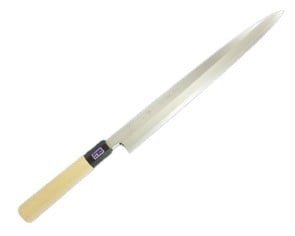
Minonokuni Matsu 11.8-inch (300mm) Yanagi
The 300mm yanagi is a sushi counter knife. Its length lets the chef slice a large block of fish, or a wide fillet of salmon, in a single long draw from heel to tip, so each slice keeps a smooth face and holds its shape on the plate.A knife this long needs space. It works best on a deep board with room to the side, and it rewards a practiced, relaxed stroke over force. We recommend it for experienced cooks, both because of the length and because of the steel. Matsu knives are forged from blue steel, which holds the keenest edge in the three standard Minonokuni lines but is also the most brittle. A cook who already sharpens single-bevel knives will keep it in good order.
Choosing a Yanagi LengthThe Matsu 240mm yanagiba is the standard counter length, and the Matsu 270mm is a step up in reach. Choose the 300mm when the fish and the board are large and the work is mostly slicing. For a 300mm yanagi in a less demanding steel, see the Take 300mm yanagiba.The knife shapes guide explains how the yanagi is used with the deba and usuba. Learn More$400.00 -
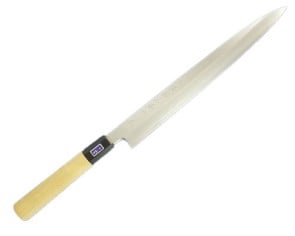
Minonokuni Matsu 10.6-inch (270mm) Yanagiba
At 270mm, this yanagiba suits a cook who slices large blocks of fish in volume, such as a full saku of bluefin or a wide side of salmon. The extra length over a 240mm lets each slice finish in one stroke even when the fish is broad, so fewer slices need a second pass.The longer blade asks more of the cook. It needs room on the board and a steady wrist to keep the tip from wandering. For that reason, we suggest it for professionals and experienced home sushi cooks, the same people who will appreciate the blue steel edge. A hard, thin edge like this one keeps its bite through a long service, but it is less forgiving of a twist than the white steel of the Take 270mm yanagiba.
Where the 270mm FitsThe Matsu yanagiba comes in four lengths. The 240mm is the standard counter length, while the 300mm gives the longest stroke for large fish and a wide board. Between them, the 270mm adds reach without the weight of the longest knife. The guide to Japanese and Western knife shapes covers the yanagiba in more detail.Every Matsu knife is forged by hand, and small hammer marks and color variation in the iron are normal. Learn More$355.00 -

Minonokuni Matsu 9.4-inch (240mm) Yanagiba
The 240mm yanagiba is the standard length at a sushi counter. It completes a slice of tuna or yellowtail in one draw without making the knife hard to handle on a standard board, and it gives enough room for hira-zukuri and the thin, angled sogi-zukuri cuts used for white fish.The Matsu blade is hand-forged from blue steel. Of the three standard Minonokuni lines, it holds an edge the longest, and it is also the most delicate, so it suits a cook who already has a feel for single-bevel knives.
Fitting the Length to the KitchenFor home use and smaller boards, the Matsu 210mm yanagiba is easier to manage. For whole loins and wide blocks of salmon, the Matsu 270mm adds reach. Left-handed cooks will want the Matsu 240mm left-handed yanagiba.Cooks who want the same length in a steel that is less brittle can look at the Take 240mm yanagiba. The knife shapes guide covers how the yanagiba differs from a Western slicer. Learn More$320.00 -

Minonokuni Matsu 8.3-inch (210mm) Yanagiba
The 210mm yanagiba is the length for a home kitchen or a small sushi station, where a longer slicer would overhang the board. It is long enough to cut a block of tuna or salmon for sashimi in a single pull, which leaves a clean, glossy face on each slice.Matsu is the top of the three standard Minonokuni lines, forged from blue steel. That steel holds a fine edge longer than white steel, and it is also harder and less forgiving of a twist or a knock against a plate. A sushi cook who already sharpens single-bevel knives will get the most from it.
How It CutsStart the slice at the heel and draw the knife toward you, letting the full length pass through the fish. A sawing motion tears the flesh, and pressing down crushes it. The flat back keeps each slice from sticking to the blade, and the single bevel steers the cut slightly away from the fish so the slice falls cleanly.
Other Lengths and LinesFor a longer stroke on larger blocks, see the Matsu 240mm yanagiba, the standard length at a sushi counter. Left-handed cooks need the Matsu 210mm left-handed yanagiba. To learn the technique on softer steel first, the Take 210mm yanagiba is the sensible step. Our knife shapes guide compares the yanagiba with the sujihiki and other slicers. Learn More$295.00

