
You have no items in your shopping cart.
Usuba / Nakiri
Usu(Thin)Ba(Knife)
Usuba is a traditional Japanese knife shape with a thick spine and pronounced shinogi line. Characterized by their rectangular shape and utter lack of camber Usuba knives are best used when preparing vegetables. The shape of the Usuba blade and the angle at which the handle is affixed to it allow for a significant degree of knuckle clearance which can be quite helpful when working with larger quantities. It is important to note that Usubas are typically one sided although this definition is not universally applicable and some manufacturers do create double-beveled knives that would indeed qualify as Usubas. The westernized version of an Usuba, which is typically double-beveled and also intended for use on vegetables, is known as a Nakiri. Although many believe the distinction between Usubas and Nakiris to be their one or two sidedness this is not wholly accurate. The key distinction between the two shapes is the thickness of the steel from which they are formed. Despite being named “thin knife” Usubas are thicker than their westernized counterpart the Nakiri.
-
Zwilling Four Star 6.5-inch Nakiri Knife
A nakiri is a Japanese vegetable knife with a flat edge and a squared tip, used for straight-down chopping and push cuts rather than rocking. The Zwilling Four Star 6.5-inch nakiri brings that geometry to Zwilling’s forged German steel and molded handle, for cooks who cut a lot of vegetables.The flat edge meets the board along its whole length, so slices of carrot and celery separate completely, and julienne and fine dice come out even. The tall, rectangular blade clears the knuckles and lifts chopped vegetables to the pan.Lift the whole blade and bring it straight down for each cut rather than rocking. The flat edge then separates every slice completely, which is the reason to choose a nakiri.For tip work as well as vegetables, see the Four Star bunka, which has a clipped point. Our guide to knife shapes compares the nakiri with the cleaver. Learn MoreRegular Price: $139.99
Special Price $99.95
-
Made In 6.6-inch Japanese Damascus Steel Nakiri
A nakiri is a Japanese vegetable knife with a tall, rectangular blade and a fully flat edge. Because the whole edge meets the board at once, each straight downward cut separates an onion slice or a stack of greens completely, without the connected strands a curved edge can leave. The Made In 6.6-inch Japanese Damascus Steel Nakiri is built for that kind of chopping.The tall blade keeps knuckles clear of the board and doubles as a scoop for carrying chopped vegetables to the pan. It is a push-cutting knife, so cooks who rock a blade through herbs will find the flat edge takes some adjustment.
Nakiri, Santoku or Gyuto?The 6.6-inch Japanese Damascus Santoku keeps a flat edge but adds a rounded tip for meat and fish, and the 8-inch Japanese Damascus Gyuto is the full-size all-purpose knife. Choose the nakiri if most of your prep is produce. Our Kitchen Knife Shapes guide covers the nakiri alongside the usuba, its single-bevel relative. Learn MoreRegular Price: $199.00
Special Price $169.95
-

Masahiro Shiro-Ko 7-inch (180mm) Usuba
Masahiro Shiro-Ko 180mm Usuba The Masahiro Shiro-Ko 180mm Usuba is a traditional Japanese vegetable knife sized for professional prep and larger produce. The extra length handles whole cabbages, daikon and long cucumbers in full strokes, and the tall, thin blade separates each push cut cleanly from the next. Features White #2 carbon steel: Shiro-ko (White Paper #2) is a high-purity carbon steel that takes an exceptionally keen edge and sharpens quickly on waterstones. It is not stainless. Single-bevel urasuki grind: The bevel on the face and the slightly concave back reduce friction in dense vegetables and allow paper-thin slicing and katsuramuki, the rotary peeling of daikon into long, continuous sheets. Straight edge profile: The flat edge makes full contact with the board for clean push cuts, julienne and brunoise. Lightweight wa-handle: The paulownia wood handle is exceptionally light, which keeps the balance in the blade for fine, controlled work. Choosing an Usuba The Masahiro Shiro-Ko 165mm Usuba is easier to handle on smaller boards. For a Yellow Paper carbon steel alternative at this length, see the Masahiro Traditional Carbon 180mm Usuba. Learn More$250.00 -

Masahiro Shiro-Ko 6.5-inch (165mm) Usuba
Masahiro Shiro-Ko 165mm Usuba The Masahiro Shiro-Ko 165mm Usuba is a traditional Japanese vegetable knife for cooks who want precise, clean cuts that preserve the texture and appearance of produce. Its tall, thin blade and straight edge meet the board along their full length, so each push cut separates completely without leaving connected slices. The compact length suits home kitchens and smaller boards. Features White #2 carbon steel: Shiro-ko (White Paper #2) is a high-purity carbon steel that takes an exceptionally keen edge and sharpens quickly on waterstones. It is not stainless. Single-bevel edge: The bevel on the face and the flat back let the blade produce paper-thin slices and perform katsuramuki, the rotary peeling of daikon and cucumber into long, continuous sheets. Straight edge profile: The flat edge makes full contact with the board for clean push cuts, julienne and brunoise. Lightweight wa-handle: The paulownia wood handle is exceptionally light, which keeps the balance in the blade for fine, controlled work. Choosing an Usuba The Masahiro Shiro-Ko 180mm Usuba adds length for larger vegetables such as cabbage and daikon. For a Yellow Paper carbon steel alternative, see the Masahiro Traditional Carbon 180mm Usuba. Learn More$215.00 -

Miyabi Birchwood SG2 6.5-inch Bunka Knife
The bunka combines a nakiri’s flat edge with a clipped, pointed tip, so it chops vegetables like a nakiri and also handles fine tip work such as scoring and coring. The Birchwood 6.5-inch bunka puts that shape on Miyabi’s premium line.Use the flat section for dicing onions and slicing peppers, and the reverse-angled "K-tip," or reverse tanto, for shallots, herbs and the detail work a square nakiri cannot do. It is a compact main knife for a cook who does most of the cutting on vegetables.For a squared tip, compare the Birchwood nakiri. The Miyabi Artisan bunka is the same shape with a hammered finish. Our guide to knife shapes describes the bunka. Learn More$364.95 -

Kyocera Innovation White 6-inch Ceramic Nakiri, Black Handle
A nakiri is a vegetable knife with a straight edge and a tall, squared blade. The straight edge touches the board along its whole length, so a chop through a bunch of kale or a pile of herbs cuts through completely without leaving pieces joined at the bottom. Kyocera’s 6-inch Innovation White nakiri adds a ceramic blade to that shape.Kyocera also points out that the wide blade works as a scoop for carrying chopped food from the board to a sauté pan. It suits boneless proteins as well as produce. Bone-in cuts and anything frozen should go to a steel knife, since ceramic chips under force.Knife Merchant holds authorized Kyocera dealer status, which customers raise before they order. It matters because Kyocera’s limited warranty covers only knives bought from authorized resellers.
Nakiri or Santoku?The Innovation White 5.5-inch Santoku has a pointed tip for finer work and a shorter blade. The nakiri is the better choice for chopping large amounts of vegetables. For a curved edge that rocks, see the Innovation White 7-inch Chef’s Knife. Learn More$95.00 -
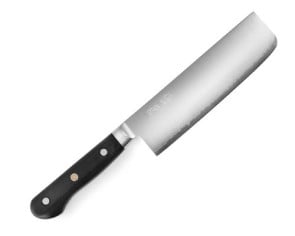
Suncraft Senzo Professional 6.5-inch (165mm) Nakiri
The nakiri is the Japanese vegetable knife, and this Senzo Professional version pairs a 6.5-inch blade with Suncraft’s SG2 core. The edge is flat from heel to tip, so each push cut meets the board along its full length and separates a carrot or a stack of scallions completely.A tall, rectangular blade gives knuckle clearance and a wide face for carrying chopped vegetables to the pan. Because there is no pointed tip, it is a forgiving knife for cooks who prep a lot of produce and want speed and precision without rocking the blade. The hard SG2 edge holds its keenness through long sessions of vegetable prep, and the black pakkawood handle and welded bolster match the rest of the Senzo Professional line. This high-hardness steel is tougher than many softer steels and well suited to a professional kitchen. Suncraft pairs a Western-style handle with the Japanese nakiri shape, and the elegantly simple design is an excellent value given the quality of the materials, the fit and finish of the handle and the balance of the knife. Vegetarian cooks and anyone who fills a wok with sliced produce will find it the fastest knife for the job.
Nakiri or Bunka?The Senzo Professional Bunka Knife adds a pointed tip for protein and detail work. Learn More$225.00 -

Kikuichi WDT Series Warikomi Damascus Tsuchime 6.7-inch (170mm) Nakiri
The WDT nakiri is Kikuichi’s vegetable knife in its Warikomi Damascus Tsuchime line, a 6.7-inch (170mm) rectangular blade with a flat edge for full contact with the board. Each push cut goes cleanly through an onion or a head of cabbage with no rocking needed, and each thin slice comes out even.The hammered tsuchime surface over 17 layers of damascus and a VG10 core helps release food, per Kikuichi, so slices of cucumber and potato fall away from the steel. Kikuichi gives the WDT line a substantial weight, comparable to many German knives, together with the precision of a Japanese blade. Its tall blade scoops prepared vegetables off the board and gives generous clearance for the knuckles. This nakiri has a Western handle of mahogany-dyed birch, a good fit for cooks who prefer a familiar grip over a Japanese wa handle.
Vegetable Knife OptionsFor a nakiri with a lighter Japanese handle, see the NWD 6.7-inch (170mm) Nakiri. To protect the edge, add a Kikuichi 180mm Universal Nakiri Saya. Learn More$309.95 -

I.O. Shen 6.7 in. (170mm) Bunka Nakiri
The I.O. Shen 6.7 in. (170mm) Oriental Slicer has a smaller handle then other knives in the I.O. Shen line that is to give the user more finger clearance between the cutting board the the handle making this a good knife for prepping onions or mincing garlic. This is not just a good vegetable knife but is naturally a slicing knife and is thin enough to slice fillets of fish or prepare sashimi. Learn More$176.75 -
Messermeister Meridian Elite 7-inch Kullens Vegetable Knife
Messermeister drew on the Japanese usuba for this 7-inch vegetable knife, a tall, straight-edged blade made for precise, clean cuts through soft, moist or firm vegetables. Kullens hollows along the blade help release starchy slices of potato and sweet potato, so they drop onto the board cleanly.Because the edge is flat from heel to tip, a push cut meets the board along its full length and separates a carrot or a bunch of scallions completely, with no strands left attached. Messermeister also suggests it for slicing squash and sectioning melons. The height of the blade keeps knuckles off the board and lets you carry chopped vegetables straight to the pan. For a busy kitchen that preps a lot of produce, it offers the usuba’s straight cut in a sturdier German blade that tolerates the pace of a dinner rush.
Vegetable Knife or Santoku?The 7-inch Kullens Santoku adds a rounded tip for more general prep. Learn MoreRegular Price: $214.95
Special Price $171.96


