
You have no items in your shopping cart.
Deba
De(Fat) Ba(Knife)
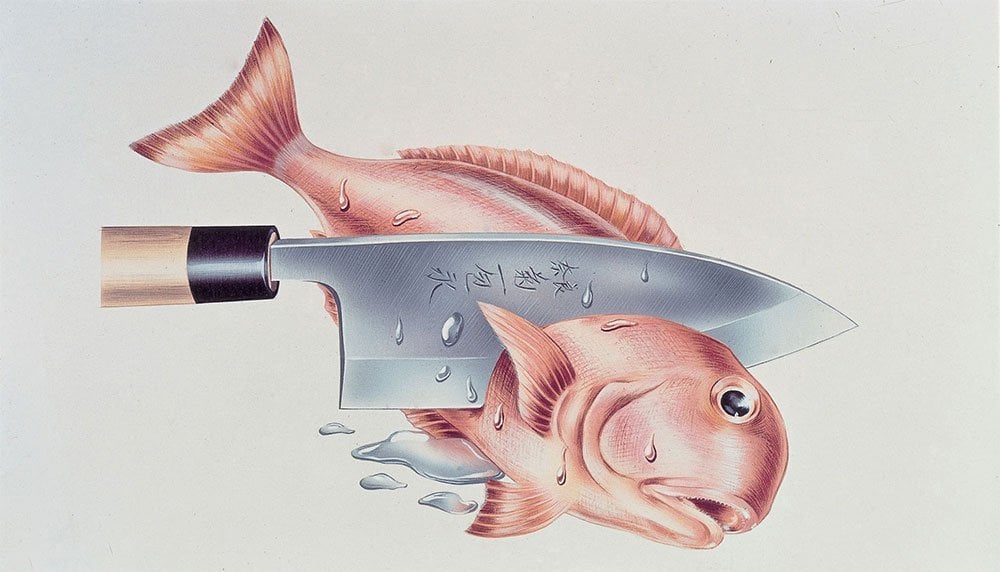
This traditional Japanese knife shape is ideal for butchering and filleting fish as its unique shape cuts cleanly and precisely preserving delicate flesh. Deba knives can also be used on poultry, vegetables, and meat although we do not recommend using it for breaking dense bones as the ultra-hard Japanese steel is subject to chipping and pitting. Keep in mind that Deba knives are typically single sided, but some more westernized debas are made with a double-bevel meaning that both sides are angled. Note that the term yo-deba may be used by certain makers to refer to a knife that is particularly thick, but this definition maintains no correlation to the standard deba characteristics.
-
Minonokuni Matsu 6.5-inch (165mm) Deba
A 165mm deba is sized for the whole fish a cook brings home from the market, such as sea bream, mackerel and small salmon. The Matsu version pairs that size with blue steel, so the edge stays keen through a full morning of breaking down fish before it needs the stone.
Work on the FrameThe heel and the thick spine take the heavy cuts through the head and collar. The forward third does the fine work, tracing the backbone for a clean three-piece fillet and lifting the belly away from the ribs. Kept to fish and poultry, the blade handles small bones well, but it is not a cleaver for frozen product or the heavy leg bones of beef.Blue steel is the hardest steel in the Minonokuni range and the most delicate, and a single-bevel edge is very thin by nature. Our advice is to choose Matsu after some experience with chisel-ground knives. A cook still learning that grind will be better served by the Take 165mm deba in white steel, which is less brittle, or the Ume 165mm deba, the most forgiving of the three.
165mm or 180mm?Choose this size for small and medium fish and for jointing chickens. For salmon and heavier heads, the Matsu 180mm deba carries more weight behind the heel. Our guide to kitchen knife shapes explains where the deba fits among the other Japanese knives. Learn MoreRegular Price: $330.00
Special Price $260.00
-

Minonokuni Sakura Damascus 5.9-inch (150mm) Deba
The Sakura Damascus deba is a hand-forged, water-quenched craftsman’s piece for breaking down whole fish and splitting lobster. At 150mm, it suits small and medium fish. Its rippled Damascus jacket makes it a knife people notice on the board.Use the heel for heads and lobster shells, and the forward edge to follow the backbone for clean fillets. The single bevel keeps the edge close to the bone. As with any deba, avoid twisting the blade in a joint or using it on frozen food.
A Specialty KnifeSakura is one of our specialty lines. It is technically more premium than our standard lines, but not necessarily right for every user. The blade is blue steel, which holds an edge a long time but is delicate, and its single-bevel edge is very thin by nature. A cook new to the deba will be better served by the Take 150mm deba or the Ume 150mm deba.Search results for “Sakura knives” also turn up an unrelated company. This knife is made by Minonokuni and sold by Knife Merchant. For more on the deba, see our guide to kitchen knife shapes. Learn More -

Minonokuni Matsu 7.1-inch (180mm) Deba
Salmon, large sea bass and big snapper call for more blade than a small deba can give. The Matsu 180mm deba adds length and weight behind the heel, so the knife does more of the work when a head must be split or a thick collar cut through.The hard blue steel edge holds up through a long run of fish. It comes with a caveat, though. Blue steel is the most delicate of the steels in the Minonokuni line, so the edge rewards a cook who already knows how a single-bevel blade tracks along a backbone. Twist the blade in a bone joint and the thin edge can chip. For a cook still building that feel, the Take 180mm deba is the better choice, and it is less brittle.
Choosing the SizePick the 180mm for larger fish, or for a kitchen that breaks down a mix of fish and whole poultry daily. The Matsu 165mm deba is quicker in the hand on mackerel and smaller bream. Both are right-handed. The kitchen knife shapes guide shows the deba alongside the yanagiba and usuba it is used with.Each Matsu knife is forged and finished by hand, so the blade carries hammer marks and small variations in the kasumi finish. Those marks are part of how the knife was made, and they do not affect the edge. Learn More


