
You have no items in your shopping cart.
Deba
De(Fat) Ba(Knife)
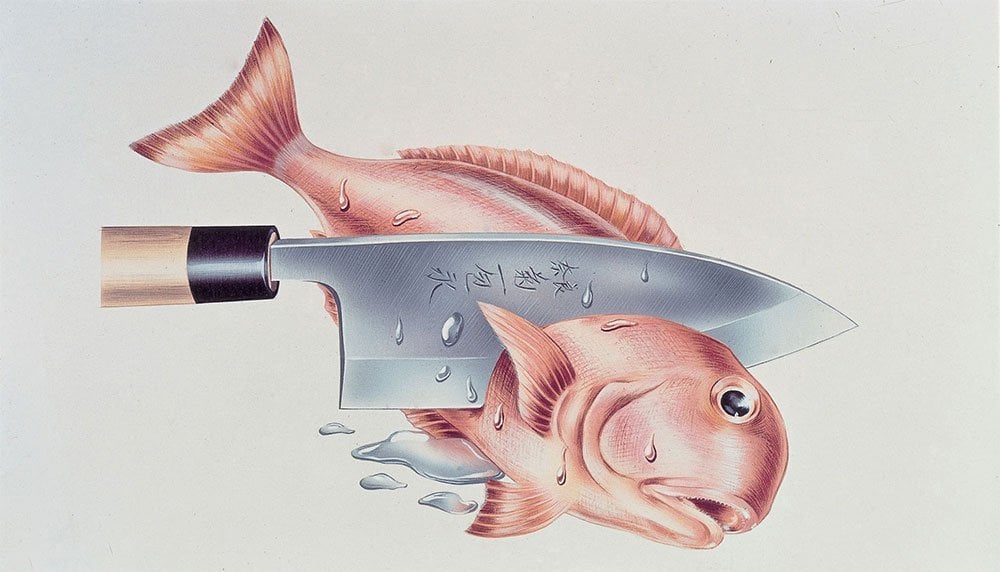
This traditional Japanese knife shape is ideal for butchering and filleting fish as its unique shape cuts cleanly and precisely preserving delicate flesh. Deba knives can also be used on poultry, vegetables, and meat although we do not recommend using it for breaking dense bones as the ultra-hard Japanese steel is subject to chipping and pitting. Keep in mind that Deba knives are typically single sided, but some more westernized debas are made with a double-bevel meaning that both sides are angled. Note that the term yo-deba may be used by certain makers to refer to a knife that is particularly thick, but this definition maintains no correlation to the standard deba characteristics.
-

Minonokuni Take 5.3-inch (135mm) Ko-Deba
Ko-deba means small deba. At 135mm, this Take knife is built for fish that a full-size deba would overpower. Horse mackerel, sardines, smelt and small trout are its work. On fish this size, the work is mostly filleting rather than cleaving.The blade tapers from a thick spine near the handle to a fine tip. That taper lets the cook open a small fish along the belly, run the tip down each side of the backbone and lift the fillets with very little flesh left on the frame. It is a light knife, so we do not recommend it for splitting heads or cutting through heavy collars. For that work, use the Take 150mm deba or a larger size.
Why TakeTake sits in the middle of the three standard Minonokuni lines. Its white steel is adequate for professional use but less brittle than the blue steel of the Matsu line, which makes it a sound choice for a cook who is not yet an expert with single-bevel knives. The knife shapes guide shows how the deba compares with Western fillet knives.A cook who processes small fish for a restaurant, or an angler who cleans a cooler of panfish at home, will find the ko-deba quicker to handle than any larger size. Learn More$180.00 -

Minonokuni Take 5.9-inch (150mm) Deba
A 150mm deba covers most fish a home cook will bring home whole, from trout and mackerel to a small snapper, and it is small enough for a standard home cutting board. The Take version is a sound first deba for a cook who wants to learn traditional fish butchery.The thick, heavy blade does the forceful work. Cut through the head and collar with the heel, then switch to the tip to follow the backbone and separate the fillets cleanly from the bone. The single bevel helps the edge ride flat along the frame, so less flesh is left behind.
A Steel That Tolerates LearningWe describe Take as the sweet spot of the Minonokuni range. Its white steel holds a fine edge well enough for professional kitchens, and it is less brittle than the blue steel used in the Matsu deba. That margin matters while a cook is learning how hard to lean on the heel.Other SizesSmaller fish are quicker work with the Take 135mm ko-deba. The Take 165mm deba adds weight for larger fish and for poultry. Left-handed cooks can order the Take 150mm left-handed deba, which we keep in stock. Read about the deba and its uses in our guide to kitchen knife shapes. Learn More$190.00 -

Minonokuni Take 6.5-inch (165mm) Deba
Between the small and large debas, the 165mm is the all-round size. It has enough weight to remove the head of a medium salmon or sea bass, yet it is easy enough to control on mackerel and trout. It is also a well-sized knife for breaking down whole chickens and for preparing poultry for yakitori.On poultry, the heel cuts through the joints and the thin wing tips, while the tip frees the oysters and the breast from the carcass. On fish, the single bevel keeps the edge flat to the frame for a clean three-piece fillet. Neither job calls for chopping through heavy bone, and the deba should not be used that way.
Matsu, Take or UmeAll three standard Minonokuni lines make a 165mm deba. Take, in white steel, is the sweet spot. It is adequate for professional use and less brittle than the blue steel Matsu 165mm deba. For a cook who wants the most forgiving knife to learn sharpening on, the Ume 165mm deba is the place to start.Left-handed cooks should choose the Take 165mm left-handed deba. The kitchen knife shapes guide covers how a deba differs from a boning knife. Learn More$216.00 -

Minonokuni Take 7.1-inch (180mm) Deba
When the fish on the board is a large salmon or a big snapper, the 180mm deba is the size to reach for. The extra length and weight let the heel drive through the head and collar in fewer strokes, and the longer edge follows a wide backbone in one pass.Being heavy, the knife does more of the work, and the cook should let it. Guide the blade along the bone instead of pushing it, and use the tip to separate the belly and ribs. A heavy deba still has a thin edge, so leave frozen fish and thick beef bones to other tools, and never twist the blade in a joint.
Why We Recommend TakeTake is the middle of the three standard lines. Its white steel holds an edge well enough for a working kitchen, and it is less brittle than blue steel, so it is the sensible choice for a cook who has not used many single-bevel knives. Cooks experienced with the grind may prefer the blue steel Matsu 180mm deba.The Take 165mm deba is more nimble, while the Take 195mm deba is the largest size. Left-handed cooks should see the Take 180mm left-handed deba. The knife shapes guide covers the deba in detail. Learn More$242.00 -

Minonokuni Take 5.9-inch (150mm) Left-Handed Deba
A deba ground for the left hand puts the bevel on the left face of the blade, so the edge follows the backbone when a left-handed cook fillets a fish. This Take 150mm deba is that mirror image, and we keep it in stock.The size suits trout, mackerel, small bream and similar fish, and it handles poultry jointing as well. Start at the head with the heavy heel, then work along the frame with the tip. A right-handed deba used in the left hand fights the cook on every pass and leaves meat on the bone, which is why the grind matters more on this knife than on a double-bevel blade.
Choosing TakeThe Take line is our recommendation for a cook who is new to single-bevel knives. Its white steel is ready for professional use, yet it is less brittle than blue steel and will tolerate the occasional misjudged cut while technique develops. A Ume 165mm left-handed deba is the more forgiving option for a cook who expects to spend time learning to sharpen.For larger fish, the Take 165mm left-handed deba and Take 180mm left-handed deba add length and weight. The right-handed version is the Take 150mm deba. The knife shapes guide has more on the deba. Learn More$260.00 -

Minonokuni Take 7.7-inch (195mm) Deba
The 195mm is the largest deba in the Take line, built for large saltwater fish and big freshwater fish. Its mass is the point. A heavy blade drops through the head and collar of a large fish with little effort from the cook, and the long edge keeps the cut straight along a wide frame.That weight makes it slower on small fish, so it suits a cook who regularly handles large ones, such as a restaurant buying whole fish or an angler cleaning a large catch. For mixed work, the Take 180mm deba or Take 165mm deba is easier to manoeuvre.
Steel ChoiceWhite steel gives the Take line an edge that holds up in a professional kitchen while staying less brittle than blue steel. That combination is why we call Take the sweet spot of the Minonokuni range. A cook who wants the same size in the most forgiving steel can look at the Ume 195mm deba.Left-handed cooks will find the Take 180mm left-handed deba the largest left-handed option in the line. For more on choosing a deba, see the guide to knife shapes. Learn More$265.00 -

Minonokuni Take 6.5-inch (165mm) Left-Handed Deba
For a left-handed cook, the 165mm Take deba is a dependable all-round choice. The blade is forged and ground as a true left-handed knife, with the bevel on the left face, so it tracks along the spine of a fish the way a right-handed deba does for a right-handed cook.The weight at this size is useful when tracing the backbone on salmon or a small tuna, and it carries through the head and collar without forcing. It is also a good size for game birds and freshwater fish. Before a large job, check that the edge is keen. A deba that has lost its edge needs more force, and force is how a thin edge gets chipped.
Steel and SizeTake uses white steel, which takes a very keen edge and returns to sharpness quickly on a waterstone. It is less brittle than blue steel, which is why we suggest Take for cooks who are not yet experts in single-bevel knives.The Take 150mm left-handed deba is lighter for small fish, and the Take 180mm left-handed deba adds weight for larger ones. The right-handed model is the Take 165mm deba. See the kitchen knife shapes guide for an overview of the deba. Learn More$295.00 -

Minonokuni Take 7.1-inch (180mm) Left-Handed Deba
This is a left-handed deba in the true sense. Forging and grinding put the single bevel on the left face, rather than reshaping a right-handed blade, so a left-handed cook gets the same control along the frame that the knife was designed to give. At 180mm, it is the largest left-handed deba in the Take line.The size is meant for large fish such as salmon and big snapper. The heavy heel splits heads and cuts collars, and the long edge follows the backbone in fewer passes. On poultry, it breaks down a whole bird with room to spare.
A Line for Learning and for WorkTake is the line we suggest for cooks who want a knife good enough for professional work but less brittle than blue steel. For a left-handed cook still learning to sharpen a single bevel, the Ume 180mm left-handed deba is more forgiving still.Shorter left-handed sizes are the Take 165mm and Take 150mm. The right-handed version is the Take 180mm deba. The knife shapes guide explains where the deba fits.Each Take knife is forged by hand. Expect small hammer marks, a slightly uneven finish on the iron and other signs of handwork, none of which affect the edge. Learn More

