
You have no items in your shopping cart.
Deba
De(Fat) Ba(Knife)
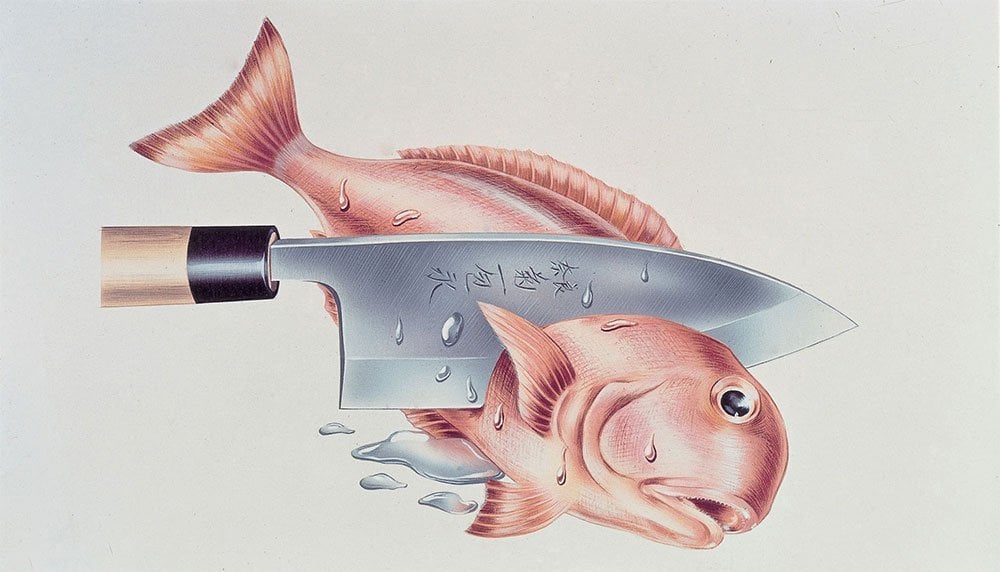
This traditional Japanese knife shape is ideal for butchering and filleting fish as its unique shape cuts cleanly and precisely preserving delicate flesh. Deba knives can also be used on poultry, vegetables, and meat although we do not recommend using it for breaking dense bones as the ultra-hard Japanese steel is subject to chipping and pitting. Keep in mind that Deba knives are typically single sided, but some more westernized debas are made with a double-bevel meaning that both sides are angled. Note that the term yo-deba may be used by certain makers to refer to a knife that is particularly thick, but this definition maintains no correlation to the standard deba characteristics.
-

Masahiro Shiro-Ko 165mm Deba
The Masahiro Shiro-Ko 165mm Deba is a traditional Japanese knife crafted for precise fish butchery and clean, confident cuts. Forged from White #2 steel (Shirogami/Shiro-Ko), this blade is celebrated for its exceptional purity, allowing it to take on an incredibly fine edge with ease—and keep it. The result is outstanding sharpness that highlights the finesse and delicacy central to Japanese cuisine. Designed in the classic Deba profile, the 165mm blade offers the perfect balance of control and power for breaking down fish, from filleting to cutting through small bones. Its thoughtful construction makes it approachable for both professionals and dedicated home cooks, combining traditional performance with user-friendly handling. Finished with a lightweight Paulownia (Empress) wood handle and a polished water buffalo horn ferrule, this knife delivers comfort, balance, and understated elegance. The Masahiro Shiro-Ko Deba is a refined tool built for cooks who value sharpness, tradition, and precision in every cut. Learn More$228.00 -

Glestain 9.4-inch (240mm) Deba
For fabricating large, powerful fish such as tuna, swordfish and large salmon, the 240mm deba has the weight and length the job demands. It removes heads and collars, splits frames and takes fillets from fish too large for a smaller deba.The blade has a smooth W Series face and the clean look of a classic deba, in stainless steel that resists rust at the fish station. Its edge is ground close to a single bevel, with only a small back bevel, so it cuts with the precision of a traditional deba.At almost double the carbon content of standard German stainless steel, this knife is over 20% lighter than carbon steel debas of the same size, significantly reducing fatigue during long sessions. A 240mm deba is a professional tool for fishmongers, sushi kitchens and anglers who land large fish.
Choosing a Deba SizeThe Glestain deba also comes as a 160mm Deba and a 200mm Deba. For filleting flatfish and portioning, pair it with a flexible fillet knife or a sujihiki. Our guide to kitchen knife shapes explains the deba. Learn More$306.00 -

Glestain 6.3-inch (160mm) Deba
A deba is the heavy Japanese knife for breaking down whole fish, and the 160mm size suits small and medium fish such as trout, mackerel and snapper. Glestain makes it in stainless steel, which spares you the rust that carbon steel debas invite around a wet fish station.A stainless deba can be given a pronounced secondary bevel, which blunts the precise work the shape is meant for. The Glestain is ground close to a traditional single bevel, with only a small back bevel, so it keeps the acute angle and clean cut of a classic deba. The thick spine and weight let it split heads and work through the small bones of a fish.
Choosing a Deba SizeThe Glestain deba also comes as a 200mm Deba and a 240mm Deba. For filleting flatfish and portioning, pair it with a flexible fillet knife or a sujihiki. Our guide to kitchen knife shapes explains the deba. Learn More -

MAC Fish Cleaver
The CL-75 is the heaviest fish knife MAC makes, a cleaver-weight deba for the heads, collars and backbones of large fish. It takes the cuts on salmon, halibut and other large fish that would damage a thinner blade.Its 5 mm blade and weight let it split a salmon head or cut through a collar in one or two strokes, while the edge is still fine enough to trim the belly. It should be sharpened by hand on whetstones.For filleting, the 6.5-inch deba is lighter and more precise. Our Kitchen Knife Shapes guide explains the deba and the cleaver. Learn More$214.95 -

MAC 6.5-inch Deba
The deba is the Japanese knife for breaking down whole fish, with a thick, heavy blade that cuts through the head and the collar and splits the backbone of small and medium fish. The MAC CL-65 is a 6.5-inch deba in molybdenum stainless steel, for filleting large fish.Its 5 mm spine gives the weight to cut through fish bones without damage to the edge, and the pointed tip follows the backbone when taking off the fillets. The stainless blade does not need the rust care of a traditional carbon steel deba, which suits a busy fish station.For small fish such as mackerel and sardines, the aji deba is the better size. For large heads and collars, the fish cleaver. Our Kitchen Knife Shapes guide explains the deba. Learn More -
Minonokuni Matsu 6.5-inch (165mm) Deba
A 165mm deba is sized for the whole fish a cook brings home from the market, such as sea bream, mackerel and small salmon. The Matsu version pairs that size with blue steel, so the edge stays keen through a full morning of breaking down fish before it needs the stone.
Work on the FrameThe heel and the thick spine take the heavy cuts through the head and collar. The forward third does the fine work, tracing the backbone for a clean three-piece fillet and lifting the belly away from the ribs. Kept to fish and poultry, the blade handles small bones well, but it is not a cleaver for frozen product or the heavy leg bones of beef.Blue steel is the hardest steel in the Minonokuni range and the most delicate, and a single-bevel edge is very thin by nature. Our advice is to choose Matsu after some experience with chisel-ground knives. A cook still learning that grind will be better served by the Take 165mm deba in white steel, which is less brittle, or the Ume 165mm deba, the most forgiving of the three.
165mm or 180mm?Choose this size for small and medium fish and for jointing chickens. For salmon and heavier heads, the Matsu 180mm deba carries more weight behind the heel. Our guide to kitchen knife shapes explains where the deba fits among the other Japanese knives. Learn MoreRegular Price: $330.00
Special Price $260.00
-

I.O. Shen 170mm Maoui Deba
The I.O. Shen 6.7 in.(170mm) Maoui Deba is not a traditional Japanese Deba design as the edge is on both sides of the blade. With this style get the great benefits of a knife that can handle work on fish like filleting, gutting, and gill removal with a more durable edge and premium stainless steel. Note that the steel that forms the scrimshaw design on I.O. Shen knives is welded to the tang and not just some type of silver paint. Tri-Ply steel with VG-12 core 1.7 mm spine thickness 12.13 inch overall length 8.5 ounces (240 grams) Made In Tai Wan Learn More$189.95 -

Minonokuni Take 7.1-inch (180mm) Left-Handed Deba
This is a left-handed deba in the true sense. Forging and grinding put the single bevel on the left face, rather than reshaping a right-handed blade, so a left-handed cook gets the same control along the frame that the knife was designed to give. At 180mm, it is the largest left-handed deba in the Take line.The size is meant for large fish such as salmon and big snapper. The heavy heel splits heads and cuts collars, and the long edge follows the backbone in fewer passes. On poultry, it breaks down a whole bird with room to spare.
A Line for Learning and for WorkTake is the line we suggest for cooks who want a knife good enough for professional work but less brittle than blue steel. For a left-handed cook still learning to sharpen a single bevel, the Ume 180mm left-handed deba is more forgiving still.Shorter left-handed sizes are the Take 165mm and Take 150mm. The right-handed version is the Take 180mm deba. The knife shapes guide explains where the deba fits.Each Take knife is forged by hand. Expect small hammer marks, a slightly uneven finish on the iron and other signs of handwork, none of which affect the edge. Learn More -

Minonokuni Take 6.5-inch (165mm) Left-Handed Deba
For a left-handed cook, the 165mm Take deba is a dependable all-round choice. The blade is forged and ground as a true left-handed knife, with the bevel on the left face, so it tracks along the spine of a fish the way a right-handed deba does for a right-handed cook.The weight at this size is useful when tracing the backbone on salmon or a small tuna, and it carries through the head and collar without forcing. It is also a good size for game birds and freshwater fish. Before a large job, check that the edge is keen. A deba that has lost its edge needs more force, and force is how a thin edge gets chipped.
Steel and SizeTake uses white steel, which takes a very keen edge and returns to sharpness quickly on a waterstone. It is less brittle than blue steel, which is why we suggest Take for cooks who are not yet experts in single-bevel knives.The Take 150mm left-handed deba is lighter for small fish, and the Take 180mm left-handed deba adds weight for larger ones. The right-handed model is the Take 165mm deba. See the kitchen knife shapes guide for an overview of the deba. Learn More$295.00 -

Minonokuni Ume 7.7-inch (195mm) Deba
The 195mm is the biggest deba in the Ume line. It is meant for removing heads and collars and separating fillets on large fish with a wide frame. The extra length gives the edge more reach along the backbone, and the extra weight takes the strain off the cook’s wrist.This deba is beautifully shaped and ground for its line. The face is flat enough that the shinogi, the line where the bevel meets the face, lies evenly on the stone during sharpening. That matters for a learner, because a flat bevel is much easier to sharpen consistently than an uneven one.
Who It SuitsUme is the most forgiving of the three standard Minonokuni lines and the best for learning to sharpen. On a large, heavy knife, a forgiving edge is especially useful, since a deba of this size meets a lot of bone. Cooks who already handle large fish with confidence may prefer the white steel Take 195mm deba.For mixed fish and poultry, the Ume 180mm deba or Ume 165mm deba is easier to handle. Our guide to kitchen knife shapes places the deba among its relatives. Learn More$148.00


