
You have no items in your shopping cart.
Gyuto
Although not a traditional Japanese knife shape, a gyuto is considered to be the Japanese alternative to a chef knife. Much flatter along the blade and longer in the heel, Gyutos lack the camber of a traditional chef knife. If you are unsure of whether a knife is a chef knife or a Gyuto take a look at the tip; on a Gyuto the tip will be parallel to or below center line of the knife.
-

Masahiro MV Left-Handed 8.25-inch (210mm) Gyuto
Most Japanese chef’s knives are ground for the right hand, and a left-handed cook using one feels it on every long slice as the blade drifts off line. Masahiro makes this 210mm MV gyuto with the edge ground for the left hand, so it tracks straight through onions, carrots and proteins.At 210mm it is the all-purpose length: big enough for a case of mirepoix, small enough for a home board. The profile is flatter than a German chef’s knife, suited to push cuts and slicing with a little curve for mincing. The steel is stainless, and the thin asymmetrical edge comes back quickly on a stone.Masahiro makes the MV line in Seki with materials sourced in Japan, and its craftsmen handle almost every step, from hardening to the final sharpening, at the company’s own factory.
Other left-handed gyutoMasahiro also makes the MV left-handed gyuto at 240mm and 270mm. For carbon steel, see the Virgin Carbon Left-Handed 210mm Gyuto. Learn More$154.00 -

Masahiro MV 8.25-inch (210mm) Gyuto
The 210mm MV gyuto is the knife to choose if you want one Japanese chef’s knife to do most of the work. It is the right length for dicing a case of onions, slicing a roast or breaking down a squash, and it is still manageable on a home cutting board.Masahiro builds the MV line as a working knife. There is no Damascus pattern or hammered finish; the effort goes into the stainless steel and the edge. The edge is ground asymmetrically for the right hand, with most of the bevel on the face, so the blade is thin behind the edge and easy to keep sharp. The profile is flatter than a German chef’s knife, which favors push cuts and slicing, with enough belly near the tip to mince.
Choosing a lengthThe 180mm suits tight stations; the 240mm gives longer strokes for larger produce and roasts. Left-handed cooks should choose the MV Left-Handed 210mm Gyuto. For carbon steel, see the Virgin Carbon 210mm Gyuto. Learn More$119.25 -
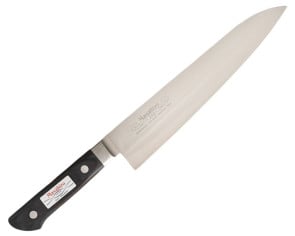
Masahiro MV 9.5-inch (240mm) Gyuto
The extra 30mm over a 210mm knife means a cabbage or melon is cut in one pass, a roast is sliced in long strokes and a pile of herbs is chopped without shuffling the knife across the board.Masahiro makes every MV knife in Seki, with materials sourced in Japan and almost every step, from hardening to final sharpening, done at its own factory. The result is a plain, well-made stainless knife with an asymmetrical edge ground for the right hand. Its profile favors push cuts and slicing, and the steel is quick to restore on a ceramic rod between sharpenings.Hand wash it, dry it and store it in a block or edge guard; the stainless steel needs no more than that.
210 or 240?Choose the 210mm for a small board or if you are new to Japanese knives; choose the 240mm for a large board and high-volume prep. Left-handed cooks should choose the MV Left-Handed 240mm Gyuto. For carbon steel, see the Virgin Carbon 240mm Gyuto. Learn More$149.00 -

Masahiro MV 10.5-inch (270mm) Gyuto
A 270mm gyuto is a production knife. On a large board it moves through cases of onions, peppers and celery with long, efficient strokes, slices large roasts and fish loins in one pass and splits cabbages and melons cleanly.The MV steel is stainless and Masahiro’s right-handed asymmetrical edge keeps the blade thin behind the cutting edge, so even at this length it cuts with little wedging. It is a long knife, though, and on a small board a 210 or 240mm is easier to control.It is also useful on the carving station, where its length handles a whole roast or a ham in long strokes, and in kitchens that break down large quantities of produce such as cabbage, melons and squash.
Choosing a long gyutoThe 240mm is easier to control; the 300mm is longer still for brisket and very large produce. Left-handed cooks should choose the MV Left-Handed 270mm Gyuto. For carbon steel, see the Virgin Carbon 270mm Gyuto. Learn More$188.75 -
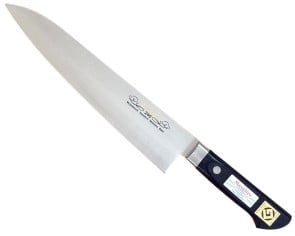
Masahiro MV Left-Handed 9.5-inch (240mm) Gyuto
Left-handed versions of professional Japanese knives are hard to find, and Masahiro grinds this one for the left hand at the factory. At 240mm it gives a left-handed cook the length most professionals prefer for daily prep.The longer blade slices roasts and large fish in fewer strokes, splits cabbages and squash in one pass and covers more of the board when chopping herbs. The MV steel is stainless, and the profile is flatter than a German chef’s knife, so it favors push cuts and slicing. Keep it on a stone or ceramic rod; the thin edge comes back quickly.Every MV knife is sharpened by hand before it is packed, and Masahiro checks cutting performance with a Honda-type paper cutting test at the Gifu Prefectural research institute.
Why left-handed Japanese knives are scarceAn old Japanese superstition regarded left-handedness as untrustworthy, so most Japanese cooks learned to cut with the right hand. Demand for left-handed knives in Japan stayed low as a result, and the final work on left-handed models such as this one is done by hand.
Other left-handed gyutoFor a smaller board, choose the MV Left-Handed 210mm Gyuto; for the largest prep jobs, the 270mm. For carbon steel, see the Virgin Carbon Left-Handed 240mm Gyuto. Learn More$192.75 -
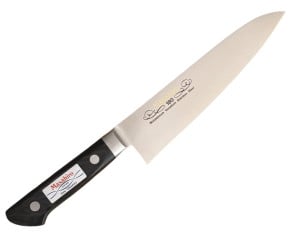
Masahiro MV 7-inch (180mm) Gyuto
A 180mm gyuto is the size for a station where board space is short: long enough to dice an onion or slice a chicken breast, short enough to work on a small board without knocking into the pans. On the line it is the knife that stays out during service; at home it suits cooks who find an 8-inch knife unwieldy.The profile is flatter than a German chef’s knife, so it favors push cuts and slicing over rocking, with enough curve near the tip for mincing herbs and garlic. The MV steel is stainless, and the right-handed asymmetrical edge is thin and quick to touch up.
Which MV gyuto?For one all-purpose knife, consider the MV 210mm Gyuto. The 180mm suits tight stations and smaller hands. For carbon steel at this size, see the Virgin Carbon 180mm Gyuto; for a lighter knife, the L Series 180mm Gyuto. Learn More$112.50 -

Masahiro MV Left-Handed 10.5-inch (270mm) Gyuto
This is the longest left-handed knife in the MV line, made for left-handed cooks who do production prep. The 270mm blade covers a large board with each stroke, slices roasts and fish loins in a single pass and splits large produce cleanly.The edge is ground for the left hand, so long strokes stay straight instead of drifting. The profile is flatter than a German chef’s knife and is meant to slice rather than rock. The steel is stainless and easy to keep sharp on a stone. At this length, a large board and some room to work make the most of it.A left-handed cook working on a large board gets the full benefit of the length, since every long stroke stays straight from heel to tip.
Other left-handed gyutoFor a more manageable length, choose the MV Left-Handed 240mm Gyuto or the 210mm. The right-handed version is the MV 270mm Gyuto. Learn More$244.50 -

Masahiro L Series 7-inch (180mm) Gyuto
For those not in the industry: most prep is done away from the heat on larger tables, but a line cook needs a blade for the many small cutting jobs that come up during service. This light, nimble 180mm gyuto is made for that part of the kitchen.Its cutting edge is flatter than a Western chef’s knife’s, so it favors slicing and push cuts over rocking. Most chef’s knives are 8 inches or longer, and this shorter blade also suits home cooks who want a knife that is easy to handle. The thin blade passes through food with little resistance and is easy to touch up on a honing rod.Without a bolster, the edge runs to the heel, so the whole length is usable and easy to sharpen.
Choosing an L Series gyutoThe L Series 210mm Gyuto is the everyday length. For a heavier stainless knife at this size, see the MV 180mm Gyuto. Learn More$63.00 -

Masahiro L Series 8.25-inch (210mm) Gyuto
A gyuto is the Japanese chef’s knife. Where a German chef’s knife has its tip in line with the spine, a gyuto’s tip sits closer to the cutting edge, giving a longer, flatter cutting surface. It is the workhorse that handles most of the prep.Some cooks prefer a heavy knife and let the weight do some of the work; others prefer a lighter knife that is easier on the hand and wrist. If you are in the second group, this thin, light stainless gyuto is the one to choose. It is especially easy to maintain with a ceramic or steel honing rod.Without a bolster, the edge runs to the heel and the whole length can be sharpened evenly.
L Series or MV?The MV 210mm Gyuto is heavier, with a bolster and a fuller handle. For a shorter L Series knife, see the 180mm Gyuto; for a santoku, the L Series Santoku. Learn More$73.00 -
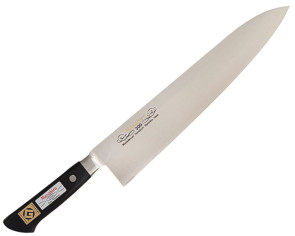
Masahiro MV 11.8-inch (300mm) Gyuto
At 300mm, this gyuto is for the jobs a shorter knife needs several strokes to finish: slicing a whole brisket or prime rib, splitting watermelons and large squash, and breaking down big fish loins. One long, unbroken stroke leaves a cleaner surface than sawing back and forth.It is a large knife and needs a large board and room to swing, so it suits professional kitchens, butchers and pitmasters more than most home kitchens. The stainless MV steel and the right-handed asymmetrical edge keep the blade thin enough to cut cleanly despite its size.Because the blade is so long, a light touch is enough: let the length carry the cut instead of pressing down. A long edge guard or a knife roll with a long pocket protects it in transport.
Long knife choicesThe MV 270mm Gyuto is easier to manage for daily prep. For slicing only, the MV 270mm Sujihiki is narrower and lighter. Learn More$235.00

