
You have no items in your shopping cart.
Gyuto
Although not a traditional Japanese knife shape, a gyuto is considered to be the Japanese alternative to a chef knife. Much flatter along the blade and longer in the heel, Gyutos lack the camber of a traditional chef knife. If you are unsure of whether a knife is a chef knife or a Gyuto take a look at the tip; on a Gyuto the tip will be parallel to or below center line of the knife.
-
Made In 8-inch Japanese Damascus Steel Gyuto
A gyuto is the Japanese form of the chef’s knife, the blade a cook reaches for first for most prep. The Made In 8-inch Japanese Damascus Steel Gyuto has a thin blade and a fairly flat edge profile, so it suits push and pull cuts through onions and carrots, and still rocks gently for mincing.It handles proteins as well as produce. A thin edge slices a roast without tearing the crust and portions fish cleanly. The hard stainless core holds a finer edge than Made In’s French-made knives, and the layered Damascus cladding gives each blade its own grain pattern.
Gyuto, Santoku or Nakiri?The 6.6-inch Japanese Damascus Santoku has a shorter blade and a flatter edge for straight up-and-down chopping, and the 6.6-inch Japanese Damascus Nakiri has a squared tip made for vegetables. Choose the gyuto if you want one knife for both proteins and produce. For a Western-style blade, see the French-made Made In 8-inch Forged Olive Wood Chef Knife. Our guide to kitchen knife shapes explains how these profiles differ. Learn MoreRegular Price: $239.00
Special Price $199.95
-

Masahiro Virgin Carbon 10.5-inch (270mm) Gyuto
The 270mm Virgin Carbon gyuto is a long production knife for a large board. It slices proteins thinly in a single stroke, dices large quantities of vegetables quickly and splits big produce cleanly.Masahiro grinds the edge asymmetrically for the right hand, which keeps the blade thin behind the edge for its size. As a carbon steel knife it takes a very keen edge and sharpens easily, and it is reactive: it will develop a gray or blue patina and must be washed and dried right after use.Because the blade is long and thin, keep it on a large board and give it room; it rewards long, smooth strokes rather than force. Store it in a block or a long edge guard. It is a knife for a professional kitchen or a home cook with a large board.
Choosing a long gyutoThe Virgin Carbon 240mm Gyuto is easier to control. For stainless, see the MV 270mm Gyuto. Learn More$162.25 -

I.O. Shen 20th Anniversary 8.25-inch (210mm) Bunka Chef Knife
To mark its 20th anniversary, I.O. Shen released a knife that combines the gyuto and the bunka. Its defining feature is the clipped tip: the front of the spine is cut straight down, which lowers the point. With the tip closer to the board, fine work such as mincing shallots or tip-down pulling cuts can be done without raising the handle to a steep angle.The edge is curved toward the front for rocking cuts and flat toward the heel for tap-chopping and push cuts, so one knife covers both styles. The ERDON core is tempered to HRC 62 and clad in softer jacket steel for durability. The ebonite handle is waterproof and resistant to heat and chemicals.The silver scrimshaw design on the handle is steel welded to the tang, not paint.
Choosing a chef’s knifeFor a conventional gyuto, see the 8.25-inch Chef Knife. For a bunka-style vegetable knife, compare the Oriental Slicer. Learn More$219.95 -
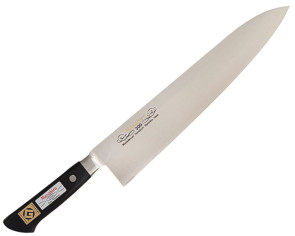
Masahiro MV 11.8-inch (300mm) Gyuto
At 300mm, this gyuto is for the jobs a shorter knife needs several strokes to finish: slicing a whole brisket or prime rib, splitting watermelons and large squash, and breaking down big fish loins. One long, unbroken stroke leaves a cleaner surface than sawing back and forth.It is a large knife and needs a large board and room to swing, so it suits professional kitchens, butchers and pitmasters more than most home kitchens. The stainless MV steel and the right-handed asymmetrical edge keep the blade thin enough to cut cleanly despite its size.Because the blade is so long, a light touch is enough: let the length carry the cut instead of pressing down. A long edge guard or a knife roll with a long pocket protects it in transport.
Long knife choicesThe MV 270mm Gyuto is easier to manage for daily prep. For slicing only, the MV 270mm Sujihiki is narrower and lighter. Learn More$235.00 -

Kikuichi WDT Series Warikomi Damascus Tsuchime 9.4-inch (240mm) Gyuto
The 9.4-inch (240mm) WDT gyuto is the long chef’s knife of Kikuichi’s Warikomi Damascus Tsuchime series, built for cooks who prep in volume. The extra length covers a full board, so a case of peppers or a stack of cabbage goes faster, and the blade slices roasts in a single stroke.A VG10 core sits inside 17 layers of damascus steel, and the hand-hammered tsuchime surface leaves small pockets that, per Kikuichi, help release food from the blade. On a long knife that means fewer pauses to scrape slices off the side. The Western birch handle gives a secure, familiar grip, which makes this a natural step up for a cook who already uses a 10-inch German chef’s knife. Hone it lightly each day.
240mm Gyuto OptionsFor a lighter knife with a Japanese handle, see the NWD 9.4-inch (240mm) Gyuto. For a shorter WDT blade, choose the WDT 8.25-inch (210mm) Gyuto. Learn More -

Kikuichi WDT Series Warikomi Damascus Tsuchime 8.25-inch (210mm) Gyuto
Kikuichi describes its Warikomi Damascus Tsuchime series as popular with people who want a Western handle and a Japanese blade, and the 8.25-inch (210mm) gyuto is the all-purpose knife of the line. Its 17-layer damascus blade is hammered with a tsuchime finish over a VG10 cutting core, and Kikuichi notes the hammered surface helps release food from the blade.That release is useful with starchy and wet foods, such as potato slices and cucumber rounds that would otherwise cling to the steel. The 210mm length is close to a standard Western chef’s knife, so it is an easy choice for a home cook moving to Japanese cutlery. The mahogany-dyed birch handle gives a warm, familiar grip, and the blade is stainless, so care is a quick wash and dry. Each knife is hand-engraved with Kikuichi’s signature chrysanthemum logo.
Choosing a WDT KnifeThe WDT 9.4-inch (240mm) Gyuto adds reach, and the WDT 7.1-inch (180mm) Santoku suits push cuts on a smaller board. Learn More$354.95 -

Kikuichi GN Series Ginsan Nashiji 9.4-inch (240mm) Gyuto
Shibui, the Japanese design idea of balancing simplicity and complexity, is how Kikuichi frames its GN Series, and this 9.4-inch (240mm) gyuto shows it in a quiet nashiji, or pear-skin, finish. The texture comes from the outer layers of a three-layer blade with a Ginsan core, a stainless steel also called Silver-3.Kikuichi’s description of the Ginsan blade is thin, strong and precise, and at 61 HRC it is the hardest stainless core in Kikuichi’s premium lines we carry. Its length carves a large roast in a single pass, and the burnished octagonal oak handle gives a comfortable grip and sets the balance just ahead of the hand. It suits experienced cooks who want a long, understated Japanese chef’s knife with a fine edge and no decorative pattern. Store it in a saya to protect the thin edge.
Ginsan SlicersFor slicing, see the GW Series Ginsan Sanmai 9.4-inch (240mm) Sujihiki. The Kikuichi 240mm Gyuto Magnet Saya fits this blade. Learn More -

Kikuichi GC Series Carbon Steel 7.1-inch (180mm) Gyuto
Kikuichi’s 7.1-inch (180mm) GC Series gyuto is a compact carbon steel chef’s knife, nimble enough for quick work and short enough for a small cutting board or a crowded apartment kitchen. It handles the everyday jobs of a larger gyuto, such as slicing shallots, dicing peppers and portioning chicken, with more control at the tip.Kikuichi says a carbon steel gyuto has been trusted by chefs for nearly a millennium, and this line keeps that tradition with a blade that takes a keen edge and sharpens easily. Expect a patina to form with use. It is a sound choice for a cook with smaller hands, and it also works as a second gyuto beside a 240mm on a professional station, where its short blade is easier to steer through garnish work.
180mm or 210mm?The 8.25-inch (210mm) Gyuto is closer to a standard chef’s knife length. For a flatter profile at this size, see the 7.1-inch (180mm) Santoku. Learn More$119.95 -
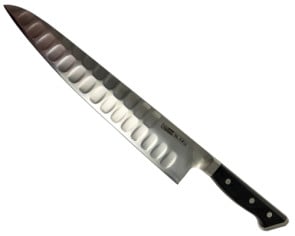
Glestain KE Series 10.6-inch (270mm) Left-Handed Gyuto
The 270mm Left-Handed Gyuto gives left-handed professionals and serious home cooks a long Japanese chef’s knife built for their hand. Glestain grinds the blade as the mirror image of the right-handed 727TK, with the dimples on the left face, so slices release and the long blade stays on line through a cut.This length is a working tool for a large board and big batches of produce. It cuts across a head of cabbage or a stack of onions in one pass, and the KE Series bolster and end cap counter the weight of the long blade at the hand.This is an excellent knife for heavy use. The way that food doesn’t cling to the blade really speeds up dicing potatoes, onions and the like. Everything just stays on the cutting board without having to hold the slices together. If you do a lot of cutting, this is likely to become your favorite knife.Because the asymmetry is in the steel, the knife cannot be adjusted for the right hand later. Cooks who will hold it in the left get the full benefit of Glestain’s geometry, which a symmetrical knife with a left-biased edge cannot match.
Other Left-Handed GyutosFor a shorter knife, see the 240mm Left-Handed Gyuto and the 210mm Left-Handed Gyuto. The table below lists every Glestain gyuto, and our guide to knife shapes explains where a long gyuto fits among chef’s knives. Learn More$295.00 -

Shun Premier 7-inch Asian Cook's Knife
The Shun Premier 7-inch Asian Cook’s Knife is the Japanese equivalent of the chef’s knife, known in Japan as a gyuto. It is an all-purpose blade that excels with meat and fish and works equally well on vegetables. The blade is narrower than a traditional Western chef’s knife, which makes it lighter and more agile in the hand, yet it still leaves enough height for knuckle clearance on the board. The gentle curve along the edge supports a rocking cut, and the pointed tip handles detail work. The hand-hammered tsuchime finish on the Shun Premier blade helps food release as you cut.
FeaturesNarrow gyuto profile: The slimmer blade is lighter and quicker in the hand than a Western chef’s knife of similar length.Knuckle clearance: The blade keeps enough height to keep your knuckles off the board.VG-MAX cutting core: Shun’s proprietary steel resists wear and corrosion and holds a fine, keen edge.Damascus cladding: Layered stainless steel supports and protects the core.Hammered tsuchime finish: The hand-hammered surface helps food release from the blade while cutting.Contoured walnut PakkaWood handle: The handle offers comfort and control and resists moisture.Handcrafted in Seki City, Japan: Each Shun knife requires at least 100 individual steps to complete in Seki City, one of Japan’s most important blade-making centers since the 13th century.Free lifetime sharpening: Shun offers free lifetime sharpening, so the edge can be professionally restored whenever it needs it.
Tasks It Handles WellSlicing boneless beef, pork, and chickenPortioning fish filletsDicing onions, carrots, and peppersMincing herbs and garlicScoring meat and fine detail work with the tip
Choosing a Shun Premier Chef’s KnifeFor a wider blade with more weight behind each cut, the Shun Premier 8-inch Chef’s Knife is the Western-style option. For a flatter edge suited to push cuts, consider the Shun Premier 7-inch Santoku. The same shape is available with a D-shaped ebony handle and smooth Damascus finish as the Shun Classic 7-inch Asian Cook’s Knife. Learn More$209.95


