
You have no items in your shopping cart.
Wusthof Classic Knives
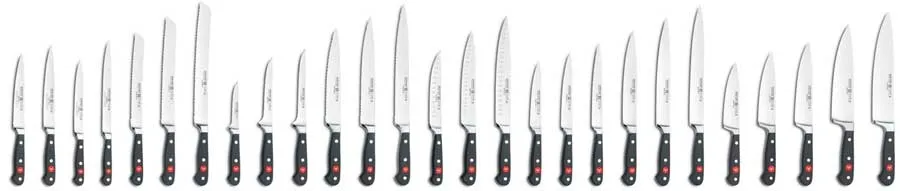
Wusthof Classic series has the most robust offering of all the Wusthof product lines. Meaning that there are many specialized tools available in this series. So if you like all of your tools to match, Wusthof Classic is an excellent choice. The knives are very consistently crafted with a smooth polish and nice taper from the handle to the tip, and spine to edge. Tempered to a Rockwell hardness of 58, they are easily maintained with the use of a honing rod. Edges are set via precise laser-guided technology. Full bolster, full tang, hot forged, with triple riveted handles of polyoxymethylene. Made in Solingen, Germany, Wusthof Classic knives are backed by a lifetime warranty.
-

Wüsthof Gourmet 6-Piece Steak Knife Set
For a table of six, the Wüsthof Gourmet 6-piece steak knife set gives every guest a 4.5-inch knife with a straight edge. Gourmet knives are laser cut from one piece of steel, the way Wüsthof makes its non-forged lines, and they carry black handles with three rivets.Customers ask us for non-serrated steak knives, and this is a set Wüsthof confirms has a straight edge. That edge leaves a neat face on a steak or a pork chop, and you can hone and sharpen it at home on the tools you use for your kitchen knives. Serrations keep cutting longer between sharpenings, a reason restaurants choose them. At home, a few strokes on a honing steel before dinner keeps a straight edge ready.If you prefer the heft of a forged knife with a bolster, compare the Classic 6-piece steak knife set. All six fit the 6-slot steak knife block on the counter or in a cabinet. The Gourmet 4-piece steak knife set suits a smaller table. Our kitchen knife shapes guide explains how steak knives differ from paring and utility knives. Learn More$204.95 -

Wüsthof Classic 8-inch Extra Wide Chef's Knife
Knuckle clearance is the reason to choose this knife. The Wüsthof Classic 8-inch Extra Wide chef’s knife has a blade about a third of an inch taller than the regular Classic 8-inch. That extra height gives your knuckles more clearance above the board, which makes a difference for cooks with large hands and for anyone who chops with a fast rocking motion.The wide blade also works as a bench scraper. Turn it on its side to carry chopped onions or herbs from the board to the pan, or press down with the flat to crush garlic cloves. The added steel shifts a little more weight into the blade, which helps it drop through firm vegetables.Customers comparing it with the standard Classic 8-inch decide by hand size and technique. If your knuckles graze the board with a standard chef’s knife, choose the Extra Wide. For a longer blade, see the Classic 10-inch, and for a lighter knife, the Classic 6-inch. Our knife shapes guide compares the chef’s knife with wider Asian shapes such as the santoku. Learn More$199.95 -

Wüsthof Classic 10-inch Chef's Knife
For cooks who prep in volume, the Wüsthof Classic 10-inch chef’s knife covers more of the cutting board with each stroke. The longer blade slices a whole cabbage or a large watermelon in one pass, chops a mountain of parsley quickly and carves a roast when a slicer is not at hand.It shares the standard Classic profile and width with the 8-inch, so the extra length adds reach without making the blade taller. Three rivets hold the handle firmly to the full tang, and the added weight up front helps the blade fall through dense vegetables such as sweet potatoes.Professional cooks have traditionally worked with 10-inch knives because more food fits under the blade and every cut does more work. If you are comfortable with a knife this size, we recommend it for the efficiency it brings. Customers ask us about 6, 8 or 10 inches. A 10-inch knife needs a large board and some practice; on a small board, the tip runs off the edge. If you cook mostly for a family, the Classic 8-inch is easier to control. For a wider blade at 8 inches, see the Classic 8-inch Extra Wide. Our Kitchen Knife Shapes guide covers when a long chef’s knife makes sense. Learn More$199.95 -

Wüsthof Classic 12-inch Hollow Edge Flexible Salmon Slicer
The ultimate specialty knife designed solely for the paper-thin slicing of this delicate cut of fish. Learn More$199.95 -

Wüsthof Classic 2-Piece Prep Set
Small kitchens and first apartments are well served by the Wüsthof Classic 2-piece prep set, which pairs a 6-inch chef’s knife with a paring knife. Both are forged Classic knives with a full bolster and a riveted handle.Customers ask us whether to choose a 6, 8 or 10-inch chef’s knife. The shortest is easy to control, and it suits smaller hands and narrow boards. Quick jobs like a single onion suit it well. An 8-inch blade gets through large squash and big batches with fewer strokes. The 10-inch size calls for a big board and room to work. If you want the longer knife, the Classic 2-piece starter set has the 8-inch size with the same paring knife.The paring knife takes care of small, in-hand work that a chef’s knife is too big for, like hulling strawberries. You can also buy them one at a time. Look for the Classic 6-inch chef’s knife plus the Classic 3.5-inch paring knife. Each blade is described in our knife shapes guide, and a honing steel keeps both sharp between sharpenings. Learn More$194.95 -

Wüsthof Classic 8-inch Chef's Knife
When someone asks us for one knife to do nearly everything, we suggest the Wüsthof Classic 8-inch chef’s knife. It is the size we suggest when someone wants one knife to do nearly everything. The 8-inch blade is long enough to slice through a large onion or a butternut squash in one stroke and short enough to control on a standard cutting board.The edge curves gently from heel to tip, so the knife rocks through herbs and garlic, then lifts for a straight push cut through carrots and celery. A full bolster where the blade meets the handle adds weight in the middle of the knife and protects your fingers, and the triple-riveted handle stays secure in a wet hand.Customers ask us whether to choose 6, 8 or 10 inches, and 8 is the length that suits the widest range of cooks. The Classic 6-inch suits a small board or a cook who prefers a lighter knife, and the Classic 10-inch handles large volumes and big roasts. For more knuckle clearance, the 8-inch Extra Wide has a taller blade. Our kitchen knife shapes guide explains how a chef’s knife differs from a santoku or a utility knife. Learn More$169.95 -

Wüsthof Classic 8-inch Half Bolster Chef's Knife
Wüsthof’s Classic 8-inch Half Bolster chef’s knife, also called the demi-bolster, has the familiar Classic handle and blade with one change. The bolster stops short of the heel, so the edge runs all the way back to the handle.That matters in two ways. The heel of the blade touches the board, so it can do heavy work such as splitting a hard squash. It is also simpler to maintain. A full bolster eventually has to be ground down as the blade wears with sharpening, and this knife never needs that.The knife is a little lighter than the standard Classic 8-inch, with the same 1.9-inch width and triple-riveted handle. It suits customers who like the shape of the Classic 8-inch chef’s knife and sharpen their own knives. The Classic Ikon 8-inch offers the same sharpening advantage on a contoured handle. Our kitchen knife shapes guide explains how bolster styles differ. Learn More$169.95 -

Wüsthof Classic 7-inch Hollow Edge Santoku
Santoku means three virtues in Japanese, taken to mean slicing, dicing and mincing, and Wüsthof’s Classic 7-inch is the full-size version of this all-purpose knife. Its flat edge and rounded tip suit an up-and-down push cut, which many cooks find easier to learn than rocking a chef’s knife. The blade is long enough for a large onion or a head of broccoli.At 1.8 inches, the blade gives knuckle clearance and lifts chopped vegetables off the board in one sweep. Hollows ground into each face let slices of zucchini and potato fall free, and the edge is ground thinner than on Wüsthof’s German-profile knives.Customers choosing between this santoku and an 8-inch chef’s knife can decide by technique. Rocking cooks prefer the chef’s knife’s curved edge; push-cutters prefer the santoku. See the Classic 8-inch chef’s knife for comparison, or the Classic Ikon 7-inch santoku if you prefer Ikon’s rounded grip. Our guide to knife shapes covers the santoku in detail. Learn More$169.95 -

Wüsthof Classic 10-inch Super Slicer
Wüsthof’s Super Slicer is a 10-inch serrated slicer with a rounded tip and an outwardly curved edge of wide, scalloped serrations. Those scallops cut through a crusty loaf, but they also glide through a beef tenderloin, a ham or a brisket without tearing the surface, which makes it two knives in one. Look closely and you will see that the scallops protrude from the edge and are not cut into it, so the cutting is done by smooth knife edges and the jagged teeth of a typical serrated knife never touch the food. In effect it is a reverse-scalloped bread knife, with a gentle serration that cuts without tearing.The 1.6-inch blade is taller than a typical bread knife, so it stays straight through a tall loaf or a layer cake, and the length handles a whole watermelon or a pineapple. The rounded tip is safer for slicing at the table.One knife for the holiday roast and the bread basket saves drawer space. Carving purists may prefer the straight edge of the Classic 9-inch carving knife, and serious bread bakers the Classic 9-inch double-serrated bread knife. For Ikon’s rounded grip, choose the Classic Ikon 10-inch Super Slicer. Our Kitchen Knife Shapes guide covers slicers. Learn More$169.95 -

Wüsthof Classic 7-inch Hollow Edge Nakiri
A nakiri is a Japanese vegetable knife with a straight, rectangular blade. The Wüsthof Classic 7-inch hollow edge nakiri brings that shape to a forged German knife on the familiar riveted handle. Because there is no curve to the edge, each downward stroke cuts all the way through a bunch of scallions.Use it to slice onions, shred cabbage for slaw and cut squash into even planks. Its tall blade keeps your knuckles clear and doubles as a scoop for the cutting board. Hollows along the sides help thin slices fall away, and the edge is ground fine for vegetables.Since it is built for produce, pair it with a chef’s knife or boning knife for meat. Compare the Classic 7-inch santoku, whose rounded tip handles more varied work, and the Classic Ikon 7-inch nakiri with its contoured grip. The Kitchen Knife Shapes guide explains the nakiri and usuba. Learn More$169.95

