
You have no items in your shopping cart.
Wusthof Classic Knives
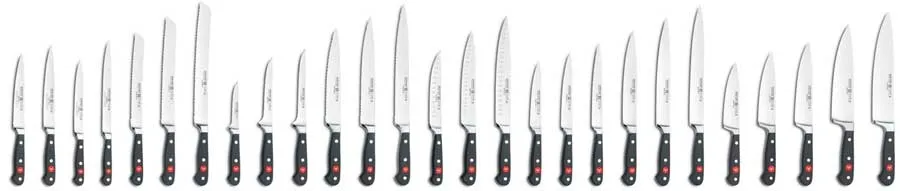
Wusthof Classic series has the most robust offering of all the Wusthof product lines. Meaning that there are many specialized tools available in this series. So if you like all of your tools to match, Wusthof Classic is an excellent choice. The knives are very consistently crafted with a smooth polish and nice taper from the handle to the tip, and spine to edge. Tempered to a Rockwell hardness of 58, they are easily maintained with the use of a honing rod. Edges are set via precise laser-guided technology. Full bolster, full tang, hot forged, with triple riveted handles of polyoxymethylene. Made in Solingen, Germany, Wusthof Classic knives are backed by a lifetime warranty.
-
Wüsthof 6-inch Meat Cleaver
A cleaver uses weight more than sharpness to do its work, and this Wüsthof 6-inch cleaver has a heavy, rectangular blade for chopping through chicken backbones and splitting spare ribs. Bring it down in one firm stroke and let the mass of the blade carry through.At nearly 2.8 inches tall, the blade holds your knuckles well above the board, and its flat side crushes garlic or flattens a chicken breast. Wüsthof stamps this cleaver from sheet steel, and the steel is tempered slightly softer than Wüsthof’s chef’s knives, which helps the edge withstand impact on bone.Use it on a thick wooden or plastic board that can absorb the blows, and keep your fine-edged knives off bones. For slicing and chopping vegetables in the Chinese style, see the Classic Ikon Chinese chef’s knife, which is not meant for bone. Our knife shapes guide explains the difference between meat and vegetable cleavers. Learn MoreRegular Price: $124.95
Special Price $93.95
-

Wüsthof Classic 4.5-inch Utility Knife
Wüsthof calls this knife a utility knife, and the name fits its job. The Classic 4.5-inch fills the space between a paring knife and a chef’s knife, with a blade long enough to slice a tomato or cut a block of cheese, and narrow enough to trim a pork tenderloin or peel a mango.Some cooks know this size as a petty knife, the Japanese term for a small all-purpose blade. It is a sensible second knife for a kitchen that already has an 8-inch chef’s knife, since it handles the small jobs that make a big knife feel clumsy. It also trims meat, deveins shrimp, removes small bones from seafood, sections citrus and makes quick work of lunches and snacks. For a cook who wants to keep the collection small, it is a good two-for-one.Classic is the original Wüsthof line, with the widest variety of shapes and styles. For longer slicing, see the Classic 6-inch utility knife; for a wider blade that also chops herbs and garlic, the Classic 4.5-inch Asian utility knife. The Classic Ikon 4.5-inch utility knife has this length on the contoured Ikon handle. See our Kitchen Knife Shapes guide for more on utility knives. Learn More$94.95 -

Wüsthof Classic 2.75-inch Peeling Knife (Bird's Beak)
Many cooks know Wüsthof’s Classic peeling knife as a bird’s beak. Its short blade that curves down to its point. The curve follows the shape of round fruit and vegetables, so it peels an apple, a pear or a turnip in one continuous strip and cuts close to the skin.Classically trained cooks use it for tourné cuts, the seven-sided barrel shapes carved from potatoes and carrots. It also removes the eyes and blemishes from potatoes, cuts citrus zest into fine strips and shapes radish and mushroom garnishes. The 2.75-inch blade keeps your hand close to the work for control.A peeling knife is a specialist; it does not slice on the board as well as a straight paring knife. Pair it with the Classic 3.5-inch paring knife for everyday trimming, or the Classic Ikon 3-inch flat cut paring knife for straight cuts. The table below compares all of Wüsthof’s small blades, and our kitchen knife shapes guide explains the bird’s beak shape. Learn More$94.95 -

Wüsthof Classic 3.5-inch Paring Knife
A paring knife handles the small, close work a chef’s knife is too large for, and the Wüsthof Classic 3.5-inch is the size we reach for first. Its narrow, pointed blade hulls strawberries, trims the root end of a shallot, deveins shrimp and cuts the core from a halved apple.Much of that work happens in the hand, off the board, so control matters more than length here. The short blade keeps the tip close to your fingers. Its three-rivet handle gives a secure hold when your hands are wet from washing produce. On the board, the tip scores the skin of a duck breast or a loaf of bread before baking.For a slightly longer blade that also slices small fruit on the board, see the Classic 4-inch paring knife. For peeling round fruit and shaping garnishes, the curved Classic peeling knife is the better tool. The Classic Ikon 3.5-inch puts this blade on Ikon’s rounded handle, and our kitchen knife shapes guide compares the paring styles. Learn More$94.95 -

Wüsthof Classic 4-inch Paring Knife
Half an inch longer than the standard paring blade, the Wüsthof Classic 4-inch paring knife adds reach, and that extra length lets it work on the cutting board as well as in the hand. It slices limes for drinks, segments an orange and trims the fat cap from a small steak.The pointed tip still handles detail work, such as removing the eyes from a potato or hulling berries, and the blade is long enough to cut a whole apple into wedges without sawing. Its grip holds firm even with damp fingers, and the knife is light enough to use for a long session of prep.Choose the Classic 3.5-inch paring knife if your paring is done in the hand, and this 4-inch if you also want a small knife for quick jobs on the board. For jobs between paring and chef’s knife, see the Classic 4.5-inch utility knife. Our guide to knife shapes explains where paring and utility knives overlap. Learn More$94.95 -

Wüsthof Classic 5-inch Boning Knife
A boning knife needs a narrow, pointed blade that slips between meat and bone, and the Wüsthof Classic 5-inch boning knife is sized for home kitchens. It separates chicken thighs from the bone and takes the bone out of a leg of lamb.The short blade keeps the point under control as you work around joints, and the pointed tip pierces connective tissue to start each cut. Wüsthof lists its uses as removing bones and skinning, along with trimming tendons and fat. Let the tip and edge ride along the bone; chopping through bone is a job for a cleaver.For longer cuts, such as boning a whole ham or a turkey breast, the Classic 6-inch flexible boning knife gives more reach and bends to follow the bone. For fish, see the Classic Ikon 7-inch flexible fillet knife. The Classic Ikon 5-inch boning knife carries this blade on a Classic Ikon handle. Our Kitchen Knife Shapes guide explains boning and fillet knives. Learn More$114.95 -

Wüsthof Classic 6-inch Utility Knife
A 6-inch utility knife is the knife many cooks grab for lunch-hour jobs. The Wüsthof Classic 6-inch slices a sandwich in half, cuts cheese and salami for a board, trims the silver skin from a pork tenderloin and slices a few tomatoes, all without reaching for the chef’s knife. Many cooks call a knife of this size a petty knife.The blade is an inch wide, narrow enough to follow the contour of a melon rind or a cut of meat and long enough to halve a large onion. Its straight edge gives clean cuts on firm foods; for crusty bread and ripe tomatoes, a serrated edge grips better.On the Classic handle, it feels steady whether you are slicing on the board or trimming over a bowl. For a smaller blade, see the Classic 4.5-inch utility knife. The Classic 5-inch serrated utility knife handles bagels and tomatoes. The Classic Ikon 6-inch utility knife puts this blade on the contoured Ikon handle. Utility knives are covered in our knife shapes guide. Learn More$114.95 -

Wüsthof Classic 4.5-inch Asian Utility Knife
This Wüsthof Classic Asian utility knife takes the length of a small utility knife and gives it a taller, 1.2-inch blade with a gently curved edge. The added height gives your knuckles room above the board, so the knife can mince garlic and chop herbs with a rocking motion as well as slice.It is a good size for the small, frequent jobs of a weeknight, such as a few cloves of garlic or a knob of ginger. The wide blade also scoops what you have cut and carries it to the pan, which a narrow utility knife cannot do.On the board, the curved edge rocks easily, and the flat face of the blade crushes a garlic clove before mincing. For a narrower blade that slices and trims, see the Classic 4.5-inch utility knife. The Classic 5-inch hollow edge santoku is the next size up for chopping, and both come together in the Classic 2-piece Asian knife set. Our kitchen knife shapes guide covers Asian-style blades. Learn More$114.95 -

Wüsthof Gourmet 4-Piece Steak Knife Set
Straight edges and laser-cut blades make Wüsthof’s Gourmet 4-piece steak knife set a non-serrated choice for four. It is the smaller version of the Gourmet 6-piece set and uses the same knife design with a riveted black handle.If you are deciding whether non-serrated steak knives are right for you, consider what you serve. A straight edge glides through tender beef and roast pork and leaves neat slices, and it can be maintained in your own kitchen. A serrated knife suits a cook who never sharpens, since its teeth keep biting after the edge wears. With a hand-held sharpener or a steel in the drawer, a straight edge is the better match.Gourmet knives are laser cut and stamped, which makes them lighter and more economical than the forged Classic line they resemble. Chef David recommends this set to anyone looking for a cost-effective, functional set of steak knives. For forged steak knives, see the Classic 4-piece set, or the Classic Ikon 4-piece set with its curved handle. Six guests call for the Gourmet 6-piece steak knife set, which has two more of the same knife, and a 6-slot block stores either set. See our knife shapes page for more on blade styles. Learn More$134.95 -

Wüsthof Classic 6-inch Chef's Knife
A 6-inch chef’s knife does the work of a full-size chef’s knife on a smaller scale, and the Wüsthof Classic 6-inch suits cooks with small hands or small cutting boards. It dices an onion and trims a chicken breast with less blade to manage than an 8-inch knife.A full bolster at the heel balances the short blade against the handle and keeps your fingers clear of the edge. The shorter blade is quicker to maneuver around the board and easier to tuck into a drawer or a travel roll for a vacation rental.When customers ask us which size to buy, we start with the board and the cook. If the 8-inch feels long in your hand, or you cook mostly for one or two, the 6-inch is the comfortable choice. The 6-inch lacks the height and weight to chop through heavy root vegetables or large cuts of meat; for those jobs and for larger batches, move up to the Classic 8-inch chef’s knife or a 10-inch. The Classic Ikon 6-inch puts this length on a contoured handle with a half bolster, which makes the full edge easy to sharpen. Compare blade shapes in our guide to kitchen knife shapes. Learn More$134.95


