
You have no items in your shopping cart.
Minonokuni Knives
Authentic Japanese blades (hochoes) hand-forged using traditional Japanese methods of old-world craftsmanship; Minonokuni knives are part of a project designed to preserve and protect the master/apprentice relationship. Even as demand for Japanese knives has grown; the skilled masters are aging, and it has been difficult to keep apprentices. While the methods of construction mastered over the centuries have changed very little, the methods of bringing the pieces to market is dramatically different. Then Knife Merchant was asked to assist by bringing knives from various masters in different types of material to market, so that the craftsmen can concentrate on their work and keep the apprentice fully employed, without the burden of stopping production to make sales. Minonokuni is the name of a prefecture (state) that existed in the days of the Samurai. It encompassed a wide area including Seki-City and Sakai, which are the areas of Japan in which our craftsmen are making these blades. This is why we have chosen this as a brand name to represent these knives. You will find the quality to be far superior to comparable material types. When the knife maker has his name on the blade (instead of working for a company), there is greater pride and care taken in little details that make a great difference in final quality. Minonokuni knives are now available in a variety of grades to suit every need and price point.
-

Minonokuni Homura 8.3-inch (210mm) Gyuto
Homura puts a blue carbon steel edge inside a stainless steel jacket. Only the exposed edge needs the care a carbon knife requires, which makes this 210mm gyuto a practical way for a cook to get the edge of blue steel with far less upkeep.As the edge develops a patina with use, the blade takes on a two-tone look, with the darkened carbon edge against the matte stainless faces. The 210mm length is a versatile size for a home kitchen, long enough for slicing roasts and quick enough for dicing onions and mincing herbs.
Why HomuraAmong our double-bevel blue steel knives, Homura is the one we suggest to a cook who has not owned carbon steel before. The Aogami Black 210mm gyuto and the Aogami Damascus 210mm gyuto have iron jackets that need drying and attention, and the Raku 210mm gyuto uses a harder Aogami Super steel.The Homura 240mm gyuto adds length, and the Homura 170mm santoku is shorter. The knife shapes guide explains the gyuto.Each Homura is forged by hand, so handle colors and finish vary from piece to piece. Learn More$330.00 -

Minonokuni Homura 9.4-inch (240mm) Gyuto
A 240mm gyuto gives a professional the length for long slicing strokes and the knuckle clearance for chopping a full board of vegetables. The Homura version adds a blue steel edge that holds through extended prep, wrapped in stainless steel that keeps the rest of the blade free of rust.It is equally suited to vegetables and proteins. Push-cut carrots and celery near the heel, slice a brisket or a side of salmon with the full length, and work the tip for fine mincing. The double bevel suits either hand.
Homura or Another Blue Steel Gyuto?The stainless jacket is the reason to choose Homura. It makes the knife approachable for cooks who want blue steel performance without the upkeep of a fully carbon blade. A cook who is comfortable caring for carbon steel and wants a rustic finish can compare the Aogami Black 240mm gyuto. The Aogami Damascus 240mm gyuto has a Damascus pattern, and the Raku 240mm gyuto uses Aogami Super.The Homura 210mm gyuto is the more compact choice for a home board. Our kitchen knife shapes guide compares the gyuto and santoku. Learn More -

Minonokuni Homura 6.7-inch (170mm) Santoku
The Homura 170mm santoku is an all-purpose Japanese knife for cooks who want the edge of blue carbon steel with less of its maintenance. A santoku, or knife of three virtues, handles slicing, dicing and mincing with equal ease, and its compact length suits smaller boards and everyday prep of vegetables and boneless meat.The flatter edge favors push cuts and tap chopping over rocking. Its blade is tall enough to scoop chopped vegetables from the board, and the rounded tip makes the knife comfortable for a cook moving from a Western chef’s knife.
Choosing Within the Homura LineCooks who prepare mostly vegetables may prefer the flat edge of the Homura 170mm nakiri. For longer slicing strokes and larger cuts of meat, the Homura 210mm gyuto offers more length. The Homura 150mm petty covers detail work and trimming.Homura’s stainless jacket sets it apart from our other blue steel santoku, the Aogami Black, Aogami Damascus and Raku, which need more attention to stay free of rust. For the santoku and its relatives, see our kitchen knife shapes guide. Learn More$230.00 -

Minonokuni Homura 6.7-inch (170mm) Nakiri
Primarily an all-purpose vegetable knife, the nakiri is a more durable relative of the usuba because of its double grind. The Homura 170mm nakiri push-cuts cabbage, onions and root vegetables cleanly, and its flat edge separates each slice without rocking.The construction is a matte stainless jacket welded to a blue carbon steel core. Only the exposed edge needs the care carbon steel requires, and as that edge patinas, the blade takes on a two-tone look. Should the stainless faces become scratched over time, they can be restored with fine 0000 steel wool or a synthetic pad.
Choosing a NakiriThe Homura is the low-maintenance choice among our 170mm nakiri. The Aogami Black nakiri and the Aogami Damascus nakiri have iron jackets that need drying and care, and the Raku nakiri uses Aogami Super with a hammered finish. A cook who also wants katsuramuki and fine garnish work will need a single-bevel usuba, such as the Take 210mm usuba.The Homura 170mm santoku adds a tip for meat and fish. See the knife shapes guide for more. Learn More -

Minonokuni Homura 5.9-inch (150mm) Petty Knife
The Homura 150mm petty is a small utility knife for the jobs a gyuto is too large for. It trims boneless meat, peels fruit and handles garnish work, and it fits comfortably in the hand for peeling off the board.Like the rest of the Homura line, it has a blue steel edge inside a stainless jacket, so only the very edge needs the care of carbon steel. That makes it a practical first carbon-edged knife for a cook who wants to see how blue steel behaves before buying a larger one.
Matching It to a Larger KnifeThe petty pairs naturally with the Homura 210mm gyuto or the Homura 170mm santoku. For a petty with a Damascus finish, see the Aogami Damascus 150mm petty, which has an iron jacket and needs more attention to stay free of rust.The fine tip is the most delicate part of a blue steel blade. Keep it off bones and frozen food, and do not use the tip to pry. The kitchen knife shapes guide covers utility knives. Learn More -

Minonokuni Aogami Damascus 8.3-inch (210mm) Gyuto
The gyuto is the Japanese chef’s knife, the one knife that can slice and dice vegetables and portion fish and meat. At 210mm, this Aogami Damascus gyuto is long enough for serious slicing yet nimble enough for fine dicing, which makes it a good fit for most home kitchens.Its gentle curve allows both push-cutting and rock-chopping. Slice a roast or a side of salmon with long strokes using the full edge, and use the tip for scoring and fine work around the board. The double bevel works equally well in either hand.
Choosing a Blue Steel GyutoThe Aogami Damascus is part of our Sakura series, a specialty line rather than the default choice. The forge-welded Damascus jacket gives each blade its own pattern. For the same blue steel with a stainless jacket that needs less care, see the Homura 210mm gyuto. The Aogami Black 210mm gyuto has a rustic kurouchi finish, and the Raku 210mm gyuto uses Aogami Super with a hammered finish.Other Aogami Damascus gyuto are the 180mm and 240mm. The knife shapes guide compares the gyuto with the santoku. Learn More$385.00 -

Minonokuni Aogami Damascus 9.4-inch (240mm) Gyuto
At 240mm, this Aogami Damascus gyuto is the length a professional reaches for when the prep list is long. It slices large roasts and whole fish fillets in one stroke and covers a wide board of vegetables quickly, and the extra height gives the knuckles clearance.The longer blade has the weight to move through dense vegetables with less pressure from the cook. On delicate work, choke up to a pinch grip at the bolster and let the front third of the edge do the cutting.
Where It FitsAogami Damascus knives belong to the Sakura series, a specialty line that is technically more premium than our standard knives but not necessarily right for every cook. Its blue steel edge is hard and delicate, so it rewards a cook who sharpens on waterstones and keeps the knife away from bones.For a shorter gyuto, see the Aogami Damascus 210mm gyuto. The Homura 240mm gyuto uses a stainless jacket for easier care, the Aogami Black 240mm gyuto a kurouchi finish, and the Raku 240mm gyuto Aogami Super. The guide to knife shapes explains the gyuto. Learn More -

Minonokuni Aogami Damascus 6.7-inch (170mm) Nakiri
A nakiri is a double-bevel vegetable knife with a flat edge and a square tip. It push-cuts through cabbage and onions without rocking, and because the edge meets the board along its entire length, each slice separates completely.This 170mm Aogami Damascus nakiri is easier to learn than a single-bevel usuba, since the symmetrical edge cuts straight in either hand. The tall blade also serves as a scoop to carry cut vegetables to the pan.
Nakiri or Usuba?The usuba is the traditional single-bevel vegetable knife, needed for katsuramuki and fine garnish work. The nakiri is the more practical knife for everyday vegetable prep, and its double bevel is more durable. For an usuba in the same series, see the Sakura Damascus 210mm usuba.Aogami Damascus belongs to our Sakura series, a specialty line that is technically more premium but not right for every cook. Other 170mm nakiri are the Homura, with a stainless jacket, the Aogami Black, with a kurouchi finish, and the Raku, in Aogami Super. See the knife shapes guide for the usuba and nakiri. Learn More -
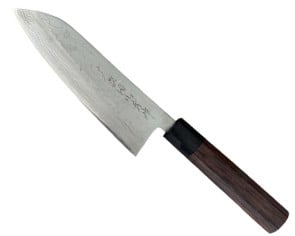
Minonokuni Aogami Damascus 6.7-inch (170mm) Santoku
The santoku, or knife of three virtues, handles slicing, dicing and mincing with a flatter edge and a shorter blade than a gyuto. This 170mm Aogami Damascus santoku suits a cook who works on a smaller board and prefers push cuts to rocking.The flat edge meets the board along most of its length, so slices of onion and carrot separate cleanly. The rounded tip is less likely to catch than a pointed one. Boneless chicken and fish fillets are well within its range.
Comparing 170mm SantokuAogami Damascus is part of our Sakura series, a specialty line, technically more premium than our standard knives but not necessarily the right fit for every cook. Its Damascus jacket gives each knife its own pattern. The Homura 170mm santoku has a stainless jacket for less upkeep, the Aogami Black 170mm santoku a kurouchi finish, and the Raku 170mm santoku Aogami Super steel.For a longer blade with a pointed tip, see the Aogami Damascus 210mm gyuto. For mostly vegetables, the Aogami Damascus 170mm nakiri is flat from end to end. The knife shapes guide explains the santoku. Learn More$318.00 -

Minonokuni Aogami Damascus 7.1-inch (180mm) Gyuto
A 180mm gyuto is a compact chef’s knife, easy to handle on a small board and quick for everyday prep. This Aogami Damascus version pairs that size with a blue steel edge and a rippled Damascus jacket, so it is as much a pleasure to look at as to use.The double-bevel edge suits right- and left-handed cooks alike. Use it for slicing onions and peppers, dicing shallots and trimming boneless chicken and fish. The gentle curve allows a rocking cut for herbs, and the flatter section near the heel handles push cuts.
Part of the Sakura SeriesThe Aogami Damascus knives belong to our Sakura series, a specialty line that is technically more premium than our standard knives but not necessarily the right fit for every cook. Blue steel is hard and holds an edge a long time, and the thin edge is delicate, so keep it away from bones and frozen food.For more length, see the Aogami Damascus 210mm gyuto. Other 180mm gyuto in blue steel are the Aogami Black 180mm gyuto, with a rustic kurouchi finish, and the Raku 180mm gyuto, with a hammered finish. Our kitchen knife shapes guide explains the gyuto. Learn More$320.00