
You have no items in your shopping cart.
Minonokuni Knives
Authentic Japanese blades (hochoes) hand-forged using traditional Japanese methods of old-world craftsmanship; Minonokuni knives are part of a project designed to preserve and protect the master/apprentice relationship. Even as demand for Japanese knives has grown; the skilled masters are aging, and it has been difficult to keep apprentices. While the methods of construction mastered over the centuries have changed very little, the methods of bringing the pieces to market is dramatically different. Then Knife Merchant was asked to assist by bringing knives from various masters in different types of material to market, so that the craftsmen can concentrate on their work and keep the apprentice fully employed, without the burden of stopping production to make sales. Minonokuni is the name of a prefecture (state) that existed in the days of the Samurai. It encompassed a wide area including Seki-City and Sakai, which are the areas of Japan in which our craftsmen are making these blades. This is why we have chosen this as a brand name to represent these knives. You will find the quality to be far superior to comparable material types. When the knife maker has his name on the blade (instead of working for a company), there is greater pride and care taken in little details that make a great difference in final quality. Minonokuni knives are now available in a variety of grades to suit every need and price point.
-

Minonokuni Aogami Damascus 6.7-inch (170mm) Nakiri
A nakiri is a double-bevel vegetable knife with a flat edge and a square tip. It push-cuts through cabbage and onions without rocking, and because the edge meets the board along its entire length, each slice separates completely.This 170mm Aogami Damascus nakiri is easier to learn than a single-bevel usuba, since the symmetrical edge cuts straight in either hand. The tall blade also serves as a scoop to carry cut vegetables to the pan.
Nakiri or Usuba?The usuba is the traditional single-bevel vegetable knife, needed for katsuramuki and fine garnish work. The nakiri is the more practical knife for everyday vegetable prep, and its double bevel is more durable. For an usuba in the same series, see the Sakura Damascus 210mm usuba.Aogami Damascus belongs to our Sakura series, a specialty line that is technically more premium but not right for every cook. Other 170mm nakiri are the Homura, with a stainless jacket, the Aogami Black, with a kurouchi finish, and the Raku, in Aogami Super. See the knife shapes guide for the usuba and nakiri. Learn More -
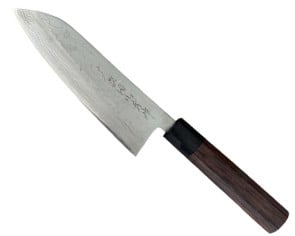
Minonokuni Aogami Damascus 6.7-inch (170mm) Santoku
The santoku, or knife of three virtues, handles slicing, dicing and mincing with a flatter edge and a shorter blade than a gyuto. This 170mm Aogami Damascus santoku suits a cook who works on a smaller board and prefers push cuts to rocking.The flat edge meets the board along most of its length, so slices of onion and carrot separate cleanly. The rounded tip is less likely to catch than a pointed one. Boneless chicken and fish fillets are well within its range.
Comparing 170mm SantokuAogami Damascus is part of our Sakura series, a specialty line, technically more premium than our standard knives but not necessarily the right fit for every cook. Its Damascus jacket gives each knife its own pattern. The Homura 170mm santoku has a stainless jacket for less upkeep, the Aogami Black 170mm santoku a kurouchi finish, and the Raku 170mm santoku Aogami Super steel.For a longer blade with a pointed tip, see the Aogami Damascus 210mm gyuto. For mostly vegetables, the Aogami Damascus 170mm nakiri is flat from end to end. The knife shapes guide explains the santoku. Learn More$318.00 -

Minonokuni Aogami Damascus 7.1-inch (180mm) Gyuto
A 180mm gyuto is a compact chef’s knife, easy to handle on a small board and quick for everyday prep. This Aogami Damascus version pairs that size with a blue steel edge and a rippled Damascus jacket, so it is as much a pleasure to look at as to use.The double-bevel edge suits right- and left-handed cooks alike. Use it for slicing onions and peppers, dicing shallots and trimming boneless chicken and fish. The gentle curve allows a rocking cut for herbs, and the flatter section near the heel handles push cuts.
Part of the Sakura SeriesThe Aogami Damascus knives belong to our Sakura series, a specialty line that is technically more premium than our standard knives but not necessarily the right fit for every cook. Blue steel is hard and holds an edge a long time, and the thin edge is delicate, so keep it away from bones and frozen food.For more length, see the Aogami Damascus 210mm gyuto. Other 180mm gyuto in blue steel are the Aogami Black 180mm gyuto, with a rustic kurouchi finish, and the Raku 180mm gyuto, with a hammered finish. Our kitchen knife shapes guide explains the gyuto. Learn More$320.00 -

Minonokuni Aogami Black 8.3-inch (210mm) Gyuto
A 210mm gyuto covers nearly every task in a home kitchen, from slicing a roast to dicing onions, and the Aogami Black version adds a blue steel edge with the rustic look of a kurouchi forge finish. It is the middle size of the Aogami Black gyuto, part of the series also called Homura Kuro.The edge is hand-sharpened on a double bevel and works equally well in either hand. Its gentle curve supports rock-chopping herbs, while the flatter heel handles push cuts through carrots and celery.
Before ChoosingBlue steel takes a very fine edge and keeps it, but it is hard and delicate, and a fully carbon blade with an iron jacket needs prompt drying after use. For a cook new to carbon steel, the stainless-clad Homura 210mm gyuto is the easier first step. The Aogami Damascus 210mm gyuto adds a Damascus pattern, and the Raku 210mm gyuto uses Aogami Super.The Aogami Black 180mm gyuto is more compact, and the Aogami Black 240mm gyuto adds reach. Our kitchen knife shapes guide compares the gyuto with the santoku. Learn More -

Minonokuni Aogami Black 9.4-inch (240mm) Gyuto
When a shift means processing a large quantity of protein or a mountain of mirepoix, a 240mm gyuto is the tool, and the Aogami Black version, called Homura Kuro, is built for that work. The length slices large cuts of meat in a single stroke and clears a full board of vegetables quickly.The black kurouchi finish is the blacksmith’s forge scale, left on the upper blade for a rustic, non-glare look. Below it, the polished bevel exposes the blue steel edge. The balance suits a pinch grip at the bolster, which makes a long blade feel more nimble than its size suggests.
Is It the Right 240mm?Blue steel holds its edge through long prep, but it is brittle, and the thin edge will chip on bones, frozen food or hard squash. The Aogami Black suits a cook who has learned basic sharpening. For the same length with a stainless jacket and less upkeep, see the Homura 240mm gyuto. The Aogami Damascus 240mm gyuto and Raku 240mm gyuto are the other blue steel options.Shorter Aogami Black gyuto are the 210mm and 180mm. Read more about the gyuto in the knife shapes guide. Learn More$265.00 -

Minonokuni Aogami Black 6.7-inch (170mm) Nakiri
The Aogami Black 170mm nakiri is a traditional vegetable knife made for push cutting. Its flat edge and squared tip chop vegetables cleanly without rocking, and the thin grind passes through dense roots and delicate herbs with little resistance.The dark kurouchi finish gives the knife a distinctive, hand-forged appearance, and the double-bevel edge is sharpened by hand. Because the edge is symmetrical, the nakiri cuts straight in either hand and is easier to learn than a single-bevel usuba.
Choosing a NakiriThe Aogami Black series, also called Homura Kuro, suits a cook comfortable caring for carbon steel, since the blade needs drying right after use. For a lower-maintenance option, the Homura 170mm nakiri has a stainless jacket. The Aogami Damascus 170mm nakiri and Raku 170mm nakiri offer Damascus and hammered finishes.For a knife that also handles meat and fish, the Aogami Black 170mm santoku adds a tip. The kitchen knife shapes guide explains the nakiri and usuba. Learn More -

Minonokuni Aogami Black 6.7-inch (170mm) Santoku
The Aogami Black 170mm santoku handles daily produce and protein preparation with a fine double bevel and a blue steel edge. The term santoku means three virtues, slicing, dicing and mincing, and at 170mm, the blade balances agility on a crowded board with enough flat edge for a long prep list.The rustic kurouchi forge finish on the upper blade gives the knife its black look. Use the flat section of the edge for push-cutting leeks and dicing shallots, and the blade’s height to carry chopped vegetables to the pan. Portioning boneless poultry and fish fillets is also well within its range.
Comparing Blue Steel SantokuThe Aogami Black series, also called Homura Kuro, suits a cook comfortable wiping and drying a carbon knife promptly. A cook who wants less upkeep should look at the stainless-clad Homura 170mm santoku. The Aogami Damascus 170mm santoku has a Damascus pattern, and the Raku 170mm santoku is made in Aogami Super.For mostly vegetables, the Aogami Black 170mm nakiri has a flat edge from end to end. The knife shapes guide compares the santoku and nakiri. Learn More$208.00 -

Minonokuni Aogami Black 7.1-inch (180mm) Gyuto
The Aogami Black 180mm gyuto, also sold as Homura Kuro, is a compact Japanese chef’s knife with a rustic black forge finish. Its size is easy to control on a small board, and its blue steel edge stays keen through a long session of everyday prep.The black kurouchi finish is the scale left from forging, kept on the upper blade rather than polished away. It gives the knife its look and offers some protection to the iron beneath. The polished bevel below it is where the cutting happens.
Aogami Black or Another Line?Blue steel is hard and holds an edge longest, but it is also delicate, so the Aogami Black suits cooks who already sharpen on stones and are comfortable drying a carbon knife promptly. For the same steel with a stainless jacket and less upkeep, see the Homura gyuto in 210mm. The Aogami Damascus 180mm gyuto and Raku 180mm gyuto are the other 180mm options.Longer Aogami Black gyuto are the 210mm and 240mm. The gyuto is covered in our guide to kitchen knife shapes. Learn More -

Minonokuni Raku Super Tsuchime 8.3-inch (210mm) Gyuto
The Raku 210mm gyuto is a hand-forged chef’s knife in Aogami Super, a blue steel with added alloying elements for edge retention. The 210mm length is a versatile size that covers slicing, dicing and portioning on a home board or a restaurant station.The hammered tsuchime finish leaves shallow dimples across the blade face. Combined with the knife’s profile, it gives a distinctive texture and look that varies from one piece to the next. The double bevel cuts straight in either hand.
Choosing a 210mm Blue Steel GyutoRaku suits a cook who sharpens on waterstones and wants an edge that lasts through long prep. Aogami Super is hard, so like any blue steel, it should be kept away from bones and frozen food. The Homura 210mm gyuto is the low-maintenance choice with a stainless jacket, the Aogami Black 210mm gyuto has a kurouchi finish, and the Aogami Damascus 210mm gyuto a Damascus pattern.The Raku 180mm gyuto is shorter and the Raku 240mm gyuto longer. See the kitchen knife shapes guide for the gyuto. Learn More -

Minonokuni Raku Super Tsuchime 9.4-inch (240mm) Gyuto
Even for a hand-forged knife, the Raku 240mm gyuto is large. A thick spine and a thick choil taper to a very thin edge, a shape that is hard to forge by hand and that gives the knife both strength through the spine and an edge that slices cleanly.Aogami Super holds a fine edge for a long time, yet it is not hard to resharpen; it responds well to waterstones and ceramics. That combination suits a professional who preps for hours and would rather sharpen less frequently.
Comparing 240mm GyutoRaku suits a cook comfortable caring for carbon steel and sharpening on stones. A cook who wants less upkeep at this length can choose the stainless-clad Homura 240mm gyuto. The Aogami Black 240mm gyuto has a kurouchi finish, and the Aogami Damascus 240mm gyuto a Damascus pattern.For a lighter knife, the Raku 210mm gyuto is the next size down. The knife shapes guide explains how the gyuto compares with a Western chef’s knife. Learn More