You have no items in your shopping cart.
Minonokuni Knives
Authentic Japanese blades (hochoes) hand-forged using traditional Japanese methods of old-world craftsmanship; Minonokuni knives are part of a project designed to preserve and protect the master/apprentice relationship. Even as demand for Japanese knives has grown; the skilled masters are aging, and it has been difficult to keep apprentices. While the methods of construction mastered over the centuries have changed very little, the methods of bringing the pieces to market is dramatically different. Then Knife Merchant was asked to assist by bringing knives from various masters in different types of material to market, so that the craftsmen can concentrate on their work and keep the apprentice fully employed, without the burden of stopping production to make sales. Minonokuni is the name of a prefecture (state) that existed in the days of the Samurai. It encompassed a wide area including Seki-City and Sakai, which are the areas of Japan in which our craftsmen are making these blades. This is why we have chosen this as a brand name to represent these knives. You will find the quality to be far superior to comparable material types. When the knife maker has his name on the blade (instead of working for a company), there is greater pride and care taken in little details that make a great difference in final quality. Minonokuni knives are now available in a variety of grades to suit every need and price point.
-

Minonokuni Ume 7.7-inch (195mm) Usuba
The 195mm usuba sits between the compact 180mm and the long 210mm. It gives a little more length for daikon and cabbage than the shorter knife while staying light enough for a home cook to control through a long prep session.The single-bevel blade cuts vegetables with a straight downward push, with no wedging action to crack a carrot or bruise a herb. That clean separation is what makes the usuba suited to fine julienne, paper-thin slices and katsuramuki sheets for garnish.
A Size Only in UmeThis in-between length is offered only in the Ume line. Ume is the most forgiving of the three standard Minonokuni lines and the best for learning to sharpen, which makes this knife a good fit for a cook who wants a bit more blade but is still building skills. A cook ready for harder white steel can compare the Take 210mm usuba.The Ume 180mm usuba is shorter and the Ume 210mm usuba longer. For a pointed tip, see the Ume 180mm kama-usuba. Our knife shapes guide covers the usuba. Learn More$104.00 -

Minonokuni Ume 8.3-inch (210mm) Usuba
Long daikon and whole cabbages are easier with a 210mm usuba, and the Ume version puts that length within reach of a cook still learning the shape. The tall, flat blade also scoops the cut vegetables off the board for the pan.The longer edge gives more room for katsuramuki, so the sheet stays on the blade as it unrolls. For julienne, stack the sheets and push-cut them into fine threads, a technique called sengiri. Each cut should be a straight push forward and down.
Matching the Line to the CookUme is the most forgiving of the three standard Minonokuni lines and the best for learning to sharpen. On a long single bevel, an even edge takes practice to keep, and a softer steel makes that practice easier. The Take 210mm usuba is the sweet spot for cooks ready for a harder edge, and the Matsu 210mm usuba suits experienced hands.Left-handed cooks can order the Ume 210mm left-handed usuba. For a shorter blade, see the Ume 195mm usuba. The Ume 210mm kama-usuba adds a pointed tip. The two forms are compared in our guide to knife shapes. Learn More -

Minonokuni Ume 8.3-inch (210mm) Left-Handed Usuba
For the left-handed cook dedicated to vegetable preparation, this Ume 210mm usuba is ground for the left hand. The single bevel sits on the left face, which gives straight push cuts and even katsuramuki sheets when the knife is held as a left-handed cook naturally holds it.The 210mm length handles long daikon and whole heads of cabbage, and the tall blade gives the knuckles clearance above the board. Slices separate fully because the flat edge meets the board along its whole length.
Ume for Left-Handed CooksUme is the most forgiving of our three standard lines and the best one to learn sharpening on. A long single bevel takes time to sharpen evenly, so that tolerance is useful on this size. We stock left-handed Ume knives, and the Ume 180mm left-handed usuba is the shorter option.The right-handed version is the Ume 210mm usuba. A left-handed cook ready for harder white steel can look at the Take 180mm left-handed usuba. See the knife shapes guide for the usuba. Learn More -

Minonokuni Ume 7.1-inch (180mm) Kama-Usuba
The kama-usuba is the Kansai-style vegetable knife, with a curved spine that ends in a point. This 180mm Ume version is a good introduction for a cook who wants both push-cutting power and a tip for detail work.The flat length of the edge slices and dices vegetables with straight push cuts and handles katsuramuki. The pointed tip carves decorative garnishes, scores mushroom caps and trims around blemishes. Together, they make one knife cover most vegetable prep.
Learning on UmeUme is the most forgiving of the three standard Minonokuni lines. It is the line we recommend to a novice and the best for learning to sharpen a single bevel, which includes keeping the tip of a kama-usuba fine. When a harder edge is wanted, the Take 180mm kama-usuba is the next step.The Ume 210mm kama-usuba is longer. For square-tipped work, see the Ume 180mm usuba. Left-handed cooks should choose the Ume 180mm left-handed kama-usuba. The knife shapes guide covers both forms of usuba. Learn More$87.25 -

Minonokuni Ume 7.1-inch (180mm) Left-Handed Kama-Usuba
This left-handed kamagata usuba is an introductory knife for left-handed cooks curious about traditional single-bevel Japanese knives. The bevel is on the left face, and the curved spine leads to a pointed tip in the Kansai style.The kama-usuba is the chisel-ground relative of the santoku shape. It is designed for slicing, dicing and mincing vegetables with push cuts, while the tip gives the precision for garnishes and decorative cuts. At 180mm, it is comfortable on a home board.
A Forgiving IntroductionUme is the most forgiving of our three standard lines and the best for learning to sharpen. A left-handed cook trying single-bevel knives for the first time will find the softer carbon steel tolerant while technique develops. We stock it. A cook who later wants a harder edge can move to the Take 180mm left-handed kama-usuba.The right-handed version is the Ume 180mm kama-usuba. For a square tip, see the Ume 180mm left-handed usuba. The kama-usuba appears in our kitchen knife shapes guide. Learn More$125.00 -
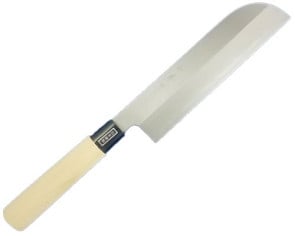
Minonokuni Ume 8.3-inch (210mm) Kama-Usuba
The 210mm Ume kama-usuba is a full-size Kansai vegetable knife for a cook who preps vegetables in quantity and wants a forgiving steel to learn on. Its length handles cucumber and daikon sheets for sushi, and its tip handles the garnish work.Kama-usuba knives are lighter than a square usuba of the same length because the spine is rounded down toward the tip. The flat section of the edge does the push cutting and katsuramuki, and the point reaches into a vegetable for carving and scoring.
Which Line?The three standard Minonokuni lines suit different cooks. Ume is the most forgiving and the best for learning to sharpen, which makes it a good choice for a novice or a cook new to single-bevel knives. The Take 210mm kama-usuba is the sweet spot for cooks ready for harder white steel, and the Matsu 210mm kama-usuba is for experienced hands.The Ume 180mm kama-usuba is lighter. For square-tipped work at this length, see the Ume 210mm usuba. See the knife shapes guide for the square and pointed usuba. Learn More$135.00 -

Minonokuni Ume 6.5-inch (165mm) Deba
The 165mm is the deba size that does a little of everything. It is heavy enough to take the head off a medium salmon and nimble enough to fillet a mackerel, and it breaks down a whole chicken without trouble. In the Ume line, it is our suggestion for a cook who wants one deba to learn on.The thick spine and substantial weight give leverage through fish collars and joints, while the single bevel keeps the forward edge close to the bone. Cutting along the frame rather than across it, the cook can take clean fillets with little waste.
Ume, Take or Matsu?The three standard lines are not a simple ranking. Each suits a different cook. Ume is the most forgiving and the best for learning to sharpen. The Take 165mm deba is the sweet spot for cooks ready for a harder edge, and the Matsu 165mm deba is for those already experienced with single-bevel knives.Left-handed cooks should choose the Ume 165mm left-handed deba. Smaller fish are easier with the Ume 150mm deba, and larger ones with the Ume 180mm deba. The knife shapes guide explains the deba. Learn More -

Minonokuni Take 6.5-inch (165mm) Deba
Between the small and large debas, the 165mm is the all-round size. It has enough weight to remove the head of a medium salmon or sea bass, yet it is easy enough to control on mackerel and trout. It is also a well-sized knife for breaking down whole chickens and for preparing poultry for yakitori.On poultry, the heel cuts through the joints and the thin wing tips, while the tip frees the oysters and the breast from the carcass. On fish, the single bevel keeps the edge flat to the frame for a clean three-piece fillet. Neither job calls for chopping through heavy bone, and the deba should not be used that way.
Matsu, Take or UmeAll three standard Minonokuni lines make a 165mm deba. Take, in white steel, is the sweet spot. It is adequate for professional use and less brittle than the blue steel Matsu 165mm deba. For a cook who wants the most forgiving knife to learn sharpening on, the Ume 165mm deba is the place to start.Left-handed cooks should choose the Take 165mm left-handed deba. The kitchen knife shapes guide covers how a deba differs from a boning knife. Learn More$216.00 -

Minonokuni Take 7.1-inch (180mm) Deba
When the fish on the board is a large salmon or a big snapper, the 180mm deba is the size to reach for. The extra length and weight let the heel drive through the head and collar in fewer strokes, and the longer edge follows a wide backbone in one pass.Being heavy, the knife does more of the work, and the cook should let it. Guide the blade along the bone instead of pushing it, and use the tip to separate the belly and ribs. A heavy deba still has a thin edge, so leave frozen fish and thick beef bones to other tools, and never twist the blade in a joint.
Why We Recommend TakeTake is the middle of the three standard lines. Its white steel holds an edge well enough for a working kitchen, and it is less brittle than blue steel, so it is the sensible choice for a cook who has not used many single-bevel knives. Cooks experienced with the grind may prefer the blue steel Matsu 180mm deba.The Take 165mm deba is more nimble, while the Take 195mm deba is the largest size. Left-handed cooks should see the Take 180mm left-handed deba. The knife shapes guide covers the deba in detail. Learn More$242.00 -

Minonokuni Take 7.7-inch (195mm) Deba
The 195mm is the largest deba in the Take line, built for large saltwater fish and big freshwater fish. Its mass is the point. A heavy blade drops through the head and collar of a large fish with little effort from the cook, and the long edge keeps the cut straight along a wide frame.That weight makes it slower on small fish, so it suits a cook who regularly handles large ones, such as a restaurant buying whole fish or an angler cleaning a large catch. For mixed work, the Take 180mm deba or Take 165mm deba is easier to manoeuvre.
Steel ChoiceWhite steel gives the Take line an edge that holds up in a professional kitchen while staying less brittle than blue steel. That combination is why we call Take the sweet spot of the Minonokuni range. A cook who wants the same size in the most forgiving steel can look at the Ume 195mm deba.Left-handed cooks will find the Take 180mm left-handed deba the largest left-handed option in the line. For more on choosing a deba, see the guide to knife shapes. Learn More$265.00