
You have no items in your shopping cart.
Minonokuni Knives
Authentic Japanese blades (hochoes) hand-forged using traditional Japanese methods of old-world craftsmanship; Minonokuni knives are part of a project designed to preserve and protect the master/apprentice relationship. Even as demand for Japanese knives has grown; the skilled masters are aging, and it has been difficult to keep apprentices. While the methods of construction mastered over the centuries have changed very little, the methods of bringing the pieces to market is dramatically different. Then Knife Merchant was asked to assist by bringing knives from various masters in different types of material to market, so that the craftsmen can concentrate on their work and keep the apprentice fully employed, without the burden of stopping production to make sales. Minonokuni is the name of a prefecture (state) that existed in the days of the Samurai. It encompassed a wide area including Seki-City and Sakai, which are the areas of Japan in which our craftsmen are making these blades. This is why we have chosen this as a brand name to represent these knives. You will find the quality to be far superior to comparable material types. When the knife maker has his name on the blade (instead of working for a company), there is greater pride and care taken in little details that make a great difference in final quality. Minonokuni knives are now available in a variety of grades to suit every need and price point.
-

Minonokuni Take 13-inch (330mm) Yanagi
The 330mm is the longest yanagi Minonokuni makes in the Take line. It is a specialist’s knife for large fish, such as whole loins of tuna and wide sides of salmon, where even a 300mm blade would need a second stroke to finish the slice.The length gives a long, slow stroke, and the cook controls the thickness of each slice through the angle of the blade. On a board of ordinary depth, it can be unwieldy, so we suggest it for a sushi counter or a kitchen that slices large fish daily.
Why TakeThe Take line uses white steel. It is good enough for professional use and less brittle than blue steel, and on a blade this long, a little extra tolerance in the edge is worth having. White steel also returns to a keen edge quickly on a waterstone, which shortens the time spent maintaining a long single bevel.For a more manageable length, see the Take 300mm yanagiba or the Take 240mm yanagiba. The knife shapes guide covers the yanagi and other slicers.As with every Take knife, the blade is forged and finished by hand, and minor marks from that work are a normal part of the knife. Learn More$300.00 -
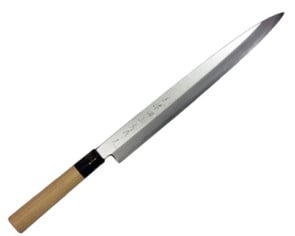
Minonokuni Take 11.8-inch (300mm) Yanagiba
At 300mm, this yanagiba is long enough to cut fillets from larger fish and to slice wide blocks for sashimi without a second stroke. It belongs on a sushi counter or a deep home board where the cook has room to draw the full length of the blade.A long yanagiba is also a precise one. The length lets the cook slow the stroke and control the thickness of each slice, which matters for thin cuts of white fish. It does take practice to keep the tip steady, and a cook coming from a shorter slicer should allow time to adjust.
Take or Matsu at 300mmBoth lines make this length. The blue steel Matsu 300mm yanagi holds an edge longer but is more brittle and suits an experienced cook. Take uses white steel, which is still good enough for professional use and tolerates more, so we suggest it for cooks who are not yet experts in single-bevel knives.For a slightly shorter knife, see the Take 270mm yanagiba. The Take 330mm yanagi is the longest in the line. Our knife shapes guide describes the yanagiba. Learn More -

Minonokuni Take 10.6-inch (270mm) Left-Handed Yanagi
A left-handed sushi chef who needs a longer slicer can choose this Take 270mm yanagi, which we stock. The blade is ground for the left hand, with the bevel on the left face and the hollow back on the right.The long, weighted blade should glide through the fish under its own weight while the thin edge makes the cut. Draw from heel to tip in a single stroke. Pressing down or sawing will crush the flesh and spoil the surface of the slice.
Take for Left-Handed CooksTake is the sweet spot of the Minonokuni range. Its white steel is ready for professional work and less brittle than blue steel, so it is a good choice for a left-handed cook who has some experience but is not yet an expert with single-bevel knives. A cook who would rather learn on the most forgiving steel can choose the Ume 270mm left-handed yanagi.The Take 240mm left-handed yanagi is shorter and easier on a home board. The right-handed version is the Take 270mm yanagiba. The knife shapes guide explains the yanagi. Learn More -

Minonokuni Take 10.6-inch (270mm) Yanagiba
Slicing fish for a full dining room calls for a longer knife, and the 270mm yanagiba adds that length without moving to the largest sizes. A wide block of fish can be sliced from heel to tip in one smooth draw, which keeps the surface of each piece glossy and intact.The added length also means added weight toward the tip. Let that weight carry the blade through the fish, and keep the grip relaxed. A cook used to a 240mm will need a few sessions to adjust to the longer stroke.
The Take LineTake uses white steel, a fine-grained carbon steel that sharpens quickly and holds an edge well in a working kitchen. It is less brittle than the blue steel Matsu 270mm yanagiba, and so suits cooks who are confident with sushi but not yet experts at maintaining a single-bevel edge.Shorter and longer options are the Take 240mm and Take 300mm. Left-handed cooks can order the Take 270mm left-handed yanagi. For more on slicers, see the knife shapes guide. Learn More$220.00