
You have no items in your shopping cart.
Kyocera Ceramic Knives
Ceramic knives offer practical advantages over steel, most notably their ability to hold a sharp edge for an extended period, their lightweight construction, and the fact that they are chemically inert, meaning they won't rust or alter the taste of food. As a Japanese company and a leader in advanced ceramics, Kyocera engineers its blades for precision and durability. Their product lines cater to different users: the Revolution series features the classic white ceramic blade, providing a dependable, all-purpose cutting tool perfect for everyday kitchen tasks. The Innovation series is designed for users seeking enhanced performance, utilizing a denser, black ceramic blade for even greater edge retention and often including a more ergonomic handle for added comfort and control. Whichever line you choose you can expect phenomenal performance for many years to come.
-

Kyocera Innovation Black 2-Piece Ceramic Knife Set
Two knives cover a large share of the produce prep in a home kitchen, one long enough for chopping and dicing on the board and one short enough for sandwiches, citrus and small vegetables. The pair is a sensible way to try ceramic alongside the steel knives already in the drawer.Both blades use Kyocera’s Innovation Black ceramic, which the company’s testing credits with twice the edge life of its earlier ceramic. Neither will rust or react with acidic food. Steel remains the right choice for bones and frozen food, since ceramic chips when it is twisted or struck.Buying from Knife Merchant keeps the set under Kyocera’s limited warranty. We are an authorized Kyocera reseller, a question customers raise with us before ordering, and Kyocera excludes knives bought from unauthorized sellers.
Choosing Between the Sets and Open StockThe Innovation Black 4-Piece Set swaps the chef’s santoku for a 7-inch chef’s knife and adds a santoku and a slicing knife. To fill one gap, buy the 6-inch Chef’s Santoku or the 4.5-inch Utility Knife on its own. Learn More$128.50 -

Kyocera Innovation Black 4-Piece Ceramic Knife Set
This set builds a ceramic lineup for vegetable-heavy cooking, with a blade length for each stage of prep, from breaking down a head of cabbage on the board to cutting thin slices of cooked fish. A longer blade for chopping and a shorter one for slicing spare you from forcing one knife to do both.Kyocera spent more than 12 years developing this ceramic and says it keeps an edge twice as long as the ceramic it replaced. The knives cannot rust and leave no metallic taste on acidic food. Like all ceramic, they are brittle, so keep a steel knife in the kitchen for bones, frozen food and prying.Before buying a ceramic set, customers ask us how it will be sharpened. Plan on diamond. The RSD-01 Diamond Wheel Sharpener covers home maintenance for all four knives, and EVERSHARP, Kyocera’s authorized service provider, repairs chips and resharpens worn edges (Kyocera’s sharpening service page explains how to send knives in).
Storing a Four-Knife SetThe Kyocera Universal Knife Block has a slotted insert that takes ceramic blades of any shape, and holds up to eight knives, enough for this set and four more. For a smaller start, the Innovation Black 2-Piece Set pairs a 6-inch chef’s santoku with the utility knife. Learn More -

Kyocera Innovation Black 7-inch Ceramic Chef's Knife
The 7-inch chef’s knife is the longest Innovation Black knife we carry and the one to reach for when the board is full. Its length covers a whole head of romaine or a row of carrots in one stroke, and the pointed tip handles the fine mincing of garlic and herbs. Kyocera describes it as the most commonly used knife shape in professional and home kitchens.On produce, ceramic has real advantages. It does not react with acids or rust, and Kyocera rates the edge at double the working life of its earlier ceramic. Bones, frozen blocks and prying will chip the edge, so pair it with a steel knife for those jobs.Our answer, when someone asks how a ceramic chef’s knife gets sharpened, is diamond. The Kyocera RSD-01 diamond sharpener restores the edge at home. EVERSHARP, the repair service Kyocera authorizes, takes care of heavy wear and chips; Kyocera’s sharpening service page has the form.
Choosing a Larger Innovation Black KnifeThe 6-inch Chef’s Santoku has a flat edge for push cutting and is a little shorter. This chef’s knife leads the Innovation Black 4-Piece Set, and the Innovation White 7-inch Chef’s Knife is the white-blade version. Learn More -
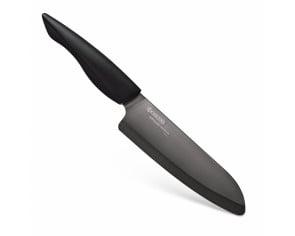
Kyocera Innovation Black 6-inch Ceramic Chef's Santoku
Kyocera calls this shape a chef’s santoku. It has the flat edge of a santoku and a 6-inch blade, enough length for chopping a head of broccoli or slicing a cucumber end to end on a full-size board.Kyocera lists chopping, slicing, dicing and mincing among its jobs, and the ceramic blade earns its keep on fruit and vegetables. It cannot rust and does not react with acidic ingredients. In Kyocera’s paper-cutting tests, Innovation blades lasted twice as long before dulling as the brand’s traditional ceramic. Since ceramic chips under twisting or impact, keep a steel knife nearby for bones, frozen food and hard cheese.Knife Merchant sells Kyocera as an authorized dealer, which customers ask about before buying. The answer affects coverage, since Kyocera’s limited warranty excludes knives sold by unauthorized dealers.
Chef’s Santoku or Chef’s Knife?The Innovation Black 7-inch Chef’s Knife adds an inch and a pointed tip. For a smaller hand or a short prep list, the 5.5-inch Innovation Black Santoku is easier to manage. It is also the larger of the two knives in the Innovation Black 2-Piece Ceramic Knife Set. Learn More -

Kyocera Innovation Black 5.5-inch Ceramic Santoku
At 5.5 inches, this is the smaller of the two Innovation Black santoku knives we carry, sized for preparing a few vegetables at a time with close control. The flat edge suits push cuts, so slicing scallions, dicing an onion and mincing parsley all happen with a straight down-and-forward stroke.Kyocera’s figures show this ceramic holding its sharpness twice as long as the company’s older Z206 material. The blade will not brown a cut apple or pick up a metallic taste from vinegar, and it cannot rust. Ceramic is also brittle, which is why Kyocera recommends steel for boning and frozen food.Customers ask us how to sharpen a ceramic santoku. A honing rod will not restore this edge, and Kyocera specifies diamond for the job. The Kyocera Diamond Wheel Sharpener is the home option. For a worn edge or a chipped tip, Kyocera sends owners to EVERSHARP, its authorized service provider (details on Kyocera’s sharpening service page).
5.5-Inch or 6-Inch Santoku?The Innovation Black 6-inch Chef’s Santoku gives a little more length for larger vegetables and a full cutting board. The same knife comes in the 4-Piece Set. With a white blade, it is the Innovation White 5.5-inch Santoku. Learn More$80.00 -

Kyocera Innovation Black 5-inch Ceramic Slicing Knife
Cooked chicken breast, roast pork loin and smoked salmon slice most cleanly when the blade is long and narrow enough to finish each cut in a single draw. Kyocera designed this 5-inch Innovation Black knife for thin slices of boneless meat, and the extra length over a utility knife also lets it cross a wide melon or a bell pepper in one pass.Because the blade is ceramic, it leaves no metallic taste on fish or fruit and never needs drying to prevent rust. Kyocera reports that its Innovation ceramic keeps its edge for double the time of the company’s earlier blades. Ceramic does not flex, so use a steel knife for carving around bones or anything frozen.Knife Merchant is an authorized Kyocera dealer, a point customers ask us to confirm before ordering. Kyocera extends its limited warranty only to purchases from authorized resellers.
Comparing the 5-Inch SlicerThe 4.5-inch Innovation Black Utility Knife is half an inch shorter and easier to use in the hand. The Innovation White 5-inch Tomato Knife has a micro-serrated edge that bites into tomato skin and crusty rolls, where this plain edge is better for meat. You will also find this slicer in the Innovation Black 4-Piece Ceramic Knife Set. Learn More$65.00 -

Kyocera Innovation Black 4.5-inch Ceramic Utility Knife
A 4.5-inch utility knife covers the in-between jobs where a paring knife runs short and a santoku feels oversized. Kyocera suggests this one for slicing sandwiches and smaller fruits and vegetables, and it is just as handy for sectioning an orange or cutting a block of tofu into cubes.The Innovation Black blade is solid ceramic. Citrus and tomato acids have nothing to react with, and the blade cannot rust if it is left wet in the rack. Kyocera’s testing puts the edge life of its Innovation blades at double that of its earlier ceramic knives. The trade-off with any ceramic edge is brittleness. Keep the tip out of bones and frozen food, and do not use it to pry.Customers ask us whether we are an authorized Kyocera dealer. We are, and it matters here, because Kyocera’s warranty only covers knives bought from authorized resellers. Knives from unauthorized sellers are excluded.
Where the 4.5-Inch Size FitsFor peeling and other in-hand work, the 3-inch Innovation Black Paring Knife is easier to steer. For thin slices of cooked meat, step up to the 5-inch Slicing Knife. This utility knife also comes in the Innovation Black 2-Piece Set and the 4-Piece Set, and the Innovation White 4.5-inch Utility Knife offers the same length with a white blade. Learn More$55.00 -

Kyocera Innovation Black 3-inch Ceramic Paring Knife
Peeling an apple in the hand, hulling strawberries and trimming the root end from a shallot call for a short, pointed blade that is easy to steer. This 3-inch Innovation Black paring knife is made for that close work. Its ceramic blade will not rust or react with food, so lemon juice and onion leave no stain or metallic taste behind.Kyocera rates its Innovation blades to stay sharp twice as long as its earlier ceramic blades, which Kyocera already credits with holding an edge up to ten times longer than steel. On a knife that spends most of its life on fruit and vegetables, that means long stretches between sharpenings. Ceramic is hard and brittle, though, so leave bones and frozen food to a steel paring knife.Customers ask us how a ceramic knife gets sharpened when it finally dulls. It needs diamond. The Kyocera Diamond Wheel Sharpener handles touch-ups at home, and Kyocera’s authorized service provider, EVERSHARP, sharpens blades and removes chips (see Kyocera’s sharpening service page).
Paring Knife or Utility Knife?Choose the 3-inch blade for work done in the hand or on small produce. The Innovation Black 4.5-inch Utility Knife adds enough length to halve a sandwich or slice a cucumber on the board. For the same blade length with a white blade and a choice of handle colors, see the Innovation White 3-inch Paring Knife. Learn More

