
You have no items in your shopping cart.
Glestain Knives
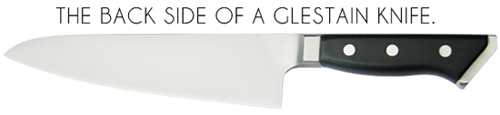
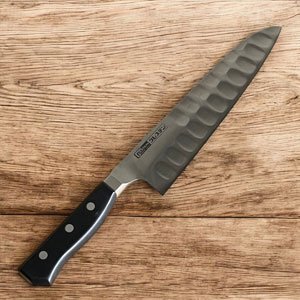
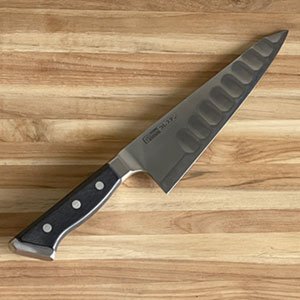
Glestain Knives are instantly recognizable by the rectangular scallops running down one side of the blade. This design of a Glestain knife is not only beautiful, but extremely functional. As you'll see in the demonstration video; this is the only design that truly works to keep starchy foods, like potatoes and cheese, from clinging to the blade this greatly increases speed when dicing and chopping. Glestain's proprietary Acuto stainless steel holds a razor sharp edge and is very easy to resharpen. It is a Molybdenum Vanadium steel set to a rockwell hardness of 58/59. Glestain knives are in a class of their own; you will not be disappointed with its superior performance.
For Left Handed Customers: We carry many left handed Glestain knives, and can custom order any knife in left handed. For more information, please e-mail us.
-

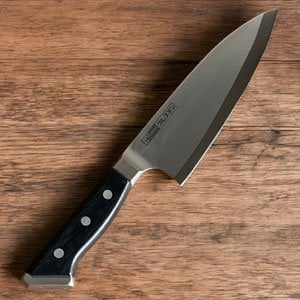
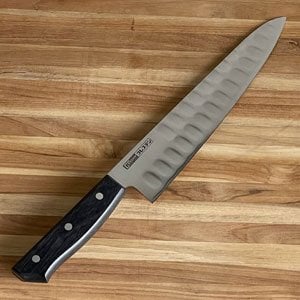
Glestain K Series 7.5-inch (190mm) Left-Handed Santoku
At 190mm, this left-handed santoku is longer than most santoku blades, which gives a left-handed cook more reach for cabbage, squash and large onions while keeping the flat edge that suits push cuts.The dimples on the left face make the biggest difference on a santoku, which is used with a straight push more than a rocking motion. Sliced vegetables fall away from the steel, and the mirrored asymmetrical grind keeps the blade on line in the left hand.An asymmetrical blade cannot be converted to the other hand, so left-handed cooks need the left-handed model to get this geometry.
Other Left-Handed KnivesThe K Series 170mm Left-Handed Santoku is more compact. For a chef’s knife with more curve, see the K Series 210mm Left-Handed Gyuto. Our kitchen knife shapes guide explains the santoku and the gyuto. Learn More$170.00 -
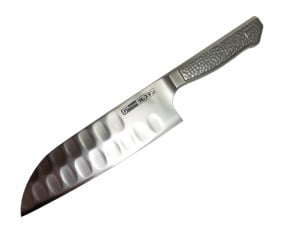
Glestain Ice Handle 6.7-inch (170mm) Left-Handed Santoku
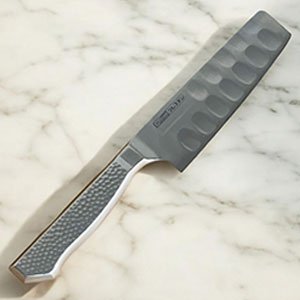
An all-metal santoku made for the left hand, the Ice Handle 170mm Left-Handed Santoku combines Glestain’s mirrored, left-handed blade with a stainless handle that cleans and sanitizes easily.The dimples sit on the left face, the face that meets the food when a left-handed cook works, so sliced vegetables fall away from it. The dimpled, textured handle stays secure in a wet hand, and the compact blade fits a small board.Left-handed knives with metal handles are uncommon. This one suits a left-handed professional at a station that requires sanitary knives, and a home cook who prefers the one-piece style.
Other Left-Handed SantokuThe K Series 170mm Left-Handed Santoku has the same blade on a wood handle, and the 190mm Left-Handed Santoku is longer. Our knife shapes guide covers the santoku. Learn More$150.00 -

Glestain Ice Handle 6.7-inch (170mm) Santoku
The Ice Handle santoku puts Glestain’s 170mm dimpled blade on an all-stainless handle that is quick to clean and sanitize. With no wood and no seam where blade meets handle, it suits professional kitchens that move between produce and proteins, and home cooks who want a knife that cleans in a moment.The handle is dimpled and textured so it holds in a wet hand. On the board, the flat edge suits push cuts through vegetables, and the dimpled blade keeps slices of potato and cucumber from sticking.Its compact length handles dicing, mincing and slicing boneless meat and fish on a small board.
Choosing a SantokuFor a wood handle, see the K Series 170mm Santoku. Left-handed cooks can choose the Ice Handle 170mm Left-Handed Santoku. The Ice Handle line also includes the 210mm Gyuto. Our guide to kitchen knife shapes explains the santoku. Learn More$137.00 -

Glestain K Series 6.7-inch (170mm) Left-Handed Santoku
The Glestain 6.7 in. (170mm) Left Handed Santoku is good to use on fruits and vegetables. Learn More -

Glestain K Series 6.7-inch (170mm) Santoku
A santoku is used mostly with a straight push cut, with the blade driven down and forward through the food, and that motion is where Glestain’s dimples help most. Each slice of potato, cucumber or onion drops off the face instead of riding up it, so the next cut starts on a clear blade.The 170mm blade is compact and tall, with a flatter edge than a gyuto. It suits dicing vegetables, mincing herbs and slicing boneless meat and fish, and it fits easily on a small cutting board. The asymmetrical grind pushes each slice away from the knife, which keeps a rhythm of fast, even cuts.The K Series has a bolster and no end cap. Glestain is bought by home cooks and professionals alike, and this santoku suits a home cook who wants one compact knife as well as a professional who keeps a santoku for vegetable work.
Choosing a SantokuFor a smaller blade, see the K Series 160mm Santoku; for an all-stainless handle, the Ice Handle 170mm Santoku. Left-handed cooks can choose the 170mm Left-Handed Santoku. If you prefer a rocking cut, a 210mm gyuto has more curve. Our guide to kitchen knife shapes compares the santoku and the gyuto. Learn More -

Glestain K Series 6.3-inch (160mm) Santoku
The 160mm santoku is the smallest santoku Glestain makes, a compact knife for cooks with smaller hands, small cutting boards or limited counter space. It handles nearly every daily task, from slicing a tomato to mincing garlic and dicing an onion.On a short blade, the dimples still make a difference. Slices of cucumber and potato release instead of sticking, and the asymmetrical grind sends them off the blade so you can keep cutting without stopping to clear it. The flat edge suits push cuts, and the tall blade gives knuckle clearance over the board.The K Series handle has a bolster and no end cap, which keeps this knife light and easy to control.
Comparing Santoku SizesThe K Series 170mm Santoku is slightly longer, and the Ice Handle 170mm Santoku has a stainless handle. Our guide to kitchen knife shapes explains how a santoku compares with a gyuto. Learn More

