
You have no items in your shopping cart.
Glestain Knives
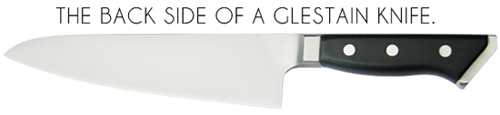
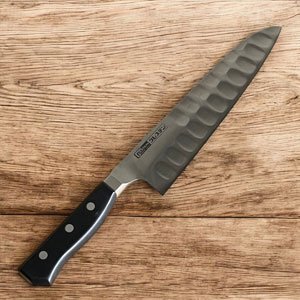
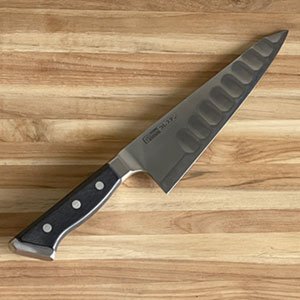
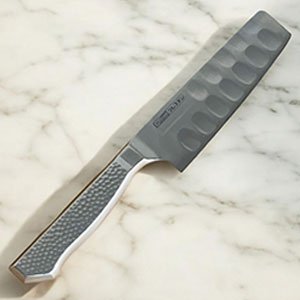
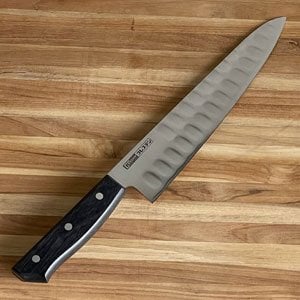
Glestain Knives are instantly recognizable by the rectangular scallops running down one side of the blade. This design of a Glestain knife is not only beautiful, but extremely functional. As you'll see in the demonstration video; this is the only design that truly works to keep starchy foods, like potatoes and cheese, from clinging to the blade this greatly increases speed when dicing and chopping. Glestain's proprietary Acuto stainless steel holds a razor sharp edge and is very easy to resharpen. It is a Molybdenum Vanadium steel set to a rockwell hardness of 58/59. Glestain knives are in a class of their own; you will not be disappointed with its superior performance.
For Left Handed Customers: We carry many left handed Glestain knives, and can custom order any knife in left handed. For more information, please e-mail us.
-

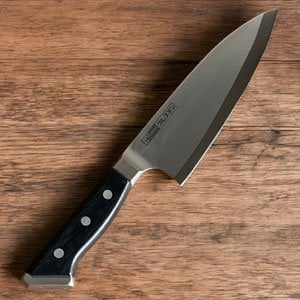
Glestain 9.4-inch (240mm) Deba
For fabricating large, powerful fish such as tuna, swordfish and large salmon, the 240mm deba has the weight and length the job demands. It removes heads and collars, splits frames and takes fillets from fish too large for a smaller deba.The blade has a smooth W Series face and the clean look of a classic deba, in stainless steel that resists rust at the fish station. Its edge is ground close to a single bevel, with only a small back bevel, so it cuts with the precision of a traditional deba.At almost double the carbon content of standard German stainless steel, this knife is over 20% lighter than carbon steel debas of the same size, significantly reducing fatigue during long sessions. A 240mm deba is a professional tool for fishmongers, sushi kitchens and anglers who land large fish.
Choosing a Deba SizeThe Glestain deba also comes as a 160mm Deba and a 200mm Deba. For filleting flatfish and portioning, pair it with a flexible fillet knife or a sujihiki. Our guide to kitchen knife shapes explains the deba. Learn More$306.00 -

Glestain SO Series 9.8-inch (250mm) Serrated Slicer
For a light serrated slicer, the SO Series 250mm puts Glestain’s scalloped serrated blade on the plain Home Series handle, which has squared shoulders and no bolster. It is a lighter knife than the K Series version of the same blade.The serrations grip the bark on brisket and the crust on bread, then the thin blade slices the interior without tearing it. It is a big favorite of participants in BBQ competitions, who use it on brisket and tri-tip, and it works as a bread knife and a cake knife at home. In Japan, Glestain markets this shape for cake.With no bolster, the edge runs straight to the handle, so the full length of the blade is available for slicing. It is easy to touch up the edge with just a honing rod.
Other Serrated SlicersSee the K Series 250mm Serrated Slicer for a bolstered handle, or the SO Series 310mm Serrated Slicer for more length. Every Glestain slicer is compared below, and our kitchen knife shapes guide explains how bread knives and slicers differ. Learn More -
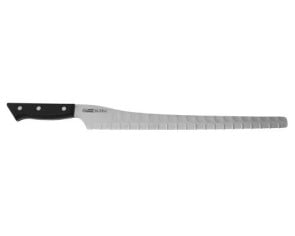
Glestain SO Series 12.2-inch (310mm) Serrated Slicer
The SO Series 310mm serrated slicer is the long Glestain slicer on the light Home Series handle. The plain handle has squared shoulders and no bolster, which keeps weight down on a knife that spends its time making long, steady strokes.This slicer is a big favorite of participants in BBQ competitions. On a brisket, a 310mm blade crosses the whole flat in one pass and keeps the bark on every slice. The scalloped serrations grip crust and bark, and the thin blade does not crush the tender meat beneath.At home it slices large loaves, roasts and layer cakes. The edge between the scallops gives a semi-serrated effect that cuts cleanly with little pressure. It is easy to touch up the edge with just a honing rod.
Other Long SlicersFor a bolstered handle, choose the K Series 310mm Serrated Slicer. The SO Series 250mm Serrated Slicer is shorter. The table below compares every Glestain slicer, and our kitchen knife shapes guide explains bread knives and slicers. Learn More -

Glestain KE Series 5.9-inch (150mm) Honesuki
The honesuki is the Japanese boning knife for poultry. Its stiff, triangular 150mm blade has a pointed tip for finding the joints of a chicken or duck and a tall heel that gives the hand room above the board. Use it in place of a gyuto to break down whole birds, bone out thighs and trim pork.The dimples keep raw chicken from clinging to the blade, so the knife moves cleanly along the bone and the meat comes away without tearing. The asymmetrical grind helps the edge follow the carcass closely. The KE Series bolster and end cap give the knife weight and a secure grip when working with slippery poultry.A honesuki works around bones and through joints; it is not built for chopping through bone.
Choosing a Boning KnifeFor larger birds and heavier boning, see the KE Series 190mm Garasuki. The Ice Handle 150mm Honesuki has a stainless handle, and left-handed cooks can choose the 150mm Left-Handed Honesuki. Our kitchen knife shapes guide explains how a honesuki differs from a Western boning knife. Learn More$174.00 -
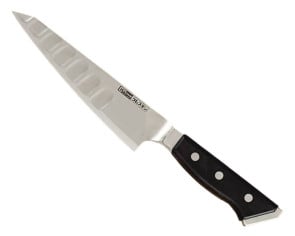
Glestain KE Series 5.9-inch (150mm) Left-Handed Honesuki
The 150mm Left-Handed Honesuki is the Glestain poultry boning knife ground for the left hand. Like the right-handed 415TK, it has a stiff triangular blade with a pointed tip for finding joints and a tall heel for knuckle clearance; the asymmetry and the dimples are mirrored for a left-handed grip.Use it on chicken and duck to separate legs and thighs and bone out breasts, and to trim pork. The dimples keep raw meat from clinging, and the mirrored grind lets the edge follow the bone in a left-handed cut. The KE Series bolster and end cap give a firm, weighted grip.Left-handed boning knives are hard to find, and an asymmetrical blade cannot be reground for the other hand, so this is the right choice for a left-handed butcher or cook.
Other Left-Handed Boning KnivesFor heavier work, see the KE Series 190mm Left-Handed Garasuki. All Glestain boning and fish knives are compared below, and our guide to knife shapes covers the honesuki. Learn More$190.00 -

Glestain Ice Handle 5.9-inch (150mm) Honesuki
Raw poultry is the strongest argument for a metal handle, and the Ice Handle honesuki puts Glestain’s 150mm poultry boning blade on an all-stainless handle that is easy to clean and sanitize. There is no wood to absorb juices and no seam at the blade.Use it to break down chicken, duck and pork in place of your gyuto. The triangular blade has a pointed tip for joints and a tall heel for knuckle clearance, and the dimples keep raw meat from sticking. The textured M Series handle stays secure in a hand slick with fat.For butcher counters, poultry processors and home cooks who break down whole birds, it is a practical, hygienic boning knife.
Other HonesukiThe KE Series 150mm Honesuki has a wood handle with bolster and end cap. For larger birds, see the 190mm Garasuki. Our kitchen knife shapes guide explains boning knives. Learn More$162.00 -

Glestain KE Series 7.5-inch (190mm) Garasuki
The garasuki is the larger, heavier relative of the honesuki. Its 190mm triangular blade has the length and the thicker spine for bigger birds and heavier boning, such as breaking down turkeys, boning a leg of lamb or separating pork shoulder, and it slices the boned meat as well.The dimpled face keeps raw meat from clinging, so the knife travels cleanly along the bone. With the KE Series bolster and end cap, it is a substantial knife with a secure, weighted grip, suited to butcher shops and kitchens that process whole animals.Like the honesuki, the garasuki is meant for working around bones and through joints; use a cleaver or saw to cut through heavy bone.
Honesuki or Garasuki?For chicken and duck, the KE Series 150mm Honesuki is quicker and more nimble. Left-handed cooks can choose the 190mm Left-Handed Garasuki. For steaks and large cuts, see the KE Series 220mm Scimitar. Our guide to kitchen knife shapes compares these knives. Learn More -

Glestain KE Series 7.5-inch (190mm) Left-Handed Garasuki
For left-handed butchers and cooks, the 190mm Left-Handed Garasuki brings Glestain’s heavier boning knife to the left hand. The blade is a mirror image of the right-handed 420TK, with the dimples and the steep face reversed, so it follows the bone in a left-handed cut.Use it on large poultry, lamb and pork, and to slice the meat once it is off the bone. The thick spine gives the blade strength for heavy boning, and the dimples keep raw meat from sticking. The KE Series bolster and end cap give a weighted, secure grip.Left-handed Japanese boning knives are rare, and Glestain’s asymmetrical blades cannot be reground for the opposite hand.
Other Left-Handed Boning KnivesFor poultry, the 150mm Left-Handed Honesuki is smaller and quicker. Our kitchen knife shapes guide explains boning knives. Learn More$260.00 -

Glestain KE Series 8.7-inch (220mm) Scimitar
The scimitar is a butcher’s knife for cutting large slabs of meat, and Glestain’s 220mm version adds dimples to the traditional Western curved blade. Butchers use it to cut steaks from a strip loin, trim fat and sinew, and portion large cuts; hunters use it to break down game.The long, upswept curve lets the knife draw through a cut in one stroke, which gives clean, even steaks. The dimples keep raw meat from clinging to the blade, and the handle curves for a secure grip and comfort through long sessions at the block. It also carves roasts and trims briskets.The knife fits the F. Dick Scimitar Knife Sheath, which protects the edge on the way to the shop or the field.
Other Butchery KnivesFor boning, see the KE Series 190mm Garasuki and the 150mm Honesuki. For slicing cooked roasts, the 270mm Sujihiki is narrower. Our guide to kitchen knife shapes covers butcher and breaking knives. Learn More$262.00 -

Glestain K Series 8.7-inch (220mm) Chinese Chef’s Knife
The Chinese chef’s knife is the all-purpose knife of Chinese cooking, and Glestain’s 220mm version adds the dimpled face to a very wide, thin blade. Use it to slice, cube and mince vegetables, to julienne ginger and to cut boneless meat, then turn it flat to scoop the prepared food off the board.A wide blade has a large face for food to stick to. The dimples keep slices of potato, cucumber and daikon from clinging, and the asymmetrical grind pushes them away as you cut. The spine is thin, so this is a slicing knife for vegetables and boneless proteins, and it should not be used as a meat cleaver on bone.Cooks trained on a Chinese chef’s knife will recognize the shape; for others, the tall blade gives ample knuckle clearance and a broad surface for crushing garlic.
Other All-Purpose Glestain KnivesFor a Western-style chef’s knife, see the KE Series 240mm Gyuto. For compact push cuts, the K Series 170mm Santoku is smaller. Our guide to kitchen knife shapes explains vegetable cleavers and meat cleavers. Learn More$375.00

