
You have no items in your shopping cart.
F Dick Cleavers
Renowned for their quality and durability, Friedrich Dick cleavers are available in a variety of weights and styles made to suit any task. Superior fit and finish offer comfort during use and ensure optimal hygeine.
-

F. Dick ErgoGrip 11-inch Extra-Wide Butcher Knife
At 3.8 inches tall, the blade on this 11-inch butcher knife feels closer to a cleaver than a slicer, and it is made for cutting large slabs of meat. The handle is just as substantial, about 1.5 by 1 inch where the palm sits.The strongly curved, pointed blade follows what is called the American style. Its long, sweeping edge glides through a steak or a rib section in a flowing movement and keeps the hand in a comfortable position. The weight of the blade does some of the work on thick cuts.A blade of this weight and height also clears the board easily on long draws, and the flat face carries cut pieces off the table. It suits plants and shops that cut large slabs, ribs and whole primals every day.For a narrower blade at a similar size, the 10-inch and 12-inch ErgoGrip butcher knives are lighter in the hand. The ErgoGrip wide trimming knife shares the broad profile in a shorter length. Our knife shapes guide has more on butcher knife styles. Learn More$101.40 -

F. Dick 8-inch 2.25-Pound Kitchen Cleaver
Disjointing larger bones and cutting through smaller ones in pork, lamb and beef is the work this 8-inch F. Dick cleaver is built for. Its longer blade and short handle put the weight forward, so it breaks cleanly through bone in a single movement.That forward balance distinguishes it from the 7-inch model. The blade carries more of the mass, which helps on a pork shoulder or a lamb leg where the cleaver has to pass through a joint and the bone around it. F. Dick forges and balances each cleaver and hand-sharpens the edge.For a kitchen that breaks down whole pork shoulders or lamb legs, the longer blade clears the bone in a single stroke and leaves a cleaner cut face on the meat.For lighter work, the 7-inch 2-pound meat cleaver is quicker to lift. The 9-inch 3-pound cleaver takes on denser beef bones. Our kitchen knife shapes guide explains how a meat cleaver differs from a vegetable cleaver. Learn More$100.75 -

F. Dick 9-inch 3-Pound Meat Cleaver
Large, dense bones call for weight, and this 9-inch F. Dick cleaver uses the mass of its blade to go through them. It disjoints larger bones and cuts the smaller ones in beef, pork and lamb, at a butcher shop or in a restaurant kitchen that buys whole primals.The blade is heavier toward the front than on the smaller F. Dick models, so the cleaver drives through bone with less effort from the arm. For a cleaver, the edge comes quite sharp, with a wide bevel on both sides that makes later resharpening easy. F. Dick tapers and balances each one at the factory.Its 5-inch blade height also keeps knuckles well clear of the block on every stroke.If the work is mostly chops and ribs, the 7-inch 2-pound cleaver is less tiring. For the thickest beef bones, the 10-inch 4-pound cleaver adds another pound, and the two-handed 14-inch beef and pork splitter takes on carcass work. Learn More$126.75 -
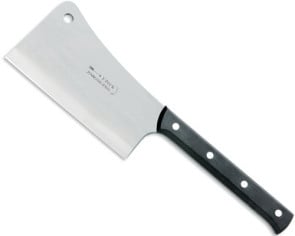
F. Dick 10-inch 4-Pound Meat Cleaver
The largest one-handed F. Dick cleaver we carry is meant for the thickest and densest bones in cattle, pork and lamb. At about 4 pounds, it lets gravity do most of the work on a beef shank or a heavy rib section.Weight is the reason to choose it. A heavy blade carries through bone in one stroke, which gives a cleaner cut face and fewer bone splinters than repeated chops with a lighter cleaver. The steel on the bolster and spine is smoothed for a comfortable grip, and the edge leaves the factory with bevels sized for immediate use and easy resharpening.Lift it only a short distance and let it fall; the weight of the blade does the rest.For most restaurant work, the 9-inch 3-pound cleaver is easier to control. Splitting whole carcasses calls for a two-handed tool such as the 14-inch beef and pork splitter or the 16-inch beef splitter. Our knife shapes guide covers cleaver types. Learn More$154.00 -
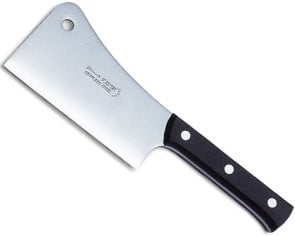
F. Dick 7-inch 2-Pound Meat Cleaver
Chops, ribs and restaurant butchering are the jobs for this 2-pound F. Dick cleaver. It has enough weight to sever meat and bone in a clean stroke and a long, thick handle that balances the heavy blade.The forged blade is tapered so it wedges through bone instead of bouncing off it. The bolster is smoothed, so it does not dig into the hand during heavy use, and a hole in the blade lets the cleaver hang on a hook or rail. Each edge is hand-sharpened at the F. Dick factory.Restaurant kitchens that cut their own short ribs and oxtails get a cleaver heavy enough for bone that still lifts easily for repeated strokes. The 7-inch blade also leaves room to scoop cut pieces off the block.A lighter option for poultry is the 6-inch 1-pound meat cleaver. For beef and larger pork bones, the 9-inch 3-pound and 10-inch 4-pound cleavers bring more mass. The comparison table below shows each weight and its typical work. Learn More$76.70 -

F. Dick 6-inch 1-Pound Meat Cleaver
The smallest of F. Dick’s forged meat cleavers is light enough for repeated chops through poultry cartilage and small joints, and heavy enough to go through a chicken back or a rack of lamb ribs. It suits a home cook or a restaurant line that breaks down birds.A short blade keeps the weight close to the hand, so each chop lands where it is aimed. F. Dick sets a good bevel on the edge at the factory, which makes later honing and resharpening straightforward for a cleaver. The smooth handle stays comfortable through a run of birds.At 6 inches, it is also small enough to store in a knife drawer or a block slot, unlike the heavier cleavers.For pork chops and ribs, the 7-inch 2-pound meat cleaver brings more mass. Larger bones in pork, lamb and beef suit the 8-inch kitchen cleaver, and the comparison table below lists every F. Dick cleaver we stock, up to the two-handed splitters. Learn More$53.95

