
You have no items in your shopping cart.
F Dick 1905 Knives
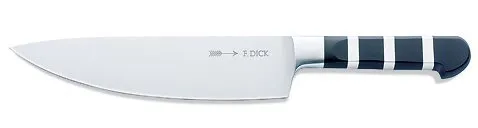
In 1905, a year of upheaval and technical progress, Friedrich Dick developed a series of knives which used aesthetic metal rings to secure the handle scales to the blade rather than the traditional 3 metal rivets used by all other German makers. This special design became the trademark of F. Dick knives as their blades could be identified easily when compared to any other maker. The symmetrical steel rings are inseparably connected to the handle using a proprietary technology that has never been replicated. Seamlessly polished and comfortable to hold, the 1905 series quickly became a favorite of German knife enthusiasts, so much so that these knives are still in production over 100 years later. Beautifully balanced 1905 Series blades are precisely ground from spine to heel and heel to tip resulting in a perfect taper that glides through food with ease. These knives are forged using a solid piece of X50CrMoV15 that holds an edge well, responds quickly to honing and can be sharpened with ease. A half bolster finger guard protects your fingers, but gives the user full access to the knife's edge in order to resharpen the cutting edge completely. Each knife in the 1905 series was thoughtfully designed and lovingly crafted to the exceptionally high standards associated with the name Friedrich Dick. The original marking of "F. Dick" is stamped by hand onto each blade as a quality mark. 1905 Series knives are Made in Taiwan using a process that combines traditional design and modern technology.
-

F. Dick 1905 7-inch Granton Edge Santoku
Santoku means “three virtues” in Japanese, for slicing, dicing and mincing, and this 1905 santoku covers that everyday work on meat and vegetables. Its granton edge, a row of hollow scallops along the blade, keeps slices of potato and cucumber from sticking.A santoku has a thin blade, a flatter edge than a chef’s knife and a rounded tip, so it works best with a straight push or a forward slice. The scallops put small pockets of air between the blade and wet or starchy food, which lets each slice fall away instead of riding up the knife. The thin profile also makes it capable of decorative cuts.Cooks who prefer a rocking cut should look at the 1905 8-inch chef’s knife. A smaller granton blade is the Premier Plus 5.5-inch granton edge santoku, and the 1778 santoku offers a much harder edge. See our knife shapes guide for santoku and chef’s knife profiles. Learn More$107.25

