
You have no items in your shopping cart.
F Dick 1905 Knives
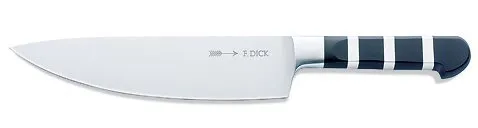
In 1905, a year of upheaval and technical progress, Friedrich Dick developed a series of knives which used aesthetic metal rings to secure the handle scales to the blade rather than the traditional 3 metal rivets used by all other German makers. This special design became the trademark of F. Dick knives as their blades could be identified easily when compared to any other maker. The symmetrical steel rings are inseparably connected to the handle using a proprietary technology that has never been replicated. Seamlessly polished and comfortable to hold, the 1905 series quickly became a favorite of German knife enthusiasts, so much so that these knives are still in production over 100 years later. Beautifully balanced 1905 Series blades are precisely ground from spine to heel and heel to tip resulting in a perfect taper that glides through food with ease. These knives are forged using a solid piece of X50CrMoV15 that holds an edge well, responds quickly to honing and can be sharpened with ease. A half bolster finger guard protects your fingers, but gives the user full access to the knife's edge in order to resharpen the cutting edge completely. Each knife in the 1905 series was thoughtfully designed and lovingly crafted to the exceptionally high standards associated with the name Friedrich Dick. The original marking of "F. Dick" is stamped by hand onto each blade as a quality mark. 1905 Series knives are Made in Taiwan using a process that combines traditional design and modern technology.
-

F. Dick 1905 3.5-inch Paring Knife
Peeling, slicing and garnishing fruits and vegetables are the jobs for this 3.5-inch 1905 paring knife. It comes with a keen edge that cuts thin, even tomato slices for a knife this small.A paring knife does much of its work in the hand, and the short blade keeps the tip close to the fingers for control when hulling strawberries or coring tomatoes. The ringed 1905 handle gives a secure grip for that close work.A paring knife also handles small jobs at the stove, such as scoring the skin of a sausage, testing a potato for doneness or cutting a lemon to finish a dish. Keep one near the range so the chef’s knife stays on the board.For tourné cuts and peeling round produce, the curved 1905 3-inch bird’s beak peeler is better shaped. Larger fruit and slicing on the board suit the 1905 6-inch utility knife. The comparison table below lists the 1905 paring and utility knives. Learn More$49.40 -

F. Dick 1905 3-inch Bird’s Beak Paring Knife
A bird’s beak knife has a short blade that curves inward like a beak, and this 1905 version is made for tourné cuts and for peeling round produce. The curve keeps the edge in contact with a potato, an apple or a stone fruit as the cook turns it in the hand.The classic tourné, a seven-sided football-shaped vegetable, is cut with the thumb as a pivot and the blade drawing toward it. The inward curve makes that motion natural, and it also helps with peeling citrus segments and removing blemishes from fruit. The forged blade stays rigid under the thumb.The short blade also suits trimming artichokes and fluting mushrooms, two classic garnish tasks.For straight-edged peeling and trimming on the board, the 1905 3.5-inch paring knife is the counterpart. A Premier Plus bird’s beak peeler offers the same shape with a modern handle, and the table below compares the 1905 small knives. Learn More$48.75

