
You have no items in your shopping cart.
Knives
-

Miyabi Black 7-inch Santoku
A Flat-Edged Alternative to the Chef’s Knife The Miyabi Black 7-inch Santoku is for cooks who cut with a downward chop or forward push rather than a rocking motion. Its flatter edge keeps more of the blade in contact with the board through each stroke, producing clean, complete cuts through stacked vegetables. The shorter length makes it quick and maneuverable on a crowded station or a small cutting board.
Construction and Performance Ultra-hard core steel. A fine-grained powder steel holds a keen edge through repeated board contact, the most demanding use a kitchen knife sees. Ice-hardened blade. Sub-zero hardening stabilizes the steel for added hardness and corrosion resistance. Flower Damascus cladding. Stainless layers protect the hard core and give each blade a distinctive pattern. Honbazuke edge. The three-stage hand-honed edge produces paper-thin slices of cucumber, radish and onion. D-shaped handle. The traditional Japanese profile gives a steady grip for repetitive chopping. Each handle’s grain and color are unique.
Best Uses Thin slicing of vegetables and fruit Dicing onions, peppers and potatoes Chopping and mincing herbs Slicing boneless fish and meat Cutting through stacked greens Cooks who prefer a rocking motion should consider the curved edge of the Miyabi Black 7-inch Rocking Santoku. For a longer blade with a pointed tip, see the Miyabi Black 8-inch Chef’s Knife. Learn More$434.95 -

Miyabi Black 9.5-inch Bread Knife
Clean Cuts Through Crust and Crumb The Miyabi Black 9.5-inch Bread Knife is a serrated blade for bakers and cooks who slice bread daily. The serrations bite into hard crusts while the thin blade passes through the crumb with little downward pressure, so soft interiors keep their shape. Its length clears wide boules and long loaves in full strokes.
Construction and Performance Ultra-hard core steel. Serrated edges are slow to resharpen, so the hard powder steel core earns its keep here by holding the points of each serration through heavy use. Ice-hardened blade. Sub-zero hardening stabilizes the steel for added hardness and corrosion resistance. Flower Damascus cladding. Stainless layers protect the hard core along the full length of the blade. Honbazuke-finished serrations. Hand finishing gives the serrations a clean bite that starts a cut without slipping on smooth or glazed crusts. D-shaped handle. The traditional Japanese profile gives steady control during long sawing strokes. Each handle’s grain and color are unique.
Best Uses Slicing crusty sourdough, boules and baguettes Slicing brioche, challah and sandwich loaves without tearing Splitting cake layers Slicing ripe tomatoes and citrus Portioning large sandwiches For roasts and fish, where a smooth edge gives a cleaner face, use the Miyabi Black 9.5-inch Sujihiki Slicing Knife. Learn More$554.95 -
Miyabi Black 7-inch Rocking Santoku
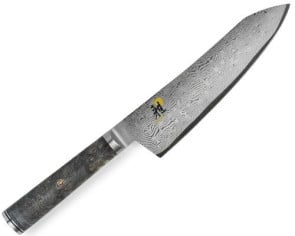
Santoku Height with a Rocking Curve The Miyabi Black 7-inch Rocking Santoku combines the tall, compact blade of a santoku with a curved edge that rolls from heel to tip. Cooks trained on Western chef’s knives can keep their rocking technique while gaining a shorter, more maneuverable blade. It suits home cooks and professionals who mince and dice in quantity but find an 8-inch blade more than they need.
Construction and Performance Ultra-hard core steel. A fine-grained powder steel holds a keen edge through the constant board contact of rock-chopping. Ice-hardened blade. Sub-zero hardening stabilizes the steel for added hardness and corrosion resistance. Flower Damascus cladding. Stainless layers protect the hard core and give each blade a distinctive pattern. Curved Honbazuke edge. The three-stage hand-honed edge follows the curve of the blade, keeping the cut even as the knife rocks through herbs and garlic. D-shaped handle. The traditional Japanese profile gives a secure grip through repetitive motion. Each handle’s grain and color are unique.
Best Uses Rock-mincing herbs, garlic and shallots Dicing onions and peppers Slicing vegetables for sautés and stir-fries Slicing boneless chicken and fish Chopping nuts and chocolate Cooks who prefer push-cutting should compare the flatter edge of the Miyabi Black 7-inch Santoku. For more length with the same rocking motion, see the Miyabi Black 8-inch Chef’s Knife. Learn More$434.95 -

Miyabi Black 10-inch Tungsten Honing Rod
Edge Maintenance Matched to Miyabi Black Steel The Miyabi Black Tungsten Honing Rod is the maintenance tool for owners of Miyabi Black knives and other hard Japanese blades. Regular honing realigns the edge between sharpenings, which keeps a knife cutting cleanly and reduces how often it must go to the stones. Miyabi designed this rod specifically for the steel used throughout the Black series.
Construction and Performance Tungsten rod. Tungsten is hard enough to work on high-hardness Japanese steels and keeps a consistent surface for honing over years of use. Light, efficient maintenance. A few strokes per side before or during prep restores the edge’s alignment without removing appreciable metal. Matched handle. The handle uses the same dyed maple burl, mosaic pin and D-shaped profile as the Miyabi Black knives, so the rod belongs with the set on the counter or the block. Protective bolster. A stainless steel bolster separates the hand from the rod during each stroke.
Best Uses Routine honing of Miyabi Black knives Maintaining other hard Japanese kitchen knives Restoring a clean cut midway through a long prep session Pair it with any knife in the series, such as the Miyabi Black 8-inch Chef’s Knife. When honing no longer restores the edge, sharpen on whetstones. Learn More$264.95 -
Miyabi Koh Prep Knife - 5.5-inch (140mm)
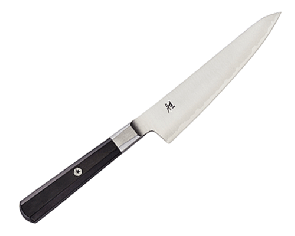
The Precision of a 'Small Sword' Reimagined for the Modern Kitchen In Japanese culinary tradition, the Shotoh is known as the 'small sword'—a tool designed for tasks where a full-sized chef's knife is too cumbersome and a paring knife lacks the necessary reach. The Miyabi Koh 5.5-inch Prep Knife is the definitive evolution of this profile. Whether you are performing intricate vegetable work, creating delicate garnishes, or trimming proteins, this blade offers a level of agility that transforms routine prep into an exercise in precision. At the heart of the Miyabi Koh series is the revolutionary FC61 fine carbide stainless steel. This advanced alloy solves the age-old kitchen dilemma: it provides the extreme edge retention typically associated with high-carbon Japanese steel while maintaining the chip-resistant toughness of German alloys. Each blade undergoes an innovative FRIODURx2 ice-hardening process, which optimizes the molecular structure of the steel. The result is a staggering 61 Rockwell hardness that remains remarkably resilient under daily professional use. Every Miyabi Koh knife is a tribute to the legendary samurai swords of Seki. Artisans employ a three-step Honbazuke honing process to achieve a scalpel-like 'Katana' edge. The blade’s thin Japanese profile (angled at 9.5–12°) ensures near-zero resistance when slicing through fibrous vegetables or delicate fish. This performance is balanced by an authentic octagonal Pakkawood handle, providing an ergonomic, slip-resistant grip that supports both Western-style chopping and the specialized Asian rocking motion. Finished with a silver mosaic pin, the Miyabi Koh is not just a tool—it is a piece of culinary heritage. Learn More$129.95 -
Miyabi Koh 8-inch (210mm) Gyuto Chef Knife
The Precision of Seki Craftsmanship Meets Modern Carbide Metallurgy A high-performance 8-inch Gyuto engineered for elite edge retention and surgical agility through heavy production shifts. The Miyabi Koh 8-inch Gyuto represents a calculated balance between traditional Japanese aesthetics and high-performance modern metallurgy. At its core is FC61 fine carbide stainless steel, a material that achieves a formidable 61 Rockwell hardness. Unlike traditional high-carbon steels that demand intensive maintenance, the FC61 provides the aggressive sharpness of a Japanese blade with the corrosion resistance and durability typically associated with German engineering. Each blade undergoes the proprietary FRIODURx2 ice-hardening process. This multi-stage thermal treatment optimizes the molecular structure of the steel, resulting in a blade that resists chipping while maintaining a 'scalpel-like' edge through 40 lbs of mirepoix or intensive protein fabrication. The blade is finished with the Honbazuke method—a traditional three-step honing process that creates a 9.5 to 12-degree edge angle. This acute geometry, combined with a thin 1.8mm spine, ensures the knife glides through dense root vegetables and delicate proteins with minimal resistance. The handle is a study in functional ergonomics. Constructed from moisture-resistant black Pakkawood, the octagonal profile provides a secure, slip-resistant grip regardless of hand orientation. Whether you utilize a traditional Western pinch grip or a Japanese-style finger-forward hold, the balance point is meticulously tuned for neutral handling. Finished with a signature silver mosaic pin and a sandblasted katana edge, the Miyabi Koh is as much a professional instrument as it is a tribute to the samurai sword-making heritage of Seki, Japan. Learn MoreRegular Price: $164.95
Special Price $139.99
-

Miyabi Koh 240mm (9.4") Gyuto Chef Knife
The Pinnacle of Hybrid Cutlery Performance The Miyabi Koh 9.4-inch (240mm) Gyuto represents a breakthrough in modern metallurgy, bridging the gap between the legendary sharpness of Japanese blades and the rugged reliability of German engineering. While many Japanese knives are notoriously fragile, the Koh series utilizes advanced FC61 fine carbide stainless steel. This unique alloy provides the remarkable edge retention and hardness (61 HRC) expected of a premium Japanese tool, yet maintains a toughness that resists the chipping and corrosion often associated with high-carbon steels. Master-Crafted in Seki, Japan Each blade undergoes a rigorous journey in the historic city of Seki, the heart of Japanese sword-making. This isn't a mass-produced tool; it is a piece of culinary art. The blades are ice-hardened using the proprietary FRIODURx2® process, which optimizes the molecular structure of the steel to ensure the blade stays sharper for longer, even under heavy professional use. The final edge is hand-honed using the traditional three-step Honbazuke method, resulting in a scalpel-like 9.5 to 12-degree angle that glides through proteins and vegetables with zero resistance. Ergonomic Perfection for the Modern Chef Designed for those who prefer the reach and leverage of a larger 240mm blade, the Miyabi Koh feels surprisingly nimble. The lightweight construction (0.44 lbs) is perfectly balanced by an ergonomic, octagonal Pakkawood handle. This traditional Japanese shape provides a secure, comfortable grip that accommodates both Western-style 'rocking' cuts and Eastern-style 'push' cuts. Finished with a stunning silver mosaic pin, the Koh is as aesthetically striking as it is functional. Learn More$174.95 -

Miyabi Koh Nakiri Vegetable Knife - 6.5" (165mm)
Master the Art of the Blade: The Miyabi Koh 6.5" Nakiri Experience the revolutionary fusion of German durability and Japanese precision—a handcrafted masterpiece engineered for the ultimate vegetable prep performance. For the culinary enthusiast who demands more than just a sharp edge, the Miyabi Koh 6.5-inch (165mm) Nakiri represents the pinnacle of modern metallurgy and ancient tradition. While standard vegetable knives often force a compromise between the 'toughness' of Western steel and the 'retention' of Eastern alloys, the Miyabi Koh series utilizes advanced FC61 Fine Carbide stainless steel. This provides a staggering 61 Rockwell hardness, allowing for a scalpel-like 9.5-12° edge angle that doesn't just cut—it glides. Hand-honed in the legendary city of Seki, Japan, each blade undergoes the proprietary FRIODURx2 ice-hardening process. This ensures your knife is not only resistant to corrosion but possesses the chip-resistance necessary for high-volume kitchen work. The aesthetic is as sharp as the edge, featuring a mirror-polished finish, a sandblasted katana edge, and the iconic embossed MIYABI logo. The ergonomic octagonal Pakkawood handle is designed for the modern chef, supporting both the precision of Asian rocking cuts and the power of Western chopping. Accented with a silver mosaic pin, it offers a secure, comfortable grip that reduces fatigue during long prep sessions. Whether you are julienning delicate root vegetables or dicing dense squash, this Nakiri provides the stability of a Japanese cleaver with the finesse of a surgeon’s tool. Learn More$164.95 -

Miyabi Koh 9-inch (230mm) Bread Knife
The Pinnacle of Slicing Perfection For the serious baker or culinary enthusiast, the Miyabi Koh 9-inch (230mm) Bread Knife represents the perfect synthesis of Japanese artistry and German engineering. Known as 'Koh' (Light) in Japanese, this series is designed to feel like an extension of your hand, providing a weightless yet powerful cutting experience. Whether you are tackling a thick-crusted sourdough boule, a delicate sponge cake, or even tough-skinned fruits like pineapple and watermelon, this blade ensures every slice is uniform, clean, and effortless. Revolutionary FC61 Fine Carbide Steel At the core of this blade lies the revolutionary FC61 fine carbide stainless steel. This advanced alloy offers a unique value proposition: it mimics the incredible toughness and durability of traditional German steel while maintaining the scalpel-like edge retention that has made Japanese cutlery world-famous. With a Rockwell hardness of 61, the edge remains sharp significantly longer than standard kitchen knives, allowing you to breeze through repetitive slicing tasks without frequent maintenance. The Art of the Katana Edge Each blade is treated with the FRIODUR® ice-hardening process, which enhances the metal’s molecular structure for superior corrosion resistance and durability. The sandblasted 'Katana' edge is more than just a visual tribute to samurai heritage; it is a mark of precision. The scalloped serrations are specifically engineered to reduce friction, meaning you create fewer crumbs and preserve the structural integrity of your bread. Hand-honed to a 12° angle by 46 master artisans in Seki, Japan, this knife delivers a level of sharpness rarely seen in serrated tools. Unrivaled Ergonomics: The Octagonal Pakkawood Handle The black Pakkawood handle is crafted in a traditional Japanese octagonal shape. This geometric design provides a secure, non-slip grip regardless of your cutting style—whether you prefer a Western chopping motion or an Eastern rocking cut. The faceted edges offer tactile feedback, ensuring your hand doesn't fatigue during long prep sessions. To ensure perfect balance, every handle is individually weight-adjusted and finished with a striking mosaic accent pin, a signature of Miyabi’s obsessive attention to detail. Learn More$164.95 -
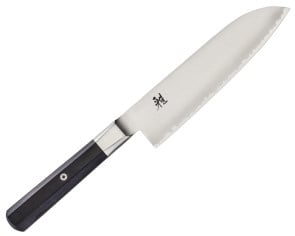
Miyabi Koh 7-Inch Santoku
The Japanese All-Purpose Knife for Everyday Precision
The Miyabi Koh 7-inch Santoku brings Japanese-inspired craftsmanship and versatility to everyday kitchen prep. The Santoku profile is designed for slicing, dicing, and mincing with ease, while its compact, agile shape offers excellent control and precision. From vegetables and herbs to boneless meats and fish, this versatile blade is a dependable choice for a wide range of kitchen tasks. At the heart of the Miyabi Koh series is the revolutionary FC61 fine carbide stainless steel. This advanced alloy solves the age-old kitchen dilemma: it provides the extreme edge retention typically associated with high-carbon Japanese steel while maintaining the chip-resistant toughness of German alloys. Each blade undergoes an innovative FRIODURx2 ice-hardening process, which optimizes the molecular structure of the steel. The result is a staggering 61 Rockwell hardness that remains remarkably resilient under daily professional use. Every Miyabi Koh knife is a tribute to the legendary samurai swords of Seki. Artisans employ a three-step Honbazuke honing process to achieve a scalpel-like 'Katana' edge. The blade’s thin Japanese profile (angled at 9.5–12°) ensures near-zero resistance when slicing through fibrous vegetables or delicate fish. This performance is balanced by an authentic octagonal Pakkawood handle, providing an ergonomic, slip-resistant grip that supports both Western-style chopping and the specialized Asian rocking motion. Finished with a silver mosaic pin, the Miyabi Koh is not just a tool—it is a piece of culinary heritage. Learn More$164.95


