
You have no items in your shopping cart.
Ceramic Sharpening Rods
Keep your kitchen knives razor sharp with our selection of ceramic sharpening rods. Ceramic rods offer fine abrasive surfaces that gently realign and refine blade edges, making them ideal for routine maintenance and touch‑ups between full sharpenings. Durable, corrosion‑resistant, and easy to use, these rods help you achieve smooth, precise cuts and extend the life of your cutlery. Whether you’re caring for chef’s knives, paring blades, or specialty knives, find the right ceramic honing tool to keep your blades performing their best.
-

MAC Black Ceramic 8.5-inch Honing Rod
If you are asking which honing rod to use with MAC knives, MAC’s answer is ceramic. Many Japanese manufacturers recommend a ceramic rod over a steel honing rod because of the hardness of Japanese steel, and the SRB-84 is MAC’s own 8.5-inch black ceramic rod.MAC rods offer two levels of cutting aggression depending on which sides you use, grooved or smooth, and the extremely hard black ceramic works on all brands of knives. Black ceramic honing rods do not show metal build-up as easily as a white rod, but it still occurs. Should you find your MAC ceramic rod is not performing as well as when new, just clean it with Bar Keepers Friend or a ceramic eraser. Its 8.5-inch length suits knives up to an 8-inch chef’s knife. For longer knives, choose the 10.5-inch SRB-104; for a smooth rod only, the white ceramic SR-85.See all our ceramic sharpening rods. Learn More$49.95 -
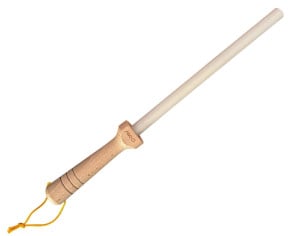
MAC 8.5-inch White Ceramic Honing Rod
The SR-85 is MAC’s smooth white ceramic rod, the simplest way to keep a MAC knife sharp between sharpenings. MAC describes its ceramic rods as harder than typical steel rods, with a finer grit for a finer edge, and intends them for touch-ups between sharpenings rather than as a replacement for sharpening.A smooth rod gives a fine finish on the edge and suits light, frequent use: a few strokes before a prep session will restore a slightly dull chef’s knife. When an edge is duller, the grooved faces of the black ceramic SRB-84 remove metal faster. For long knives, choose the 10.5-inch SRB-104.See all our ceramic sharpening rods. Learn More$34.95 -

Global 9.5-inch Ceramic Sharpening Rod
Global recommends ceramic or diamond rods for honing its knives rather than conventional honing steels, which can damage the thin, hard edges. The G-45 is Global’s ceramic rod, made to keep Global and other Japanese edges aligned between whetstone sharpenings.A thin edge rolls slightly to one side with use, and the knife starts to feel dull even though little steel has been lost. A few light strokes on the ceramic rod straighten the edge and remove a trace of metal, which brings back the bite. Global notes that, with regular use, a ceramic rod produces a finer edge than a diamond rod. The 24 cm length gives a chef’s knife enough room for a full stroke from heel to tip. It also works on other brands of straight-edged knives.
Ceramic or Diamond?The Global 10-inch Oval Diamond Sharpening Steel is harder than ceramic and restores an edge faster, and it will not break if dropped. Choose ceramic for routine maintenance and a finer edge. For dull knives that need full sharpening, see the Global 2-Stage Ceramic Water Sharpener. Learn More$149.95 -

Master Grade 11 in. White Ceramic Rod
The Master Grade ST-3700 receives our top recommendation for a ceramic honing rod.
Please note that a steel honing rod is used to straighten the edge of a knife that has "burred" or rolled over. Ceramic rods are used to remove metal and restore an edge. Knives with a Rockwell hardness of 61 or greater tend to not roll the edges, but will abrade and dull. Ceramic may be the best choice for these knives.
Not all ceramics are equal: At 9 mohs of hardness, the Master Grade ST-3700 is significantly better than others. (Diamonds are 10 mohs). The vast majority of ceramic rods on the market are 8 mohs.
Impact Resistant. Handle is square, so it is less likely to roll off the table. Rubber tip and metal core also help to make this rod more likely to survive a fall. The level of abrasiveness on a ceramic rod is anecdotal as they are textured ceramics that lack a grit that has been sieved to a particular grain size. These are roughly equivalent to a 2000 grit stone. Learn More$49.95

