
You have no items in your shopping cart.
Best Sellers
-

Kyocera Innovation Black 3-inch Ceramic Paring Knife
Peeling an apple in the hand, hulling strawberries and trimming the root end from a shallot call for a short, pointed blade that is easy to steer. This 3-inch Innovation Black paring knife is made for that close work. Its ceramic blade will not rust or react with food, so lemon juice and onion leave no stain or metallic taste behind.Kyocera rates its Innovation blades to stay sharp twice as long as its earlier ceramic blades, which Kyocera already credits with holding an edge up to ten times longer than steel. On a knife that spends most of its life on fruit and vegetables, that means long stretches between sharpenings. Ceramic is hard and brittle, though, so leave bones and frozen food to a steel paring knife.Customers ask us how a ceramic knife gets sharpened when it finally dulls. It needs diamond. The Kyocera Diamond Wheel Sharpener handles touch-ups at home, and Kyocera’s authorized service provider, EVERSHARP, sharpens blades and removes chips (see Kyocera’s sharpening service page).
Paring Knife or Utility Knife?Choose the 3-inch blade for work done in the hand or on small produce. The Innovation Black 4.5-inch Utility Knife adds enough length to halve a sandwich or slice a cucumber on the board. For the same blade length with a white blade and a choice of handle colors, see the Innovation White 3-inch Paring Knife. Learn More -
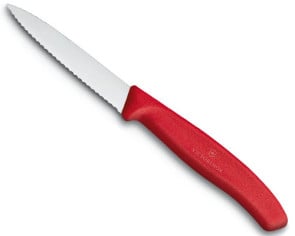
Victorinox Swiss Classic 3.25-inch Serrated Paring Knife, Red Handle
Tomato skin, avocado and ripe figs give a straight edge trouble, because the blade slides before it bites. The wavy edge on this Victorinox Swiss Classic paring knife catches the surface at once, and the pointed tip reaches into small work such as deveining shrimp. Off the cutting board, the same edge cuts fishing line and packing tape. Our customers for this knife are split about evenly between trade work and home kitchens.Victorinox lengthened the handle when it replaced the older 5.0631 model, and the newer handle gives a fuller, more comfortable grip. The serrations keep cutting for a long time between sharpenings.
Pointed, Sheep’s Foot or Straight Edge?For trimming and peeling produce on a board, the Victorinox Swiss Classic 3.25-inch Serrated Sheep's Foot Paring Knife, Red Handle has a flat edge and no point. If you prefer a plain edge for peeling and fine slicing, the Victorinox Swiss Classic 3.25-inch Spear Point Paring Knife, Red Handle has the same shape without serrations. The same serrated blade also comes with a black handle as the Victorinox Swiss Classic 3.25-inch Serrated Paring Knife, Black Handle, and the Victorinox Swiss Classic 4-inch Serrated Paring Knife, Red Handle adds length for larger fruit and vegetables.Our Kitchen Knife Shapes guide explains paring knife shapes. Learn More -
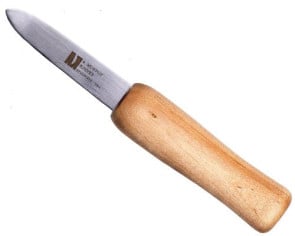
R. Murphy New Haven 2.625-inch Oyster Knife, Wood Handle
The R. Murphy New Haven oyster knife is the shucker America’s Test Kitchen named the winner of its oyster knife testing in 2012 and again in its current review, which found the New Haven design “dispatched oysters of all sizes easily.” Serious Eats also selected it as the Best Overall Oyster Knife. This version has a round wooden handle and a 2.625-inch blade.What sets a New Haven knife apart is the slight upward bend at the tip. You work the tip into the hinge and twist, and once the shell gives, the curve lets the blade ride along the underside of the top shell to cut the adductor muscle. The bend keeps the point lifted away from the oyster, which helps you open it without cutting into the meat. That makes it a forgiving knife to learn on, and it is just as much at home behind a raw bar.Wood or plastic is the handle question we hear. Wood has a warm grip and suits shucking at home or at a party. For a busy kitchen that sanitizes tools all day, the New Haven shucker with an ECOgrip handle has the same blade on recycled polypropylene. The New Haven Elite pairs this curved tip with a riveted rosewood handle. If you prefer a pointed blade, compare the Wellfleet, and see our guide to knife shapes for how oyster and clam knives differ. Learn More$18.00 -

F. Dick 1905 3.5-inch Paring Knife
Peeling, slicing and garnishing fruits and vegetables are the jobs for this 3.5-inch 1905 paring knife. It comes with a keen edge that cuts thin, even tomato slices for a knife this small.A paring knife does much of its work in the hand, and the short blade keeps the tip close to the fingers for control when hulling strawberries or coring tomatoes. The ringed 1905 handle gives a secure grip for that close work.A paring knife also handles small jobs at the stove, such as scoring the skin of a sausage, testing a potato for doneness or cutting a lemon to finish a dish. Keep one near the range so the chef’s knife stays on the board.For tourné cuts and peeling round produce, the curved 1905 3-inch bird’s beak peeler is better shaped. Larger fruit and slicing on the board suit the 1905 6-inch utility knife. The comparison table below lists the 1905 paring and utility knives. Learn More$49.40 -
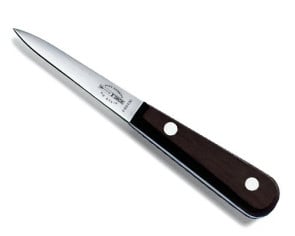
F. Dick 3-inch Oyster Knife
Small, delicate oysters with wavy shells, such as Kumamotos, Olympias and Belons, need a precise knife, and this 3-inch F. Dick oyster knife has a pointed tip and a sharpened edge to find the hinge and cut the adductor muscle cleanly.Most oyster knives have a blunt blade, which can crush a fragile shell. This one has an edge ground into it, so it also opens clams, which need to be cut rather than pried. The pointed tip slips into a tight hinge with little force, and the short blade gives control close to the hand.At a raw bar, a dedicated knife for small oysters also speeds up service. It keeps the presentation neat on the half shell.For larger, heavier oysters, the F. Dick 2.25-inch stainless steel oyster shucker is the counterpart. Protect the hand holding the shell with a folded towel or a cut-resistant glove. Our knife shapes guide covers oyster and clam knives. Learn More$28.60

