
You have no items in your shopping cart.
Buying Guide
Kitchen Knife Shapes, Explained
So many shapes, so many names — and the right one just makes prep faster, safer, and more enjoyable. This guide covers what each shape actually does and where it fits in a working set.
Cutting Motion Range
Rocking (Curved)Push-Cutting (Flat)
Start Here
Quick Recommendation
First Knife Purchase
A chef's knife — the broad, curved blade that handles the widest range of everyday tasks.
See the essentials →Meat, Poultry & Fish
Boning, butcher, and fillet knives — purpose-built for processing proteins cleanly.
See the butcher's block →Bread, Cake & Cheese
Serrated bread knives and cheese knives that slice without crushing or sticking.
See specialty knives →Detail & Garnish Work
A paring knife for small, in-hand tasks — peeling, trimming, and precise cuts.
See specialty knives →
Where to Start
The Essentials
The versatile workhorses of the kitchen. If you're just starting out, your first purchase should come from this group.

Style 01 · All-Purpose
Chef's Knife
The undisputed king of the kitchen — a true multi-purpose tool built to handle a wide range of tasks with ease.
Best For
Slicing, dicing, mincing, and chopping. Your go-to all-purpose knife.
Key Features
A broad blade with a gentle curve, or "belly," that allows for a smooth rocking motion on the cutting board.
Worth Knowing: If you can only own one high-quality knife, make it a chef's knife.
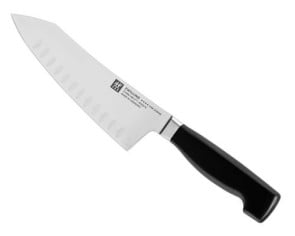
Style 02 · All-Purpose
Santoku Knife
The name translates to "three virtues," referring to its excellence at slicing, dicing, and mincing — a popular all-purpose alternative to the Western chef's knife.
Best For
Chopping, slicing, and mincing, especially for those who prefer a direct up-and-down motion.
Key Features
A flatter edge with less curve and a rounded "sheepsfoot" tip, geared toward chopping and slicing rather than rocking.
Worth Knowing: A santoku is a great choice for anyone intimidated by a longer blade.

Style 03 · All-Purpose
Gyuto Knife
Also spelled "gyutoh," this Japanese variant of the Western chef's knife has a flatter blade profile that offers a different feel when cutting — a great choice for anyone who likes quick push-cuts or long slices with the tip pressed into the board.
Best For
An all-rounder for users who prefer a flatter blade profile than a typical chef's knife.
Key Features
A flatter blade and lower tip than a Western chef's knife, excellent for push-cutting and pull-cutting.

Style 04 · All-Purpose
Utility Knife
Also called a petty knife, this is the one you'll reach for when preparing a quick snack or a charcuterie board — the perfect in-between knife for tasks that need more precision than a chef's knife but more length than a paring knife.
Best For
Slicing sandwiches, trimming produce, de-veining shrimp, or making detailed cuts.
Key Features
A thin, nimble blade, typically 4 to 7 inches long, that minimizes resistance and works well in tight spaces.
Side by Side
Comparing the All-Purpose Shapes
| Chef's Knife |
Santoku |
Gyuto |
Utility |
|
|---|---|---|---|---|
| Blade Profile | Curved belly | Flatter, sheepsfoot tip | Flatter, lower tip | Thin, 4–7" |
| Cutting Motion | Rocking motion | Direct up-and-down chop | Push-cut / pull-cut | Precision in-hand work |
| Best For | All-purpose chopping, dicing, mincing | Garlic, herbs, greens, direct cuts | Users who prefer a flatter profile | Sandwiches, produce, detail work |
Many cooks keep both a chef's knife and a santoku on hand — a chef's knife is hard to beat for chopping large potatoes and onions, while a santoku excels with garlic, herbs, and greens.
Protein Processing



The Butcher's Block
Meat, poultry, and fish knives, purpose-built for processing proteins — from trimming large roasts to delicately filleting fish.
Boning Knife
Best for: Precisely removing bones from meat, poultry, and fish.
A narrow blade with a sharply pointed tip maneuvers easily around bones and joints. NSF-certified plastic-handle versions offer unbeatable value if you don't need matching aesthetics — keep one in a blade guard in a drawer if you'd rather your knife block stay matching.
Shop Boning Knives →
Butcher & Breaking Knives
Best for: Breaking down large primal cuts, portioning steaks, trimming fat.
A long (8–12"), stiff, heavy blade for powerful, straight cuts. Breaking knives run thinner and more curved for hanging sides, and also work well on whole fish.
Shop Butcher & Breaking Knives →
Scimitars (Cimiters)
Best for: Slicing large cuts of meat like brisket or roasts in one smooth motion.
A wide, stiff blade with a dramatic upward curve creates a very long cutting edge, maximizing slicing efficiency.
Shop Scimitar Knives →
Carving & Slicing Knives
Best for: Clean, beautiful slices of cooked meats like turkey or ham.
A long, thin blade (8–14") slices in one continuous stroke. Carving knives have a pointed tip, while slicing knives often have a rounded tip for safety at a carving station. A Granton edge (scalloped divots) creates air pockets that keep meat from sticking.
Shop Carving & Slicing Knives →
Fillet Knife
Best for: Removing skin and bones from fish with minimal waste.
A very thin, flexible blade conforms to the shape of the fish. Stiffer blades suit tough-boned fish; flexible blades suit delicate fish like salmon.
Shop Fillet Knives →
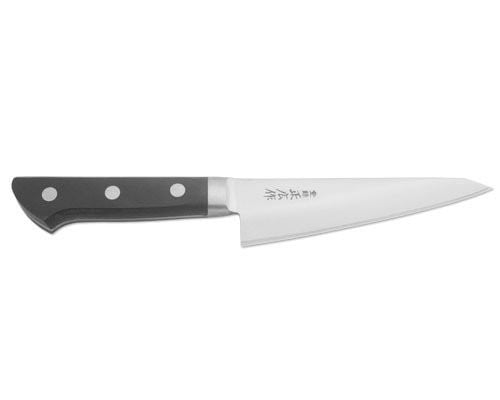
Honesuki / Garasuki
Best for: Traditional Japanese deboning of poultry and pork.
A distinct triangular shape with a sharp, clipped point for navigating joints. Under 165mm it's a Honesuki; above, a Garasuki.
Shop Honesuki & Garasuki →
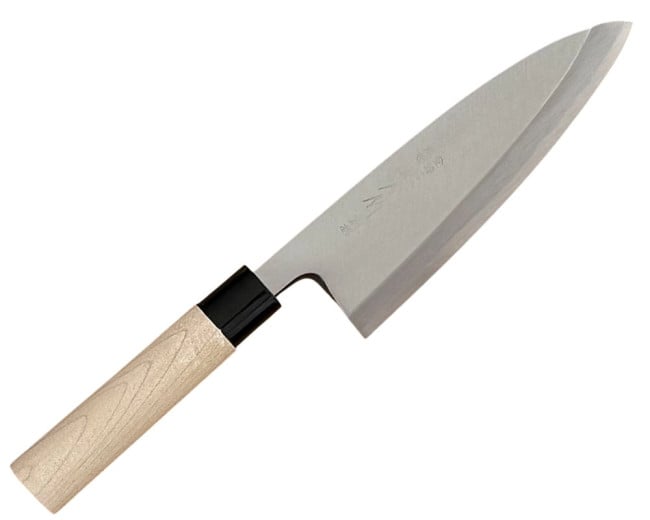
Deba
Best for: Butchering and filleting whole fish, processing poultry.
A thick, heavy spine and sharp edge cut through fish heads and bones cleanly. Avoid using it on dense meat bones.
Shop Deba Knives →
Yanagi / Sujihiki
Best for: Paper-thin slices of raw fish for sashimi or crudo.
A very long, thin blade for a single pull-cut. The Yanagi is the traditional single-bevel version; the Sujihiki is double-beveled.
Shop Yanagi & Sujihiki →A Note on Single-Bevel Japanese Knives
The Yanagi and Deba above — along with other traditional single-bevel knives — are sharpened on one side only, with a flat back that has to stay dead flat to work correctly. Never use a honing rod on one, of any type; it curls the edge over and ruins the knife's ability to release food cleanly. These knives are sharpened on stones, and stones only.
A double-bevel Japanese-style knife — a Gyuto or Santoku, for instance — is a completely different case and hones just like a Western knife. For the full breakdown, see our .
Specialty & Precision



Built for One Job
Tools designed to excel at a specific task — from slicing crusty bread to plating an intricate garnish.
Bread Knife
Best for: Slicing crusty bread without crushing the interior. Also great for melons and leveling cakes.
A long, serrated blade grips and cuts through tough exteriors. An offset handle gives better knuckle clearance.
Shop Bread Knives →
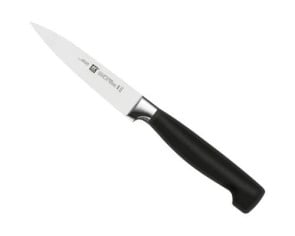
Paring Knife
Best for: Small, in-hand tasks like peeling, trimming, and garnishes.
A small blade (3–4.5") for detailed work. Common shapes: the spear point, the sheepsfoot, and the hook-bladed bird's beak.
Shop Paring Knives →
Usuba / Nakiri
Best for: Chopping, slicing, and dicing vegetables with precision.
A rectangular blade with a flat edge, built for push-cutting. The Nakiri is double-beveled; the Usuba is the thicker, traditionally single-beveled version.
Shop Vegetable Knives →
Cleaver
Best for: Heavy-duty chopping.
A tall, square blade. Meat cleavers are thick and tough, built for bone; vegetable (Chinese) cleavers are thinner, for slicing and transferring ingredients.
Shop Cleavers →
Cheese Knife
Best for: Slicing all types of cheese without sticking.
Knives with holes suit semi-soft cheeses; thin, offset knives work well for soft cheeses like brie.
Shop Cheese Knives →
Oyster & Clam Knives
Best for: Safely and effectively opening bivalve mollusks.
Short, sturdy blades with specialized tips. Clam knives slide in to cut the muscle; oyster knives pry the shell open.
Shop Oyster & Clam Knives →
Kiritsuke
Best for: A multi-purpose knife for an expert user, often for slicing fish or vegetables.
A hybrid between a Yanagi and an Usuba with a distinctive clipped tip. In Japan, often a symbol of a master chef.
Shop Kiritsuke Knives →
Steak Knife
Best for: A table knife for cutting cooked meats while eating.
Serrated or fine-edged blades designed for use on a plate, not for food prep.
Shop Steak Knives →
Round It Out

Accessories & Knife Sets
The pieces that support the knives themselves.
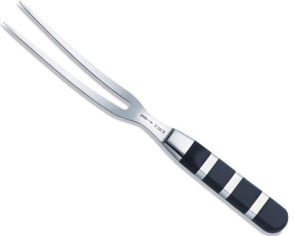
Carving Fork
Best for: Holding a large roast steady while carving, or lifting heavy items.
Curved forks keep the tines out of the way of your knife; straight forks are great for maneuvering food in a pan.
Shop Carving Forks →
Knife Sets
Best for: A cost-effective way to acquire multiple essential knives at once.
Bundled sets offer better value than individually purchased knives and make great gifts for weddings, birthdays, and graduations.
Shop Knife Sets →
Starting From Scratch
Building Your First Set
You don't need every shape on this page to cook well. Add specialty knives later as your needs evolve.
- Chef's Knife — the one knife that covers the widest range of everyday tasks.
- Paring Knife — for peeling, trimming, and small in-hand work a chef's knife is too big for.
- Serrated Bread Knife — the only shape that slices bread cleanly without crushing it.
- Boning Knife (optional) — if your diet includes meat, this lets you buy less expensive cuts that need a little trimming, and it quickly pays for itself.
Decision Time
Which Knife Should You Buy?
Recommendations by Use Case
First knife, or want one do-everything blade: a chef's knife. It's the safest default and the one shape every set is built around.
Prefer a flatter blade and a direct chopping motion: a santoku or gyuto, depending on how much you want the profile to depart from a Western chef's knife.
Meat, poultry, or fish come through your kitchen regularly: add a boning knife first, then a fillet or breaking knife depending on what you process most.
You bake, host, or carve at the table: a serrated bread knife and a carving/slicing knife with a Granton edge cover most of that ground.
You want precision for garnishes and detail work: a paring knife, in a spear point, sheepsfoot, or bird's beak depending on the task.
Still not sure which shape fits what you cook? Contact our team — we're always happy to help.
Common Questions
FAQ
What's the difference between a Chef's Knife and a Santoku?
A chef's knife has a curved blade built for a smooth rocking motion, while a santoku has a flatter edge better suited to direct chopping cuts. It often comes down to cutting style — a chef's knife is hard to beat for chopping large potatoes and onions, while a santoku excels with garlic, herbs, and greens. Many cooks keep both on hand, especially when there's extra help in the kitchen.
Do I really need to buy a full knife set?
Not necessarily. A great starting point for any home cook is a high-quality chef's knife, a paring knife, and a serrated bread knife — you can add specialty knives later as your needs evolve. If your diet includes meat, a boning knife adds real value: it lets you buy less expensive cuts that need a little trimming, and it quickly pays for itself.
What's the main difference between German and Japanese knives?
German knives are generally made of slightly softer steel, which makes them more durable and easier to maintain with a honing rod. Japanese knives use harder steel, which allows for a sharper, more acute edge, but can be more prone to chipping if misused.
What is a "Granton edge"?
A Granton edge refers to the scalloped indentations, or divots, along the side of a blade — commonly found on vegetable knives, carving knives, and slicing knives. They create small air pockets that reduce friction and keep food from sticking to the knife. The name comes from the Granton knife company, which designed them; you'll also see the same feature called a Kullenschliff or hollow edge.
Ready to Shop by Shape?
Browse all 21 knife shapes and types side by side to find exactly what your kitchen needs.
Shop by Shape & Type →